Marketing = Understanding People – Katharina Glöckel and Günther Wenzel on the Marketing Management Specialization
What sets the Marketing Management track in the Bachelor’s program in Business Administration & Business Psychology at FERNFH apart—and what are its real benefits?
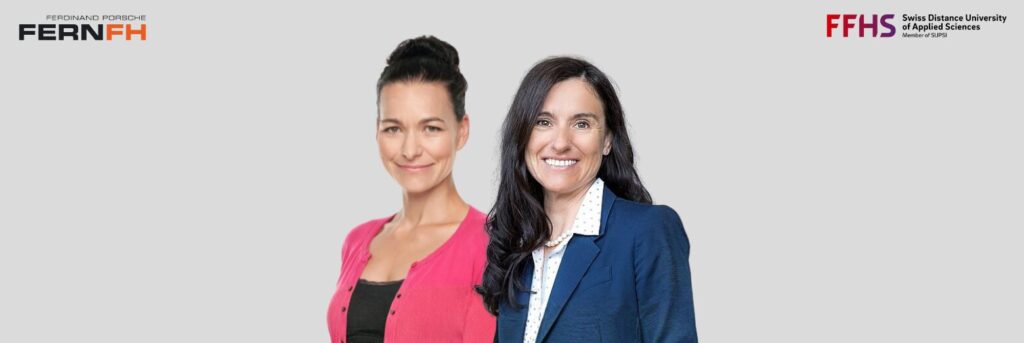
Katharina Glöckel teaches and conducts research at the Institute for Economics & Psychology at Ferdinand Porsche FERNFH—and when she talks about marketing, she’s concerned with more than just tools and methods. In her courses focused on marketing management, her primary goal is to instill a mindset, not merely a repertoire of methods. Program director Günther Wenzel, for his part, knows what sets graduates of this specialization apart in the job market. Both agree: To truly understand marketing, you must first understand people.
If you ask Katharina Glöckel what the one marketing truth is that she absolutely wants to impart to her students, you’ll get an answer that may come as a surprise at first: There isn’t one. Not because marketing is arbitrary, but because it always has to do with people. And people are complex, contradictory, and context-dependent.
“Marketing is done by people for people, which is why individual, psychological, and social factors always play an enormous role. If you want to do good marketing, you have to understand what really makes people tick—in other words, not just define target audiences, but also delve into psychology, perception, and decision-making processes.” — Katharina Glöckel, research assistant and instructor at the Institute for Economics & Psychology
That is precisely the core of the Marketing Management concentration: the combination of business thinking with an understanding of psychology. Whether it’s a social media post, product development, or pricing, it ultimately comes down to understanding human experience and behavior. And that requires more than just technical knowledge. It requires the ability to reflect—that is, the ability to question one’s own assumptions, to avoid projecting one’s own experiences onto others, and to remain open to new perspectives. After all, marketing is constantly changing—those who rely solely on established methods will quickly fall behind.
AI: fascinating and unsettling at the same time
One change that is currently shaping everything—including marketing—is artificial intelligence. Katharina Glöckel has been studying it intensively for years, and her assessment is nuanced. She finds the possibilities that AI opens up—for practice, for research, and for teaching—incredibly exciting. AI greatly expands the toolbox and opens up new creative and analytical avenues.
At the same time, the sheer speed of this development highlights just how challenging it is to keep up. It’s hard to keep pace, both in one’s own learning and in teaching. But what really worries her is something else: the potential for abuse. Deepfakes and targeted disinformation are already demonstrating how powerful these technologies can be. Technological development is happening at breakneck speed, but public awareness and many people’s AI literacy are still lagging far behind. This gap, she says, honestly gives her a bit of a stomachache sometimes.
Play works—in education as well as in marketing
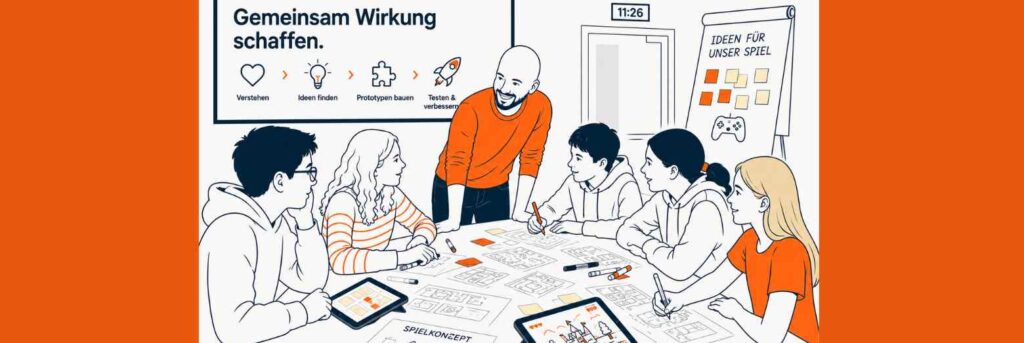
In her classes, Katharina Glöckel deliberately incorporates playful elements and consistently makes the same observation: People absolutely love to play—whether they’re 7, 17, or 47 years old. As soon as a playful element is introduced, the dynamic in the room changes immediately. Many don’t even realize how much they’re learning until it’s already happened.
For her, gamification in teaching is therefore not just a nice extra, but a serious instructional tool. Sometimes, she says, it is significantly more effective than even the most perfectly prepared lecture. And, by the way, this insight applies not only to teaching, but also to good marketing itself.
What she wants to convey to students who are balancing their studies with work can be summarized as follows: “It’s demanding, and sometimes it’s tough, but it’s worth it—not just professionally, but personally as well. Those who stick with it will surpass their own expectations.”
The Marketing Management track is one of three elective tracks in the Bachelor’s program in Business Administration & Business Psychology at FERNFH. Starting in the 5th semester, students deepen their knowledge in Strategic & Operational Marketing, Advertising Psychology & Communication, and Customer Relationship Management, always applying a psychological perspective to target groups, decision-making processes, and brand impact. The program is designed for working professionals, offers flexible scheduling, and, as a state-funded university of applied sciences, is available at a reasonable cost.
A Profile That Stands Out in the Job Market
What sets graduates of the Marketing Management track apart in the job market? Ing. Günther Wenzel, BA MA, program director of the Bachelor’s program in Business Administration & Business Psychology, sums it up: It’s the combination. A business administration degree focuses on companies, markets, and target audiences, as well as economic decisions, resource allocation, and positioning. A psychology degree, on the other hand, helps students understand how people think, feel, perceive, and make decisions. Where these two fields converge, a professional profile emerges that is more in demand today than ever before.
Good marketing should not only make strategic and economic sense; above all, it should understand and address people’s needs and translate them into appropriate solutions. By combining business administration and psychology, you can design offerings, communication, and strategies that are closely aligned with people, their real-life situations, and their actual concerns. That is the true advantage of this field, and it is evident in practice.
“Those who combine business administration and psychology can design offerings, communication, and strategies in a way that is closely attuned to people, their real-life situations, and their actual concerns.” – Ing. Günther Wenzel, BA MA, Program Director for the Bachelor’s Program in Business Administration & Business Psychology
During the interview, Günther Wenzel emphasizes that the program is open to people without a high school diploma. He is convinced that educational opportunities should not depend solely on formal entry requirements. A program like the Bachelor’s in Business Administration and Business Psychology, in particular, thrives on the diversity of its students: people with alternative educational backgrounds bring a practical perspective, high motivation, and a clear understanding of real-world challenges. In this context, openness means not only greater flexibility within the educational system, but also broader perspectives and a stronger practical focus within the program itself.
You can find all the information about the bachelor's program in Business Administration and Business Psychology here.