When Words Open Doors: The Hidden Power of Language in Tech Education
How Inclusive Language Is Changing Access to Technical Degree Programs
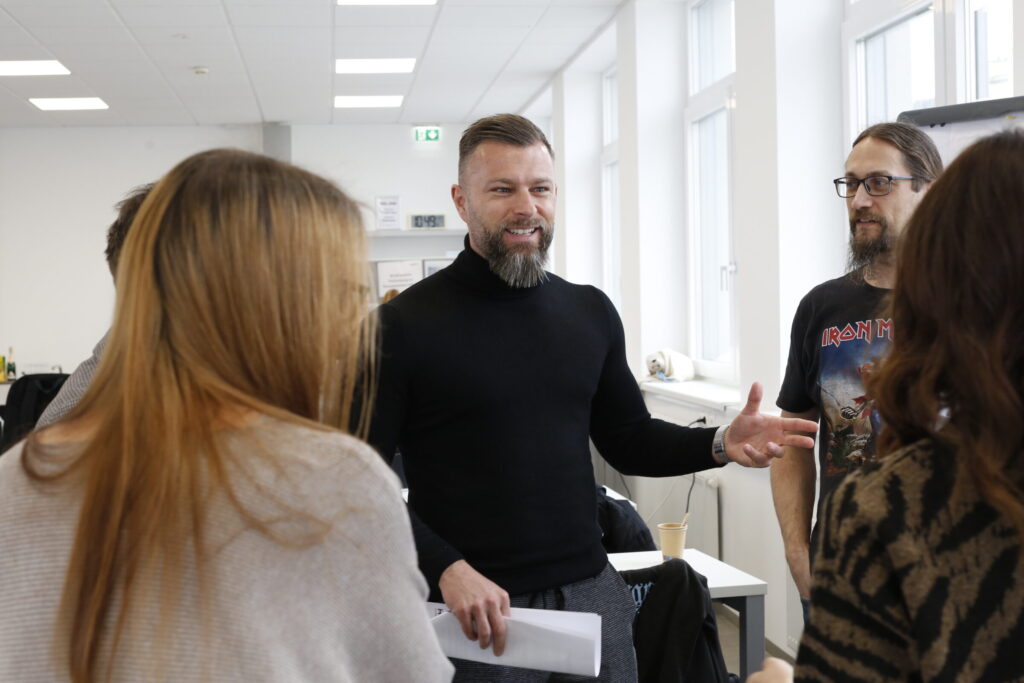
Why are women often not drawn to technical degree programs? It’s not always a lack of interest, but often a matter of using the wrong words. Daniela Wolf, a professor and researcher at FERNFH, addressed the question of the power of words in tech education at the Female Tech Summit in Linz. During her presentation, she shared her thoughts and highlighted, among other things, how course titles can influence a sense of belonging. At FERNFH, too, this initiative has set several processes in motion, and initial steps have been taken.
A few years ago, a touching video went viral: A blind man is sitting on a staircase. In front of him is a cardboard sign that reads, “I’m blind. Please help.” Passersby walk by. Then someone changes the words on the sign. Nothing else. No new face, no different story, no change in the situation. Just different words:“It’s a beautiful day and I can’t see it.” Suddenly, almost no one remains indifferent.
With this striking example, Daniela Wolf, a professor and researcher at the Institute for Information Technology and Business Informatics at Ferdinand Porsche FERNFH, opened her presentation at the Female Tech Summit in Linz and highlighted something that psychology, communication studies, and educational research have been investigating for decades: People do not always react primarily to information. People react to meaning. Or, as she quoted neuroscientist Antonio Damasio:“We are not thinking machines that feel. We are feeling machines that think.”
Wolf applied this to education and asked himself the following questions: Can words or the way they are combined influence who feels drawn to technical education programs? Can words determine who is interested in computer science and who is not?
Framing, Belonging, Access
It is no surprise that words have an impact. However, the fact that they determine who feels a sense of belonging to a community is a realization that is still far too rarely taken seriously in the field of education. Daniela Wolf bases her reflections on three lines of research: framing, sense of belonging, and ambient belonging.
According to George Lakoff’s concept of framing, people never interpret information neutrally, but always within a mental frame of reference. A degree program can be portrayed as a highly complex technical system, or as a tool for shaping the future of society. Both are true. The effect on prospective students, however, is completely different.
The “sense of belonging” goes one step further: Research shows that in STEM fields, a subject-specific sense of belonging is a stronger predictor of academic persistence than a general sense of belonging to the university. It’s not just the institution that determines whether someone stays. The subject does. And this signal is often conveyed by the title of a course (Ambient Belonging) long before anyone steps into a lecture hall.
For Daniela Wolf, this results in a chain of effects, which is illustrated in the figure below.
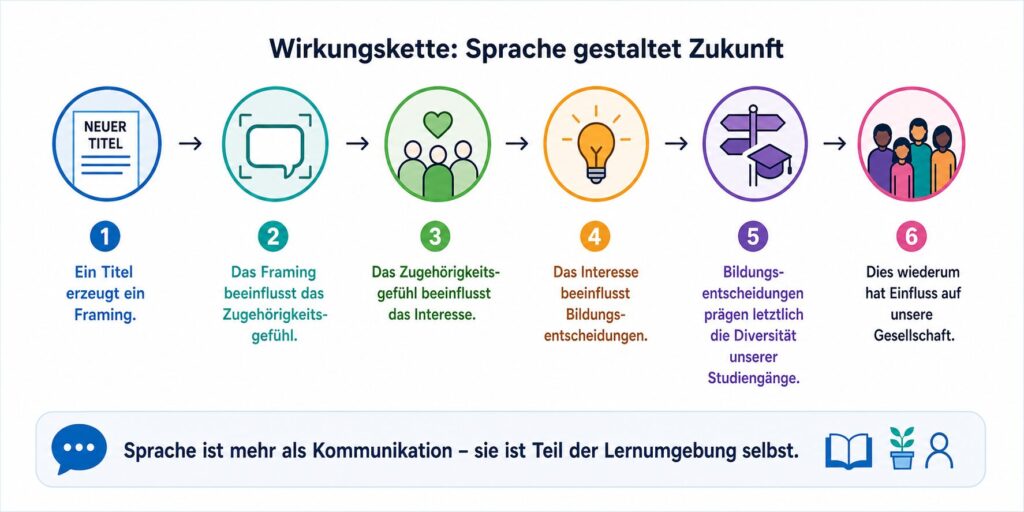
Word choice: inviting or exclusionary
Wolf uses an apt term to describe one of the underlying problems: the “zombie words of computer science.” “Distributed,” “framework,” “architecture,” “optimization”—many terms that have been haunting curricula for decades without anyone really knowing why. For experts, these terms are (self-)evident, but for prospective students , they’reoften abstract or, in the worst case ,even off-putting. “Forwomen ,the societal benefit is particularly important. It makes a difference whether something is called computer science or medical informatics. For them, it’s simply more important what I can achieve with it,” explains Daniela Wolf.
Added to this is an often-overlooked aspect: the apparent “not wanting” that is, in reality, a lack of confidence. Wolf describes a situation from a project in which tradespeople work as mentors with children. The boys are all in the workshop, while the girls are outside, mostly busy with small tasks. When asked why this is the case, the mentor replies,“They didn’t want to.” There was clearly no ill intent behind this; he simply overlooked something—namely, that women and girls sometimes need to be approached differently. The fear of embarrassing oneself or of not belonging often prevents them from taking action, not a lack of will. And this is precisely where, according to Wolf, words can sometimes play a decisive role: they can provide or take away a sense of security, and they can either invite or exclude.
What FERNFH Is Already Implementing
The Ferdinand Porsche University of Applied Sciences (FERNFH) has taken this reflection as an opportunity to take action. In the master’s program in Information Technology, the titles of the first courses have been revised—not to simplify the content, but to make their social relevance and practical applications more visible. The goal here is clearly accessibility, not simplification.
The course “Legal Issues and Problems in Computer Science” was renamed “Law & Responsibility in the Digital Age,” and “Leadership and Organization” became “Leadership and Organizational Design in IT Teams.” It is not yet possible to conclusively assess whether—and to what extent—these measures are having an effect. The proportion of women among applicants to the master’s program has recently shown a noticeable positive trend, even though it would be scientifically unsound to attribute this trend solely to the name changes. But it is a signal—one that FERNFH takes seriously.
Changing the language in curricula alone is not enough to bring about lasting change. For inclusive communication to truly take hold, those who work with students on a daily basis must also be made aware of the issue.“Faculty members—many of whom are still men in technical fields—are often completely unaware of the issue,”says Wolf.
Here, too, Daniela Wolf provided the initial impetus: With the course “IT for Everyone,” a pilot program was successfully tested for instructors in IT degree programs; it brings unconscious thought patterns to light, teaches inclusive teaching methods, and empowers instructors to reflect on their own language. Following the successful completion of the course and the positive feedback from participants, there are plans to make the format available to a broader audience.
Conclusion: Not just lip service
What is particularly important to Daniela Wolf and to the issue itself is that change in language must not be mere lip service. If phrasing is adjusted for purely marketing reasons, without genuine reflection, the measure misses its mark. There is a great deal of research on this topic at universities, but it is still not being applied enough in the day-to-day life of universities themselves.
The power of words is not a marginal issue in education policy either. It is part of the broader social project of equality. And it starts small: with our own choice of words, with an awareness of what language triggers. As Daniela Wolf puts it at the end of her talk:“There are only a few words between ‘distributed systems’ and ‘how the Internet works.’ But sometimes, there’s an entire target audience in between.”