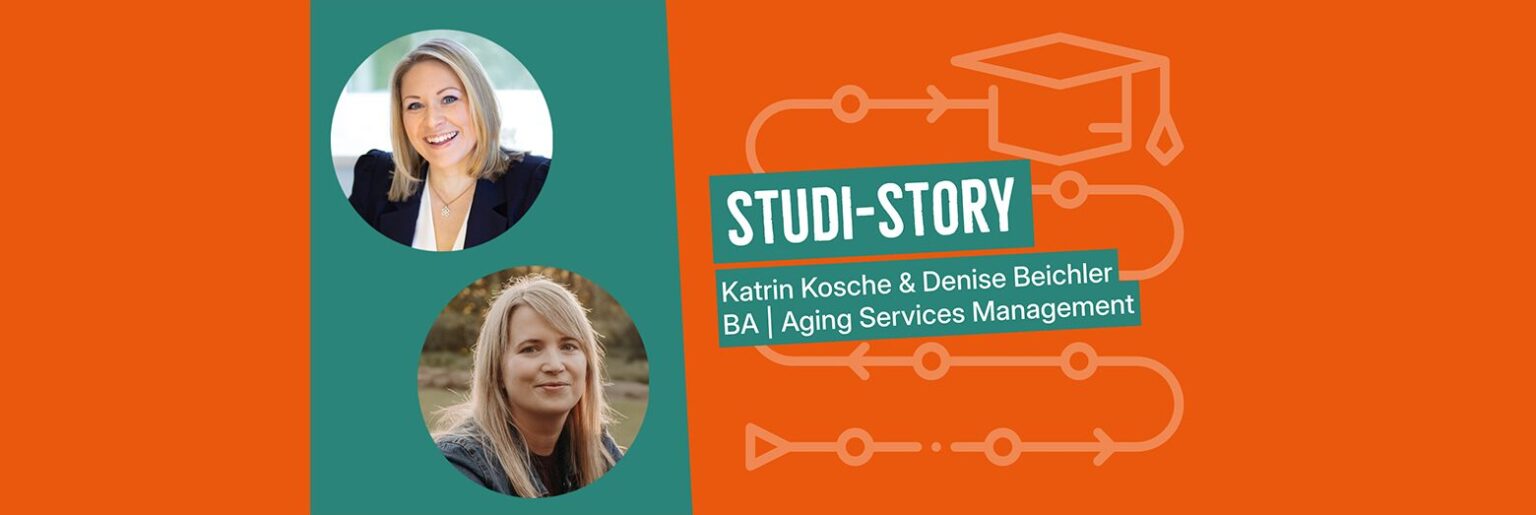
A conversation with students Katrin Kosche and Denise Beichler: When your studies adapt to your life—and not the other way around.
They met at work, share the same drive—and are now enrolled in the same degree program. Katrin Kosche and Denise Beichler are licensed nurses, self-employed entrepreneurs, and, since 2025, students in the Bachelor’s program in Aging Services Management at Ferdinand Porsche FERNFH.
Anyone who meets Katrin Kosche and Denise Beichler will find two women who know what they want—and who are used to juggling many things at once. Both work at BEKO Pflegevermittlung und Beratung OG, a company that specializes in placing caregivers in home care settings and providing 24-hour care. On top of that, each runs her own business. And yet, in 2025, they decided to add something significant to their already full lives: a distance learning program.
Katrin’s journey to FERNFH began with a recommendation from the Austrian Health and Nursing Association (ÖGKV). Before deciding to pursue a bachelor’s degree, she tested the program through a micro-credential—a compact, academically rigorous continuing education module. She wanted to know whether distance learning, family, and work could truly be balanced. The answer came quickly.
“The combination of distance learning and in-person sessions is so well organized that I can easily fit my studies into my daily routine. I also think everything is handled very professionally—that’s important to me personally.”
Katrin Kosche
Denise, on the other hand, heard about the opportunity from Katrin herself—her coworker and friend. Today, the two of them are going through their studies together, and this arrangement is more than just a happy coincidence. It reflects a shared belief: that the next step in one’s personal development shouldn’t wait until life settles down. Because it never does.
For both of them, it was the program’s content that ultimately convinced them to choose the Aging Services Management track. The curriculum hits the sweet spot where their professional realities intersect: healthcare, management, and organizational development. For Katrin, the program also opens up long-term prospects—she can envision teaching at a distance learning university herself in the future. Denise is thinking more concretely about the present: she wants to expand her business knowledge to further professionalize processes in her self-employed practice. And even now, while she’s still in the program, she’s noticing that it’s paying off.
“Even while I was still a student, I was able to gain new perspectives, deepen my understanding of economic and organizational dynamics, and apply specific concepts directly in practice—something I consider to be of great value.”
Denise Beichler
Learn whenever you can, wherever you are
It would be dishonest to claim that pursuing a distance learning program alongside a full-time job, self-employment, and a personal life doesn’t come with its own set of challenges. Katrin addresses this openly: When exams, individual assignments, and group projects all come due at the same time, you inevitably reach your limits. The difference lies in how you deal with those limits.
Katrin has found a rhythm that suits her lifestyle. Being self-employed allows her to structure her day flexibly: work, then study, then work again—or the other way around. She doesn’t study in long blocks, but rather takes advantage of the opportunities that arise. What helps her isn’t discipline in the traditional sense, but a kind of inner clarity about why she’s doing all this.
“My studies give me an incredible amount of energy. They motivate me because I know they’re opening up new opportunities for me and deepening my knowledge. During stressful periods, I try not to let it get to me. When I feel like it’s becoming too much, I take a short break—and then I get back on track.”
Katrin Kosche
Denise relies on structure. As a licensed nurse, she is used to thinking in a solution-oriented way even under pressure—a skill that directly benefits her in her daily academic life. Set study times, a tidy workspace, and realistic expectations of herself. And: interaction with her peer group. During challenging times, it is often this very support network that gets her through.
Economics was particularly challenging for Denise—and that is precisely why it impressed her. It was a subject she had to learn from scratch, with no prior exposure to it.
“The material covered in this course was completely new to me, and I had to spend a lot of time familiarizing myself with it. It was precisely this challenge—understanding new concepts and building new knowledge—that I found so rewarding.”
Denise Beichler
Distance learning does not mean “studying alone”
There is a persistent misconception about distance learning: that students sit alone in front of their laptops, with no real contact with their classmates. Katrin and Denise are experiencing the opposite. Their group communicates regularly via WhatsApp, shares documents through Microsoft Teams, and meets in online sessions. Their mutual support works—not because it’s required, but because it has developed naturally.
“We’re constantly in touch, and our collaboration is going really well and is very smooth. Everyone can count on each other, and I feel really at home in our group.”
Katrin Kosche
Denise highlights what makes this community special: the diversity of the people who come together here. Different professional backgrounds, different perspectives, different personalities—this enriches not only the group work but also one’s personal horizons. Those who study in a peer group with experienced healthcare professionals learn more than what’s in the curriculum.
Both also find the institutional support to be exceptionally positive. FERNFH staff respond promptly to inquiries, the program directors are always available, and the feeling of being taken seriously is not something Katrin and Denise take for granted—it is a hallmark of quality.
What advice would they give to others who are still on the fence? Katrin recommends taking some time at the beginning to get your bearings, familiarize yourself with the online campus, and develop your own schedule for assignments and study periods early on. And: don’t put too much pressure on yourself. Denise adds what has helped her the most: taking your time to settle in—and knowing that the challenging phases aren’t the end, but part of the journey.
“Even though there are times when things get tough or challenging, it’s worth sticking with it. We all go through moments like that—the key is to keep going.”
Katrin Kosche
Above all, Katrin and Denise’s stories show that pursuing a degree doesn’t have to turn your life upside down. Distance learning at FERNFH adapts to your schedule—whether it’s work hours, family commitments, or the small and large uncertainties of everyday life. The flexibility that distance learning offers isn’t just a nice bonus; it’s the very essence of the program: learning whenever you can and wherever you happen to be.