Privacy Policy
We—Ferdinand Porsche FERNFH (Ferdinand Porsche Fernfachhochschule GmbH) and the parent company FERNFH Management & Service GmbH—take data protection and your privacy very seriously! We respect your privacy and are committed to protecting it. To ensure this protection is implemented as effectively as possible, we would like to provide you with an overview of the technical aspects of data storage, management, and use in this privacy policy.
By using this website, you confirm that you agree with the terms of our Privacy Policy and hereby accept them. If you do not wish to accept this Privacy Policy, please do not enter any personal data on this website. You can find guidance on suitable plugins and opt-out options in the respective sections.
- Introduction and Overview
We have prepared this Privacy Policy (Version 07/11/2024-112558660) to explain to you, in accordance with the provisions ofthe General Data Protection Regulation (EU) 2016/679and applicable national laws, which personal data (hereinafter “data”) we, as the data controller—and the processors we engage (e.g., service providers)—process, will process in the future, and what legal options you have. The terms used are to be understood as gender-neutral.
In short:We provide you with comprehensive information about the data we process about you.Privacy policies usually sound very technical and use legal jargon. This privacy policy, however, is designed to explain the most important points to you as simply and transparently as possible. Where it helps with transparency, technicalterms areexplained in a reader-friendly way, links to further information are provided, andgraphicsare used. We use clear and simple language to inform you that, within the scope of our business activities, we only process personal data when there is a corresponding legal basis for doing so. This certainly isn’t possible if we provide explanations that are as brief, unclear, and legally technical as those often found online when it comes to data protection. I hope you find the following explanations interesting and informative, and perhaps there is some information here that you didn’t know before.
If you still have questions, we ask that you contact the responsible body listed below or in the legal notice, follow the provided links, and review additional information on third-party websites. You can, of course, also find our contact information in the legal notice. - Scope of Application
This Privacy Policy applies to all personal data processed by us within the company and to all personal data processed by companies we have commissioned (processors). By “personal data,” we mean information as defined in Article 4(1) of the GDPR, such as a person’s name, email address, and mailing address. The processing of personal data enables us to offer and bill for our services and products, whether online or offline. The scope of this Privacy Policy includes:
- all online platforms (websites, online stores) that we operate
- Social media presence and email communication
- mobile apps for smartphones and other devices
In short:This Privacy Policy applies to all areas within the company where personal data is processed in a structured manner through the channels mentioned above. If we enter into a legal relationship with you outside of these channels, we will notify you separately if necessary.
- Legal Basis
In the following privacy policy, we provide you with transparent information about the legal principles and regulations—that is, the legal basis under the General Data Protection Regulation—that allow us to process personal data.
With regard to EU law, we refer to REGULATION (EU) 2016/679 OF THE EUROPEAN PARLIAMENT AND OF THE COUNCIL of April 27, 2016. You can, of course, read this EU General Data Protection Regulation online on EUR-Lex, the portal for EU law, athttps://eur-lex.europa.eu/legal-content/DE/ALL/?uri=celex%3A32016R0679.We process your data only if at least one of the following conditions applies:
- Consent(Article 6(1)(a) of the GDPR): You have given us your consent to process data for a specific purpose. An example would be storing the data you entered in a contact form.
- Contract(Article 6(1)(b) of the GDPR): We process your data to fulfill a contract or pre-contractual obligations with you. For example, if we enter into a purchase agreement with you, we need certain personal information in advance.
- Legal obligation(Article 6(1)(c) of the GDPR): We process your data when we are subject to a legal obligation. For example, we are legally required to retain invoices for accounting purposes. These typically contain personal data.
- Legitimate interests(Article 6(1)(f) of the GDPR): In cases where legitimate interests do not infringe upon your fundamental rights, we reserve the right to process personal data. For example, we must process certain data in order to operate our website securely and cost-effectively. This processing therefore constitutes a legitimate interest.
Other conditions, such as the processing of data in the public interest, the exercise of official authority, or the protection of vital interests, do not generally apply to us. However, if such a legal basis were to apply, it will be indicated in the relevant section.
In addition to the EU regulation, national laws also apply:
- InAustria, this is the Federal Act on the Protection of Natural Persons with Regard to the Processing of Personal Data (Data Protection Act), orDSG for short.
- InGermany, theFederal Data Protection Act(BDSG) applies.
If additional regional or national laws apply, we will provide you with information about them in the following sections.
- Contact information for the data controller
If you have any questions regarding data protection or the processing of personal data, please find the contact information for the responsible person or department below:
Ferdinand Porsche Fernfachhochschule GmbH
Ferdinand Porsche Ring 3
2700 Wiener Neustadt
AustriaEmail:datenschutz@fernfh.ac.at
Phone:+43 2622 32600
Legal Notice:https://www.fernfh.ac.at/impressum - Retention period
It is our general policy to retain personal data only for as long as is strictly necessary to provide our services and products. This means that we delete personal data as soon as the reason for processing it no longer exists. In some cases, we are legally required to retain certain data even after the original purpose has ceased to exist, for example, for accounting purposes.
If you wish to have your data deleted or wish to withdraw your consent to data processing, the data will be deleted as soon as possible, provided there is no legal obligation to retain it.
We will provide you with information below regarding the specific duration of each data processing activity, provided we have further details on this matter.
- Rights under the General Data Protection Regulation
In accordance with Articles 13 and 14 of the GDPR, we are informing you of the following rights to which you are entitled to ensure that your data is processed fairly and transparently:
- Under Article 15 of the GDPR, you have the right to request information about whether we process your data. If we do, you have the right to receive a copy of the data and to be informed of the following:
- for what purpose we process the data;
- the categories, i.e., the types of data that are processed;
- who receives this data, and if the data is transferred to third countries, how security can be ensured;
- how long the data is stored;
- the existence of the right to rectification, erasure, or restriction of processing, and the right to object to processing;
- that you can file a complaint with a supervisory authority (links to these authorities are provided below);
- the source of the data, if we did not collect it from you;
- whether profiling is carried out—that is, whether data is automatically analyzed to create a personal profile of you.
- Under Article 16 of the GDPR, you have the right to have your data corrected, which means that we must correct any errors you find.
- Under Article 17 of the GDPR, you have the right to erasure (“right to be forgotten”), which specifically means that you may request the erasure of your data.
- Under Article 18 of the GDPR, you have the right to restrict processing, which means that we may only store the data but may not use it further.
- Under Article 20 of the GDPR, you have the right to data portability, which means that, upon request, we will provide you with your data in a commonly used format.
- Under Article 21 of the GDPR, you have the right to object, which, once exercised, will result in a change to how your data is processed.
- If the processing of your data is based on Article 6(1)(e) (public interest, exercise of official authority) or Article 6(1)(f) (legitimate interests), you may object to the processing. We will then review as soon as possible whether we can legally comply with this objection.
- If your data is used for direct marketing purposes, you may object to this type of data processing at any time. After that, we may no longer use your data for direct marketing.
- If your data is used for profiling, you may object to this type of data processing at any time. After that, we may no longer use your data for profiling.
- Under Article 22 of the GDPR, you may have the right not to be subject to a decision based solely on automated processing (such as profiling).
- Under Article 77 of the GDPR, you have the right to lodge a complaint. This means that you can file a complaint with the data protection authority at any time if you believe that the processing of your personal data violates the GDPR.
In short:You have rights—don’t hesitate to contact the responsible department listed above!
If you believe that the processing of your data violates data protection laws or that your data protection rights have been infringed in any other way, you can file a complaint with the supervisory authority. In Austria, this is the Data Protection Authority, whose website can be found athttps://www.dsb.gv.at/. In Germany, there is a data protection officer for each federal state. For more information, you can contact theFederal Commissioner for Data Protection and Freedom of Information (BfDI).
Procedures for Accessing and Deleting Data
If you have any questions, complaints, suggestions, or concerns regarding this Privacy Policy or the use or disclosure of your information, please contact us atdatenschutz@fernfh.ac.at.
If you would like specific information regarding your stored data and its use, please fill out the form “Request for Information Pursuant to Article 15 of the GDPR.” You naturally have the right at any time to request the deletion of your data stored by FERNFH. To do so, please send us the completed form “Request for Deletion pursuant to Article 17 of the GDPR” or contact widerruf(at)fernfh.ac.at.
- Under Article 15 of the GDPR, you have the right to request information about whether we process your data. If we do, you have the right to receive a copy of the data and to be informed of the following:
- Data transfers to third countries
We transfer or process data to countries outside the scope of the GDPR (third countries) only if you consent to such processing or if there is another legal basis for doing so. This applies in particular when the processing is required by law or necessary to fulfill a contractual relationship, and in any case only to the extent that it is generally permitted. In most cases, your consent is the primary reason we process data in third countries. The processing of personal data in third countries such as the United States, where many software providers offer services and have their server locations, may mean that personal data is processed and stored in unexpected ways.
We expressly note that, according to the European Court of Justice, an adequate level of protection for data transfers to the United States currently exists only if a U.S. company that processes personal data of EU citizens in the United States is an active participant in the EU-U.S. Data Privacy Framework. For more information, please visit:https://commission.europa.eu/document/fa09cbad-dd7d-4684-ae60-be03fcb0fddf_en
Data processing by U.S. services that are not active participants in the EU-U.S. Data Privacy Framework may result in data being processed and stored without anonymization. Furthermore, U.S. government authorities may access specific data. In addition, collected data may be linked to data from other services of the same provider, provided you have a corresponding user account. Whenever possible, we try to use server locations within the EU, if available.
We provide more detailed information about data transfers to third countries, where applicable, in the relevant sections of this Privacy Policy. - Data Processing Security
To protect personal data, we have implemented both technical and organizational measures. Whenever possible, we encrypt or pseudonymize personal data. In this way, we do everything in our power to make it as difficult as possible for third parties to infer personal information from our data.
Article 25 of the GDPR refers to “data protection through technology design and privacy-friendly default settings,” meaning that security must always be a priority—whether in software (e.g., forms) or hardware (e.g., access to the server room)—and appropriate measures must be implemented. Below, we will discuss specific measures where necessary.
TLS encryption with HTTPS
TLS, encryption, and HTTPS sound very technical—and they are. We use HTTPS (which stands for "Hypertext Transfer Protocol Secure") to transmit data over the internet in a way that prevents eavesdropping.
This means that the entire transmission of all data from your browser to our web server is secure—no one can "eavesdrop."This allows us to add an extra layer of security and comply with data protection through technology design (Article 25(1) of the GDPR). By using TLS (Transport Layer Security), an encryption protocol for secure data transmission over the Internet, we can ensure the protection of confidential data.
You can recognize the use of this data transmission security measure by the small padlock icon in the top-left corner of the browser, to the left of the website address (e.g., examplepage.de), and by the use of the https scheme (instead of http) as part of our website address.
If you would like to learn more about encryption, we recommend searching Google for “Hypertext Transfer Protocol Secure wiki” to find useful links to further information. - Communication
Communication Summary
Data subjects: Anyone who communicates with us by phone, email, or online form
Data processed: e.g., phone number, name, email address, form data entered. You can find more details under the respective contact method
Purpose: Handling communication with customers, business partners, etc.
Retention period: Duration of the business transaction and as required by law
Legal basis: Art. 6(1)(a) GDPR (Consent), Art. 6(1)(b) GDPR (Contract), Art. 6(1)(f) GDPR (Legitimate Interests)When you contact us and communicate via phone, email, or our online form, we may process your personal data.
The data is processed for the purpose of handling and addressing your inquiry and the related business transaction. The data will be stored for as long as required by law.
Affected individuals
These changes affect everyone who contacts us through the communication channels we provide.
Phone
When you call us, the call data is stored in pseudonymized form on the respective device and with the telecommunications provider used. In addition, data such as your name and phone number may subsequently be sent via email and stored for the purpose of responding to your inquiry. The data will be deleted as soon as the business matter has been resolved and legal requirements permit.
Email
When you communicate with us via email, data may be stored on your device (computer, laptop, smartphone, etc.) and on the email server. The data will be deleted as soon as the matter has been resolved and legal requirements permit.
Online Forms
When you contact us via the online form, your data is stored on our web server and, if necessary, forwarded to one of our email addresses. The data will be deleted as soon as the matter has been resolved and legal requirements permit.
Legal Basis
The processing of data is based on the following legal grounds:
- Art. 6(1)(a) GDPR (Consent): You give us your consent to store your data and to use it for purposes related to the business transaction;
- Art. 6(1)(b) GDPR (Contract): It is necessary for the performance of a contract with you or a processor, such as a telephone service provider, or we need to process the data for pre-contractual activities, such as preparing a quote;
- Art. 6(1)(f) GDPR (Legitimate Interests): We aim to handle customer inquiries and business communications in a professional manner. To do so, certain technical systems—such as email programs, Exchange servers, and mobile network operators—are necessary to ensure efficient communication.
- Data Processing Agreement (DPA)
In this section, we’d like to explain what a data processing agreement is and why it’s necessary. Since the term “data processing agreement” is quite a mouthful, we’ll often use the acronym DPA throughout this text. Like most companies, we don’t operate in isolation; we also rely on services provided by other companies or individuals. By involving various companies or service providers, we may need to share personal data for processing. These partners then act as data processors, with whom we enter into a contract known as a Data Processing Agreement (DPA). The most important thing for you to know is that the processing of your personal data takes place exclusively in accordance with our instructions and must be governed by the DPA.
Who are data processors?
As a company and website owner, we are responsible for all data we process from you. In addition to the data controllers, there may also be so-called data processors. This includes any company or individual that processes personal data on our behalf. More specifically, and according to the GDPR definition: any natural or legal person, public authority, agency, or other body that processes personal data on our behalf is considered a data processor. Processors can therefore include service providers such as hosting or cloud providers, payment or newsletter providers, or large companies such as Google or Microsoft.
To help clarify the terminology, here is an overview of the three roles under the GDPR:
Data subject(you as a customer or prospective customer) →Data controller(we as a company and data controller) →Data processor(service providers such as web hosts or cloud providers)
Contents of a Data Processing Agreement
As mentioned above, we have entered into a Data Processing Agreement (DPA) with our partners who act as data processors. Above all, this agreement stipulates that the data processor shall process the data exclusively in accordance with the GDPR. The agreement must be concluded in writing; however, in this context, an electronic agreement is also considered “in writing.” The processing of personal data takes place only on the basis of the contract. The contract must include the following:
- Commitment to us as the responsible party
- Duties and Rights of the Data Controller
- Categories of data subjects
- Type of personal data
- Nature and Purpose of Data Processing
- Purpose and Duration of Data Processing
- Location of data processing
In addition, the contract sets out all of the data processor’s obligations. The most important obligations are:
- Measures to ensure data security
- to take appropriate technical and organizational measures to protect the rights of the data subject
- to maintain a data processing register
- to cooperate with the data protection supervisory authority at its request
- to conduct a risk assessment regarding the personal data received
- Sub-processors may only be engaged with the written consent of the controller
You can see what an AVV actually looks like athttps://www.wko.at/service/wirtschaftsrecht-gewerberecht/eu-dsgvo-mustervertrag-auftragsverarbeitung.html, for example. A sample contract is provided there.
- Application Information
Application Data Summary
Data subjects: Users who apply for a job with us
Purpose: Processing of the application procedure
Data processed: Name, address, contact information, email address, phone number, proof of qualifications (certificates), and possibly special categories of data.
Retention period: If the application is successful, until the end of the employment relationship. Otherwise, the data will be deleted after the application process or stored for a certain period of time with your consent.
Legal basis: Art. 6(1)(a) GDPR (consent), legitimate interest (Art. 6(1)(f) GDPR), Art. 6(1)(b) GDPR (contract), Art. 9(2)(a) GDPR (processing of special categories of data)What is application data?
You can apply for a job at our company via email, an online form, or a recruiting tool. All data we receive and process from you as part of an application is considered application data. In doing so, you will always provide personal information such as your name, date of birth, address, and phone number.
Why do we process job application data?
We process your data so that we can conduct a proper selection process for the advertised position. In addition, we would also like to keep your application documents in our applicant database. This is because it often happens that, for a variety of reasons, a collaboration for the advertised position does not work out, but we are impressed by you and your application and can very well imagine working with you in the future. If you give us your consent to do so, we will archive your documents so that we can easily contact you for future opportunities within our company.
We guarantee that we will handle your data with the utmost care and process it only within the legal framework. Even within our company, your data will be shared only with those directly involved in your application. In short: Your data is safe with us!
What data is processed?
For example, if you apply to us via email, we will, of course, receive personal data as mentioned above. Even your email address is considered personal data. However, during the application process, we only process the data that is relevant to our decision on whether or not to welcome you to our team.
Exactly which data is processed depends primarily on the job posting. In most cases, however, it includes your name, date of birth, contact information, and proof of qualifications. If you submit your application via an online form, the data is transmitted to us in encrypted form. If you send us your application by email, this encryption does not take place. We therefore cannot assume any responsibility for the transmission process. However, once the data is on our servers, we are responsible for the lawful handling of your data.
During the application process, in addition to the information mentioned above, we may also request information about your health or ethnic origin so that both we and you can exercise our rights under labor law, social security, and social protection, while also fulfilling our corresponding obligations. This information constitutes special categories of data.
Here is a list of the types of data we may collect and process from you:
- Name
- Contact information
- Email address
- phone number
- Date of Birth
- Information contained in the cover letter and resume
- Proof of qualifications (e.g., certificates)
- Special categories of data (e.g., ethnic origin, health data, religious beliefs)
- Usage data (visited websites, access data, etc.)
- Metadata (IP address, device information)
How long is the data stored?
When we hire you as a team member at our company, your data will be processed for the purposes of the employment relationship and retained by us at least until the employment relationship ends. All application documents will then be added to your personnel file.
If we do not offer you the position, reject your application, or if you withdraw your application, we may retain your data for up to 6 months after the conclusion of the application process based on our legitimate interest (Art. 6(1)(f) GDPR). After that, both your electronic data and all data from physical application documents will be completely deleted or destroyed. We retain your data, for example, so that we can still answer any follow-up questions or, in the event of a legal dispute, provide evidence regarding the application. If a legal dispute arises and we may still need the data after the 6-month period has expired, we will not delete the data until there is no longer any reason to retain it. If there are legal retention obligations to be fulfilled, we must generally store the data for longer than 6 months.
In addition, we may retain your data for a longer period if you have given us specific consent to do so. We do this, for example, if we can envision working with you in the future. In that case, it is helpful to have your data on file so that we can easily reach you. In this instance, your data will be added to our applicant pool. Of course, you can revoke your consent to the extended retention of your data at any time. If you do not revoke your consent and do not provide new consent, your data will be deleted after 2 years at the latest.
Legal basis
The legal basis for the processing of your data is Article 6(1)(a) of the GDPR (consent), Art. 6(1)(b) GDPR (contract or pre-contractual measures), Art. 6(1)(f) GDPR (legitimate interests), and Art. 9(2)(a) GDPR (processing of special categories of data).
If we add you to our applicant pool, this is done on the basis of your consent (Art. 6(1)(a) GDPR). Please note that your inclusion in our applicant pool is voluntary, has no impact on the application process, and you may withdraw your consent at any time. The lawfulness of the processing up until the time of withdrawal remains unaffected.
In cases involving the protection of vital interests, data processing is carried out in accordance with Article 9(2)(c) of the GDPR. For the purposes of healthcare, occupational medicine, medical diagnostics, care or treatment in the health or social sector, or for the administration of systems and services in the health or social sector, the processing of personal data is carried out in accordance with Article 9(2)(h) of the GDPR. If you voluntarily provide special categories of data, processing is based on Article 9(2)(a) of the GDPR.
- Customer data
Customer Data Summary
Data subjects: Prospective clients, students, alumni, companies, project and R&D partners, other contractual partners
Purpose: Provision of services agreed upon in a contract or pre-contractual agreement, including related communication
Data processed: Name, address, contact details, email address, phone number, payment information (such as invoices and bank details), contract details (such as the term and subject matter of the contract), IP address, usage data, metadata
Retention period: The data will be deleted as soon as it is no longer necessary for the fulfillment of our business purposes and there is no legal obligation to retain it.
Legal basis: Legitimate interest (Art. 6(1)(f) GDPR), Contract (Art. 6(1)(b) GDPR)What is customer data?
In order to provide our services and fulfill our contractual obligations, we also process data from prospective clients, students, alumni, companies, project and R&D partners, and other contractual partners. This data always includes personal information. This data comprises all information processed on the basis of a contractual or pre-contractual relationship in order to provide the services offered.
Why do we process customer data?
There are many reasons why we collect and process customer data. The most important one is that we simply need certain data to provide our services. Sometimes your email address is all we need, but if you purchase a product or service, for example, we also require information such as your name, address, bank details, or contract information. We subsequently use this data for marketing and sales optimization so that we can improve our overall service for our customers. Another important aspect is our customer service, which is always very important to us. We want you to be able to contact us at any time with questions about our offerings, and for that we need at least your email address.
What data is processed?
At this point, we can only describe the specific data we store in general terms. This depends entirely on the services you receive from us. In some cases, you simply provide us with your email address so that we can, for example, contact you or answer your questions. In other cases, you purchase a product or service from us, and for that we need significantly more information, such as your contact details, payment information, and contract details.
Here is a list of the types of data we may collect and process from you:
- Name
- Contact information
- Email address
- phone number
- Date of Birth
- Payment information (invoices, bank details, payment history, etc.)
- Contract details (term, content)
- Usage data (visited websites, access data, etc.)
- Metadata (IP address, device information)
How long is the data stored?
As soon as we no longer need the customer data to fulfill our contractual obligations and for our purposes, and the data is also not required for any potential warranty or liability obligations, we will delete the relevant customer data. This is the case, for example, when a business contract ends. After that, the statute of limitations is generally 3 years, although longer periods are possible in individual cases. Of course, we also comply with statutory retention requirements. Your customer data will certainly not be shared with third parties unless you have explicitly given your consent.
Legal basis
The legal basis for the processing of your data is Article 6(1)(a) of the GDPR (consent), Art. 6(1)(b) GDPR (contract or pre-contractual measures), Art. 6(1)(f) GDPR (legitimate interests), and in specific cases (e.g., for medical services) Art. 9(2)(a) GDPR (processing of special categories of data).
In cases involving the protection of vital interests, data processing is carried out in accordance with Article 9(2)(c) of the GDPR. For the purposes of healthcare, occupational medicine, medical diagnostics, care or treatment in the health or social sector, or for the administration of systems and services in the health or social sector, the processing of personal data is carried out in accordance with Article 9(2)(h) of the GDPR. If you voluntarily provide special categories of data, processing is based on Article 9(2)(a) of the GDPR.
- Registration
Registration Summary
Data subjects: All individuals who register, create an account, log in, and use the account.
Data processed: Email address, name, password, and other data collected during registration, login, and account use.
Purpose: To provide our services. To communicate with customers in connection with the services.
Retention period: As long as the company account associated with the texts exists, and generally for 3 years thereafter.
Legal basis: Art. 6(1)(b) GDPR (Contract), Art. 6(1)(a) GDPR (Consent), Art. 6(1)(f) GDPR (Legitimate Interests)When you register with us, we may process personal data if you enter personally identifiable information or if data such as your IP address is collected during the processing. You can read more about what we mean by the rather cumbersome term “personal data” below.
Please enter only the information we need for registration and for which you have a third party’s authorization if you are registering on behalf of someone else. If possible, use a strong password that you do not use anywhere else and an email address that you check regularly.
Below, we’ll explain exactly how we process your data—because we want you to feel comfortable with us!
What is registration?
When you register, we collect certain information from you, which allows you to easily log in online later and use your account with us. Having an account with us has the advantage that you don’t have to re-enter all your information every time. This saves time and effort and ultimately helps prevent errors when we provide our services.
Why do we process personal data?
In short, we process personal data to enable you to create and use an account with us.
If we didn’t do this, you’d have to enter all your information every time, wait for us to approve it, and then enter everything all over again. Neither we nor many, many of our customers would be too happy about that. How would you feel about that?What data is processed?
All data that you provided during registration, enter when logging in, or enter when managing your account information.
During registration, we process the following types of data:
- First name
- Last name
- Email address
- Company name
- Street + House number
- Place of residence
- Zip code
- Country
When you sign up, we process the information you provide during registration—such as your username and password—as well as data collected in the background, such as device information and IP addresses.
When you use your account, we process the data you enter while using your account and the data generated in connection with your use of our services.
Retention period
We store the data you provide at least for as long as the account associated with that data remains active and in use with us, for as long as contractual obligations between us exist, and, if the contract ends, until any claims arising from it become time-barred. In addition, we store your data for as long as and to the extent that we are subject to legal obligations regarding storage. Thereafter, we retain booking documents related to the contract (invoices, contract documents, account statements, etc.) as well as other relevant business records for the duration required by law (usually several years).
Right to object
Have you registered, entered your data, and now want to withdraw your consent? No problem. As you can read above, under the General Data Protection Regulation, your rights remain in effect even during and after registration, sign-up, or the creation of an account with us. Contact the Data Protection Officer listed above to exercise your rights. If you already have an account with us, you can easily view or manage your data and text directly in your account.
Legal basis
By completing the registration process, you are making a pre-contractual inquiry to us with the aim of entering into a user agreement for our platform (even though this does not automatically result in an obligation to pay). You invest time in entering data and registering, and we provide you with access to our services after you log in to our system, as well as access to your customer account. In addition, we fulfill our contractual obligations. Finally, we must keep registered users informed via email of important changes. Thus, Article 6(1)(b) of the GDPR (implementation of pre-contractual measures, performance of a contract) applies.
If necessary, we may also obtain your consent, for example, if you voluntarily provide more information than is strictly necessary or if we are permitted to send you promotional materials. Article 6(1)(a) of the GDPR (Consent) therefore applies.
We also have a legitimate interest in knowing who we are dealing with in order to contact them in certain cases. In addition, we need to know who is using our services and whether they are being used in accordance with our Terms of Use; therefore, Article 6(1)(f) of the GDPR (legitimate interests) applies.
Registration using your real name
Since we need to know who we are dealing with in our business operations, registration is only possible using your real name (real name) and not pseudonyms.
Registration using pseudonyms
You may use a pseudonym when registering, which means you do not have to register with us using your real name. This ensures that we cannot process your name.
Storage of IP addresses
During the registration, login, and account usage processes, we store your IP address in the background for security reasons to verify that the account is being used legitimately.
Public Profile
User profiles are publicly visible, meaning that parts of the profile can be viewed online without entering a username and password.
Two-factor authentication (2FA)
Two-factor authentication (2FA) provides additional security during login, as it prevents you from logging in without a smartphone, for example. This technical measure to secure your account protects you from data loss or unauthorized access, even if your username and password were known. You can find out which 2FA method is used during registration, when logging in, and within your account itself.
- Web hosting
Web Hosting Summary
Data subjects: Visitors to the website
Purpose: Professional hosting of the website and ensuring its operation
Data processed: IP address, time of website visit, browser used, and other data. You can find more details below or with the respective web hosting provider.
Retention period: Depends on the respective provider, but generally 2 weeks
Legal basis: Art. 6(1)(f) GDPR (Legitimate Interests)What is web hosting?
When you visit websites today, certain information—including personal data—is automatically generated and stored, and this is also the case on this website. This data should be processed as sparingly as possible and only for a valid reason. By “website,” we mean the entirety of all web pages on a domain, i.e., everything from the home page to the very last subpage (like this one). By “domain,” we mean, for example, example.de or sampleexample.com.
If you want to view a website on a computer, tablet, or smartphone, you use a program called a web browser. You’re probably familiar with some web browsers by name: Google Chrome, Microsoft Edge, Mozilla Firefox, and Apple Safari. We often just call them browsers or web browsers.
To display a website, the browser must connect to another computer where the website’s code is stored: the web server. Operating a web server is a complex and resource-intensive task, which is why it’s usually handled by professional providers. These providers offer web hosting services, ensuring that website data is stored reliably and without errors. That’s a lot of technical terms, but hang in there—it gets even better!
When your browser connects to the internet on your computer (desktop, laptop, tablet, or smartphone) and during the transfer of data to and from the web server, personal data may be processed. On the one hand, your computer stores data; on the other hand, the web server must also store data for a certain period of time to ensure proper operation.
Why do we process personal data?
The purposes of data processing are:
- Professional website hosting and ensuring smooth operation
- To maintain operational and IT security
- Anonymous analysis of user behavior to improve our services and, if necessary, for law enforcement purposes or to pursue claims
What data is processed?
Even as you visit our website right now, our web server—the computer on which this website is hosted—typically automatically stores data such as
- the full web address (URL) of the webpage being viewed
- Browser and browser version (e.g., Chrome 87)
- the operating system used (e.g., Windows 10)
- the address (URL) of the previously visited page (referrer URL) (e.g.,https://www.beispielquellsite.de/vondabinichgekommen/)
- the hostname and IP address of the device from which the request is being made (e.g., COMPUTERNAME and 194.23.43.121)
- Date and time
- in files known as web server log files
How long is data stored?
As a rule, the data mentioned above is stored for two weeks and then automatically deleted. We do not share this data with third parties; however, we cannot rule out the possibility that government authorities may access this data in the event of unlawful conduct.
In short:Your visit is logged by our provider (the company that hosts our website on special computers called servers), but we won't share your information without your consent!
Legal basis
The lawfulness of processing personal data in the context of web hosting is based on Article 6(1)(f) of the GDPR (protection of legitimate interests), as the use of professional hosting services from a provider is necessary to present the company on the internet in a secure and user-friendly manner and, if necessary, to investigate any attacks or claims arising therefrom.
We generally have a contract with the hosting provider regarding data processing in accordance with Article 28 et seq. of the GDPR, which ensures compliance with data protection regulations and guarantees data security.
- Web Analytics
Web Analytics Privacy Policy Summary
👥 Data Subjects: Visitors to the website
🤝 Purpose: Analysis of visitor information to optimize the website.
📓 Data Processed: Access statistics, which include data such as visitor locations, device information, duration and time of access, navigation behavior, click behavior, and IP addresses. You can find more details on this in the respective web analytics tool used.
📅 Storage period: Depends on the web analytics tool used
⚖️ Legal basis: Art. 6(1)(a) GDPR (Consent), Art. 6(1)(f) GDPR (Legitimate Interests)What is web analytics?
We use software on our website to analyze the behavior of website visitors, commonly referred to as web analytics. This process involves the collection of data, which is stored, managed, and processed by the respective analytics tool provider (also known as a tracking tool). This data is used to generate analyses of user behavior on our website, which are then made available to us as the website operator. In addition, most tools offer various testing options. For example, this allows us to test which offers or content resonate best with our visitors. To do this, we show you two different offers for a limited period of time. After the test (known as an A/B test), we know which product or content our website visitors find more interesting. For such testing procedures, as well as for other analytics procedures, user profiles may also be created and the data stored in cookies.
Why do we use web analytics?
With our website, we have a clear goal in mind: we want to provide the best online experience in our industry. To achieve this goal, we aim to offer the best and most engaging content while ensuring that you feel completely at home on our website. Using web analytics tools, we can take a closer look at the behavior of our website visitors and then improve our website for both you and us accordingly. For example, we can determine the average age of our visitors, where they come from, when our website receives the most traffic, or which content or products are particularly popular. All of this information helps us optimize the website and tailor it to best meet your needs, interests, and preferences.
What data is processed?
Exactly what data is stored depends, of course, on the analytics tools used. However, as a rule, the following information is typically stored: what content you view on our website, which buttons or links you click, when you visit a page, which browser you use, what device (PC, tablet, smartphone, etc.) you use to visit the website, and what operating system you use. If you have consented to the collection of location data, this information may also be processed by the web analytics tool provider.
In addition, your IP address is also stored. Under the General Data Protection Regulation (GDPR), IP addresses are considered personal data. However, your IP address is generally stored in a pseudonymized form (i.e., in an unrecognizable and truncated form). For the purposes of testing, web analytics, and web optimization, no direct data—such as your name, age, address, or email address—is stored. All such data, if collected, is stored in a pseudonymized form. This ensures that you cannot be identified as an individual.
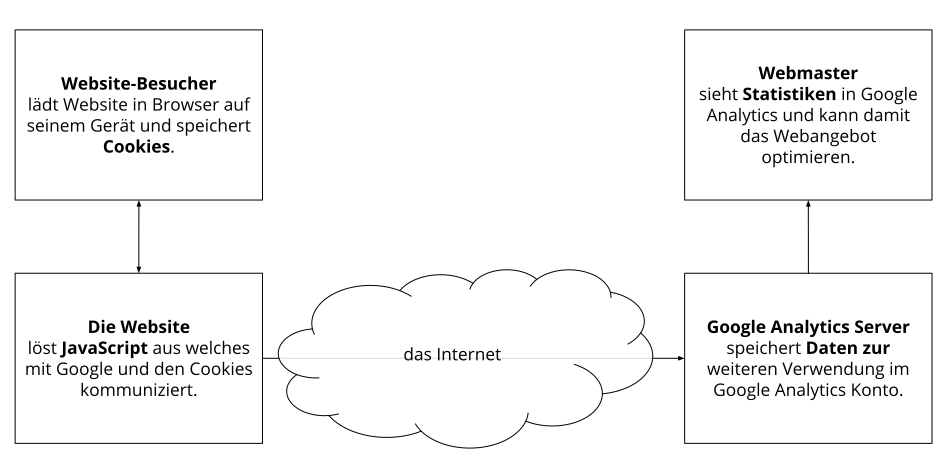
The following example provides a schematic overview of how Google Analytics works as an example of client-side web tracking using JavaScript code.

How long the data is stored depends on the provider. Some cookies store data for only a few minutes or until you leave the website, while others can store data for several years.
Duration of data processing
We provide information below regarding the duration of data processing, to the extent that we have further details. In general, we process personal data only for as long as is strictly necessary to provide our services and products. If required by law—as is the case with accounting, for example—this retention period may be extended.
Right to object
You also have the right and the option to withdraw your consent to the use of cookies or third-party providers at any time. You can do this either through our cookie management tool or via other opt-out features. For example, you can also prevent data collection via cookies by managing, disabling, or deleting cookies in your browser.
Legal basis
The use of web analytics requires your consent, which we have obtained via our cookie pop-up. Pursuantto Article 6(1)(a) of the GDPR (Consent), this consent constitutes the legal basis for the processing of personal data, such as that collected by web analytics tools.
In addition to your consent, we have a legitimate interest in analyzing the behavior of website visitors in order to improve our services both technically and economically. Web analytics help us detect website errors, identify attacks, and improve cost-effectiveness. The legal basis for this isArticle 6(1)(f) of the GDPR (Legitimate Interests). However, we only use these tools if you have given your consent.
Since web analytics tools use cookies, we also recommend that you read our general privacy policy regarding cookies. To find out exactly what data is stored and processed about you, you should review the privacy policies of the respective tools.
Information on specific web analytics tools is provided in the following sections, where available.
Google Analytics Privacy Policy
Google Analytics Privacy Policy Summary
👥 Data Subjects: Visitors to the website
🤝 Purpose: Analysis of visitor information to optimize the website.
📓 Data Processed: Access statistics, which include data such as access locations, device data, duration and time of access, navigation behavior, and click behavior. More details can be found further down in this privacy policy.
📅 Retention period: customizable; by default, Google Analytics 4 stores data for 14 months
⚖️ Legal basis: Art. 6(1)(a) GDPR (consent), Art. 6(1)(f) GDPR (legitimate interests)What is Google Analytics?
We use the Google Analytics 4 (GA4) analytics tracking tool on our website, provided by the U.S.-based company Google Inc. For the European region, Google Ireland Limited (Gordon House, Barrow Street, Dublin 4, Ireland) is responsible for all Google services. Google Analytics collects data about your activities on our website. However, by combining various technologies such as cookies, device IDs, and login information, you as a user can be identified across different devices. This allows your activities to be analyzed across platforms.
For example, when you click on a link, this event is stored in a cookie and sent to Google Analytics. The reports we receive from Google Analytics help us tailor our website and services to better meet your needs. Below, we’ll discuss this tracking tool in more detail and, most importantly, explain what data is processed and how you can prevent this.
Google Analytics is a tracking tool used to analyze traffic on our website. These measurements and analyses are based on a pseudonymous user identification number. This number does not contain any personal data such as a name or address, but is used to associate events with a device. GA4 uses an event-based model that captures detailed information on user interactions such as page views, clicks, scrolling, and conversion events. In addition, various machine learning functions have been built into GA4 to better understand user behavior and certain trends. GA4 relies on modeling with the help of machine learning functions. This means that, based on the collected data, missing data can also be extrapolated to optimize the analysis and enable forecasts.
To ensure that Google Analytics functions properly, a tracking code is embedded in our website’s code. When you visit our website, this code records various actions you perform on our site. With GA4’s event-based data model, we as website operators can define and track specific events to gain insights into user interactions. This allows us to track not only general information such as clicks or page views, but also specific events that are important to our business. Such specific events could include, for example, submitting a contact form or purchasing a product.
As soon as you leave our website, this data is sent to Google Analytics servers and stored there.
Google processes the data and provides us with reports on your user behavior. These reports may include, among other things:
- Target Audience Reports: Target audience reports help us get to know our users better and gain a clearer understanding of who is interested in our service.
- Ad reports: Ad reports help us analyze and improve our online advertising.
- Acquisition reports: Acquisition reports provide us with helpful insights into how we can attract more people to our service.
- Behavioral reports: These reports show us how you interact with our website. We can track the path you take on our site and which links you click.
- Conversion Reports: A conversion is the process by which you take a desired action in response to a marketing message. For example, when you go from being a casual website visitor to a buyer or newsletter subscriber. These reports help us understand how our marketing efforts are resonating with you. Our goal is to increase our conversion rate.
- Real-time reports: Here, we always know immediately what’s happening on our website. For example, we can see how many users are currently reading this text.
In addition to the analysis reports mentioned above, Google Analytics 4 also offers the following features, among others:
- Event-based data model: This model tracks very specific events that can occur on our website. For example, playing a video, purchasing a product, or signing up for our newsletter.
- Advanced analytics features: These features allow us to gain a deeper understanding of your behavior on our website and identify general trends. For example, we can segment user groups, conduct comparative analyses of target audiences, or track your journey or path on our website.
- Predictive modeling: Using machine learning, missing data can be extrapolated based on collected data to predict future events and trends. This can help us develop better marketing strategies.
- Cross-platform analysis: Data can be collected and analyzed from both websites and apps. This allows us to analyze user behavior across platforms, provided, of course, that you have consented to the processing of your data.
Why do we use Google Analytics on our website?
Our goal with this website is clear: we want to provide you with the best possible service. The statistics and data from Google Analytics help us achieve this goal.
The statistically analyzed data gives us a clear picture of our website’s strengths and weaknesses. On the one hand, we can optimize our site so that interested people can find it more easily on Google. On the other hand, the data helps us better understand you as a visitor. We therefore know exactly what we need to improve on our website to offer you the best possible service. The data also helps us tailor our advertising and marketing efforts to be more personalized and cost-effective. After all, it only makes sense to showcase our products and services to people who are interested in them.
What data does Google Analytics store?
Google Analytics uses a tracking code to generate a random, unique ID that is linked to your browser cookie. This allows Google Analytics to recognize you as a new user and assign you a user ID. The next time you visit our site, you will be recognized as a “returning” user. All collected data is stored along with this user ID. This is what makes it possible to analyze pseudonymous user profiles.
To analyze our website using Google Analytics, a property ID must be included in the tracking code. The data is then stored in the corresponding property. For each newly created property, the Google Analytics 4 property is selected by default. Depending on the property used, data is stored for varying lengths of time.
Using identifiers such as cookies, app instance IDs, user IDs, or custom event parameters, your interactions are tracked across platforms, provided you have given your consent. Interactions include all types of actions you perform on our website. If you also use other Google systems (such as a Google Account), data generated by Google Analytics may be linked to third-party cookies. Google does not share Google Analytics data unless we, as the website operator, authorize it. Exceptions may apply if required by law.
According to Google, IP addresses are not logged or stored in Google Analytics 4. However, Google uses IP address data to determine location information and deletes it immediately afterward. All IP addresses collected from users in the EU are therefore deleted before the data is stored in a data center or on a server.
Since Google Analytics 4 focuses on event-based data, the tool uses significantly fewer cookies than earlier versions (such as Google Universal Analytics). However, there are still some specific cookies used by GA4. These include, for example:
Name:_ga
Value: 2.1326744211.152112558660-5
Purpose:By default, analytics.js uses the _ga cookie to store the user ID. Its primary purpose is to distinguish between website visitors.
Expiration date:after 2 yearsName:_gid
Value: 2.1687193234.152112558660-1
Purpose:This cookie is also used to distinguish between website visitors
Expiration date:after 24 hoursName: _gat_gtag_UA_<property-id>
Wert: 1
Verwendungszweck: Wird zum Senken der Anforderungsrate verwendet. Wenn Google Analytics über den Google Tag Manager bereitgestellt wird, erhält dieser Cookie den Namen _dc_gtm_ <property-id>.
Ablaufdatum: nach 1 MinuteNote:This list is not exhaustive, as Google frequently updates its cookie settings. One of GA4’s goals is to improve data protection. As a result, the tool offers several options for controlling data collection. For example, we can specify the retention period ourselves and also manage data collection.
Here is an overview of the main types of data collected by Google Analytics:
Heatmaps:Google generates heatmaps. Heatmaps show exactly which areas you click on. This gives us information about where you are navigating on our site.
Session duration:Google defines session duration as the amount of time you spend on our site without leaving it. If you have been inactive for 20 minutes, the session ends automatically.
Bounce rate: A bounce occurs when you view only one page on our website and then leave.
Account creation:When you create an account or place an order on our website, Google Analytics collects this data.
Location:IP addresses are not logged or stored in Google Analytics. However, shortly before the IP address is deleted, it is used to derive location data.
Technical information:Technical information includes, among other things, your browser type, your internet service provider, and your screen resolution.
Source:Google Analytics; we are also interested in knowing which website or advertisement led you to our site.
Other data includes contact information, any reviews, media playback (e.g., when you play a video on our site), sharing content via social media, or adding items to your favorites. This list is not exhaustive and is intended only as a general guide to the data collected by Google Analytics.
How long and where is the data stored?
Google has servers located all over the world. You can find out exactly where Google's data centers are located here:https://datacenters.google/
Your data is distributed across various physical storage devices. This has the advantage of making the data more readily accessible and better protected against tampering. Every Google data center has appropriate contingency plans in place for your data. For example, even if Google’s hardware fails or natural disasters take servers offline, the risk of a service interruption at Google remains low.
The data retention period depends on the properties used. The retention period is always set separately for each individual property. Google Analytics offers four options for controlling the retention period:
- 2 months: that is the minimum retention period.
- 14 months: By default, data is stored in GA4 for 14 months.
- 26 months: You can also store the data for 26 months.
- Data is not deleted until we delete it manually
In addition, there is also the option to have your data deleted only after you have not visited our website for the period we have specified. In this case, the retention period is reset each time you visit our website again within the specified period.
Once the specified period has expired, the data is deleted once a month. This retention period applies to your data associated with cookies, user identification, and advertising IDs (e.g., cookies from the DoubleClick domain). Report results are based on aggregated data and are stored separately from user data. Aggregated data is a combination of individual data points into a larger unit.
How can I delete my data or prevent it from being stored?
Under European Union data protection law, you have the right to access, update, delete, or restrict the use of your data. By using the browser add-on to disable Google Analytics JavaScript (analytics.js, gtag.js), you can prevent Google Analytics 4 from using your data. You can download and install the browser add-on athttps://tools.google.com/dlpage/gaoptout?hl=de. Please note that this add-on only disables data collection by Google Analytics.
If you would like to disable, delete, or manage cookies, you will find links to the relevant instructions for the most popular browsers in the "Cookies" section.
Legal basis
The use of Google Analytics requires your consent, which we have obtained via our cookie pop-up. Pursuantto Article 6(1)(a) of the GDPR (Consent), this consent constitutes the legal basis for the processing of personal data, such as that collected by web analytics tools.
In addition to your consent, we have a legitimate interest in analyzing the behavior of website visitors in order to improve our services both technically and economically. With the help of Google Analytics, we can detect website errors, identify attacks, and improve cost-effectiveness. The legal basis for this isArticle 6(1)(f) of the GDPR (Legitimate Interests). However, we only use Google Analytics to the extent that you have given your consent.
Google processes your data in the United States, among other places. Google is an active participant in the EU-U.S. Data Privacy Framework, which governs the proper and secure transfer of personal data from EU citizens to the United States. For more information, please visithttps://commission.europa.eu/document/fa09cbad-dd7d-4684-ae60-be03fcb0fddf_en.
In addition, Google uses so-called Standard Contractual Clauses (Art. 46, paras. 2 and 3 of the GDPR). Standard Contractual Clauses (SCCs) are model templates provided by the European Commission and are intended to ensure that your data complies with European data protection standards even when it is transferred to and stored in third countries (such as the United States). Through the EU-US Data Privacy Framework and the Standard Contractual Clauses, Google commits to adhering to European data protection standards when processing your relevant data, even if the data is stored, processed, and managed in the US. These clauses are based on an implementing decision by the European Commission. You can find the decision and the corresponding standard contractual clauses here:https://eur-lex.europa.eu/eli/dec_impl/2021/914/oj?locale=de
The Google Ads Data Processing Terms, which refer to the Standard Contractual Clauses, can be found athttps://business.safety.google/intl/de/adsprocessorterms/.
We hope we’ve been able to provide you with the most important information about how Google Analytics processes data. If you’d like to learn more about this tracking service, we recommend these two links:https://marketingplatform.google.com/about/analytics/terms/de/andhttps://support.google.com/analytics/answer/6004245?hl=de.
If you would like to learn more about data processing, please refer to Google's Privacy Policy athttps://policies.google.com/privacy?hl=de.
Google Analytics Data Processing Agreement (DPA)
In accordance with Article 28 of the General Data Protection Regulation (GDPR), we have entered into a Data Processing Agreement (DPA) with Google. You can read more about what exactly a DPA is and, most importantly, what must be included in a DPA in our general section titled “Data Processing Agreement (DPA).”
This agreement is required by law because Google processes personal data on our behalf. It specifies that Google may only process data received from us in accordance with our instructions and must comply with the GDPR. You can find the link to the Data Processing Agreement athttps://business.safety.google/intl/de/adsprocessorterms/
Google Analytics reports on demographic characteristics and interests
We have enabled advertising reporting features in Google Analytics. The reports on demographics and interests include information on age, gender, and interests. This allows us to gain a better understanding of our users—without being able to link this data to specific individuals. You can learn more about the advertising features athttps://support.google.com/analytics/answer/3450482?hl=de_AT&utm_id=ad.
You can opt out of having your Google Account activity and information used by checking the box under “Ad Settings” athttps://adssettings.google.com/authenticated.
Google Analytics IP anonymization
We have implemented IP address anonymization for Google Analytics on this website. This feature was developed by Google to ensure that this website complies with applicable data protection regulations and the recommendations of local data protection authorities when they prohibit the storage of full IP addresses. IP anonymization or masking takes place as soon as the IP addresses enter the Google Analytics data collection network and before the data is stored or processed.
For more information on IP anonymization, visithttps://support.google.com/analytics/answer/2763052?hl=de.
Google Analytics without cookies
We do use Google Analytics (GA for short) on our website, but without setting cookies in your browser. We’ve already explained what cookies are above; hopefully, you still remember that explanation. Just briefly and specifically regarding GA: Cookies store data in your browser on your device that is helpful for GA. Since we do not use cookies, no personal data is stored in such cookies that could be used to create a user profile. While Google Analytics can perform various measurements and web analyses, the data collected for this purpose is stored solely on Google’s servers, and your privacy is significantly better respected and protected.
Google Remarketing Privacy Policy
Google Remarketing Privacy Policy Summary
👥 Data Subjects: Visitors to the website
🤝 Purpose: Business success and the optimization of our services.
📓 Processed Data: Access statistics, which include data such as access locations, device data, duration and time of access, navigation behavior, and click behavior. Personal data such as IP addresses may also be processed.
📅 Storage period: Conversion cookies typically expire after 30 days.
⚖️ Legal basis: Art. 6(1)(a) GDPR (consent), Art. 6(1)(f) GDPR (legitimate interests)What is Google Remarketing?
We use Google Remarketing as an online marketing tool to promote our products and services. Our goal is to make more people aware of the high quality of our offerings on the internet. As part of our advertising efforts, we use Google Remarketing, provided by Google Inc., on our website. In Europe, however, Google Ireland Limited (Gordon House, Barrow Street, Dublin 4, Ireland) is responsible for all Google services. With the help of this retargeting tool, we can better tailor our advertising to your interests and needs and deliver it in a more targeted manner. In the following article, we’ll explain in more detail why we use Google Remarketing, what data is stored in the process, and how you can prevent this data storage.
Google Remarketing is a specialized online advertising method in which targeted ads are shown to users who have previously visited a specific website or app. This means that, for example, after you visit our website, the system recognizes which pages you viewed and what interests you, and can use this information to display targeted online ads to you. This works through the use of cookies and other tracking technologies that track your user behavior on our site and then display relevant ads on other Google platforms (such as YouTube).
We are confident in the quality of our offerings and want as many people as possible to discover our website. In the online space, Google Ads and its built-in Google Remarketing provide the best platform for this. Of course, we also want to gain a clear understanding of the cost-benefit ratio of our advertising campaigns. That’s why we use the conversion tracking tool from Google Ads.
Why do we use Google Remarketing on our website?
We use Google Remarketing to promote our offerings on other websites and Google platforms. The goal is to ensure that our advertising campaigns reach only those people who are genuinely interested in what we have to offer. With Google Remarketing, we can deliver targeted ads to you if you have previously visited our website but have not yet taken the desired action. With the ad, we may be able to convince you that we do, in fact, have what you’re looking for. Our goal is to increase the likelihood of a repeat interaction or conversion. But what exactly is a conversion? A conversion occurs when you go from being a merely interested website visitor to an active visitor. This happens whenever you click on our ad and then take another action, such as visiting our website.
This data allows us to calculate our cost-benefit ratio, measure the success of individual advertising campaigns, and consequently optimize our online marketing efforts. We can also use the data we collect to make our website more interesting for you and tailor our advertising offerings even more closely to your needs.
What data is stored by Google Remarketing?
We have integrated Google Remarketing into our website to better analyze certain user actions and display targeted advertising. The data collected varies depending on the features used and individual settings. Generally, information is collected about which subpages you visit on our website, which products you view or have purchased, how long you stay on a page, whether you have abandoned certain actions, or what other conversions (purchases, button clicks, etc.) you have made.
As you can see, Google Remarketing generally processes only data related to your user behavior and no personal data, such as your name or email address. However, Google Remarketing does process your IP address, which is considered personal data under the GDPR. Furthermore, cookies or other tracking technologies may be used to store information about your devices (browser, operating system, device type, etc.) and demographic data such as age or gender. All data is anonymized and aggregated to protect user privacy.
When you click on one of our Google Ads, a "Conversion" cookie from a Google domain is stored on your computer (usually in your browser) or mobile device. Cookies are small text files that store information on your computer.
Here is the information about the most important cookies that can be used for remarketing:
Name:Conversion
Value:EhMI_aySuoyv4gIVled3Ch0llweVGAEgt-mr6aXd7dYlSAGQ112558660-3
Purpose: Thiscookie tracks every conversion you make on our site after arriving via a Google ad.
Expiration date:after 3 monthsName:_gac
Value:1.1558695989.EAIaIQobChMIiOmEgYO04gIVj5AYCh2CBAPrEAAYASAAEgIYQfD_BwE
Purpose:This is a standard Google Analytics cookie used to track various actions on our website.
Expiration date:after 3 monthsNote:The _gac cookie appears only in connection with Google Analytics. The list above is not exhaustive, as Google frequently uses other cookies for analytical purposes.
As soon as you complete an action on our website, Google recognizes the cookie and records your action as a so-called conversion. As long as you are browsing our website and the cookie has not yet expired, we and Google recognize that you have returned to us via our Google Ads ad. The cookie is read and sent back to Google Ads along with the conversion data. It is also possible that other cookies are used to measure conversions. Google Remarketing and the tracking often associated with it can be further refined and improved using Google Analytics. For ads that Google displays in various locations across the web, cookies named “__gads” or “_gac” may be set under our domain. Since September 2017, various campaign information has been stored by analytics.js using the _gac cookie. The cookie stores this data as soon as you visit one of our pages for which Google Ads’ automatic tagging has been set up. Unlike cookies set for Google domains, Google can only read these conversion cookies when you are on our website.
How long and where is the data stored?
Google has servers located all over the world. You can find out exactly where Google's data centers are located here:https://datacenters.google/
In general, Google processes data only for as long as is necessary to fulfill the purposes for which it was collected and as required by law. We would like to point out that we have no control over how Google uses the collected data. According to Google, the data is encrypted and stored on secure servers. In most cases, conversion cookies expire after 30 days and do not transmit any personal data. The cookies named “Conversion” and “_gac” (which is used in conjunction with Google Analytics) have an expiration date of 3 months.
How can I delete my data or prevent it from being stored?
You have the option to opt out of Google Remarketing. If you disable Google Remarketing in your browser, you will block tracking. In this case, you will not be included in the tool’s statistics. You can also change your browser’s cookie settings at any time. The process varies slightly depending on the browser. Under the “Cookies” section, you will find links to the relevant instructions for the most popular browsers.
If you do not want to accept cookies at all, you can configure your browser to notify you whenever a cookie is about to be set. This allows you to decide for each individual cookie whether to accept it or not. Downloading and installing this browser plug-in fromhttps://support.google.com/ads/answer/7395996will also disable all “advertising cookies.” Please note that disabling these cookies does not prevent ads from appearing; it only prevents personalized advertising.
In your Google Account settings, under “Ads” or “Advertising,” you can disable personalized ads based on Google Remarketing. If you do not consent to data processing by Google Remarketing via the Consent Management Tool on our website, no data will be collected through this process.
Legal basis
If you have consented to the use of Google Remarketing, the legal basis for the corresponding data processing is this consent. Pursuantto Article 6(1)(a) of the GDPR (Consent), this consent constitutes the legal basis for the processing of personal data, such as that collected by Google Remarketing (IP address).
We also have a legitimate interest in using Google Remarketing to optimize our online services and marketing activities. The legal basis for this isArticle 6(1)(f) of the GDPR (legitimate interests). However, we only use Google Remarketing if you have given your consent.
Google processes your data in the United States, among other places. Google is an active participant in the EU-U.S. Data Privacy Framework, which governs the proper and secure transfer of personal data from EU citizens to the United States. For more information, please visithttps://commission.europa.eu/document/fa09cbad-dd7d-4684-ae60-be03fcb0fddf_en.
In addition, Google uses so-called Standard Contractual Clauses (Art. 46, paras. 2 and 3 of the GDPR). Standard Contractual Clauses (SCCs) are model templates provided by the European Commission and are intended to ensure that your data complies with European data protection standards even when it is transferred to and stored in third countries (such as the United States). Through the EU-US Data Privacy Framework and the Standard Contractual Clauses, Google commits to adhering to European data protection standards when processing your relevant data, even if the data is stored, processed, and managed in the US. These clauses are based on an implementing decision by the European Commission. You can find the decision and the corresponding standard contractual clauses here:https://eur-lex.europa.eu/eli/dec_impl/2021/914/oj?locale=de
Google has a data processing agreement in place pursuant to Article 28 of the GDPR, which serves as the legal basis for our customer relationship with Google under data protection law. The agreement refers to the EU Standard Contractual Clauses. You can find the data processing terms here:https://business.safety.google/intl/de/adsprocessorterms/
For more information about the data processed through the use of Google Remarketing, please see the Privacy Policy athttps://policies.google.com/privacy?hl=de.
Google Tag Manager Privacy Policy
Google Tag Manager Privacy Policy Summary
👥 Data subjects: Visitors to the website
🤝 Purpose: Organization of individual tracking tools
📓 Data processed: Google Tag Manager does not store any data itself. The data is collected by the tags of the web analytics tools used.
📅 Storage period: Depends on the web analytics tool used
⚖️ Legal basis: Art. 6(1)(a) GDPR (Consent), Art. 6(1)(f) GDPR (Legitimate Interests)What is Google Tag Manager?
We use Google Tag Manager, provided by Google Inc., on our website. For the European region, Google Ireland Limited (Gordon House, Barrow Street, Dublin 4, Ireland) is responsible for all Google services. Google Tag Manager is one of many useful marketing products offered by Google. It allows us to centrally integrate and manage code snippets from various tracking tools that we use on our website.
In this privacy policy, we would like to explain in more detail what Google Tag Manager does, why we use it, and how data is processed.
Google Tag Manager is an organizational tool that allows us to integrate and manage website tags centrally via a single user interface. Tags are small pieces of code that, for example, track your activities on our website. To do this, JavaScript code snippets are inserted into the source code of our page. The tags often come from Google’s internal products, such as Google Ads or Google Analytics, but tags from other companies can also be integrated and managed through the Manager. These tags perform various tasks. They can collect browser data, feed data into marketing tools, integrate buttons, set cookies, and track users across multiple websites.
Why do we use Google Tag Manager for our website?
As the saying goes: Organization is half the battle! And of course, this also applies to maintaining our website. To make our website as user-friendly as possible for you and everyone interested in our products and services, we need various tracking tools, such as Google Analytics. The data collected by these tools shows us what interests you most, where we can improve our services, and which people we should be targeting with our offers. And for this tracking to work, we need to integrate the corresponding JavaScript code into our website. In principle, we could embed each code snippet from the individual tracking tools separately into our source code. However, that takes a relatively long time, and it’s easy to lose track of everything. That’s why we use Google Tag Manager. We can easily integrate the necessary scripts and manage them from a single location. Additionally, Google Tag Manager offers an easy-to-use interface, and no programming knowledge is required. This is how we manage to keep order in our tag jungle.
What data does Google Tag Manager store?
Google Tag Manager itself is a domain that does not set cookies or store data. It acts merely as an “administrator” for the tags that have been implemented. The data is collected by the individual tags of the various web analytics tools. In Google Tag Manager, the data is essentially routed to the individual tracking tools and is not stored.
However, the situation is quite different when it comes to the embedded tags from various web analytics tools, such as Google Analytics. Depending on the analytics tool, various data about your web behavior is typically collected, stored, and processed using cookies. For more information, please read our privacy policies regarding the individual analytics and tracking tools we use on our website.
In the Tag Manager account settings, we have allowed Google to receive anonymized data from us. However, this pertains solely to the use of our Tag Manager and does not involve your data, which is stored via the code snippets. We allow Google and others to receive selected data in anonymized form. We therefore consent to the anonymous sharing of our website data. Despite extensive research, we were unable to determine exactly which aggregated and anonymous data is shared. In any case, Google deletes all information that could identify our website. Google aggregates the data with hundreds of other anonymous website data sets and creates user trends as part of benchmarking measures. Benchmarking involves comparing one’s own results with those of competitors. Processes can be optimized based on the information collected.
How long and where is the data stored?
When Google stores data, it is stored on Google’s own servers. These servers are located all over the world, with most of them in the United States. You can find out exactly where Google’s servers are located athttps://datacenters.google/.
For information on how long each tracking tool stores your data, please refer to the specific privacy policies for each tool.
How can I delete my data or prevent it from being stored?
Google Tag Manager itself does not set any cookies; instead, it manages tags from various tracking websites. In our privacy policies for each tracking tool, you will find detailed information on how to delete or manage your data.
Please note that when you use this tool, your data may be stored and processed outside the EU. Under current European data protection law, most third countries (including the United States) are considered unsafe. Data may therefore not simply be transferred to, stored in, or processed in unsafe third countries unless there are appropriate safeguards (such as EU Standard Contractual Clauses) in place between us and the non-European service provider.
Legal basis
The use of Google Tag Manager requires your consent, which we have obtained via our cookie pop-up. Pursuantto Article 6(1)(a) of the GDPR (Consent), this consent constitutes the legal basis for the processing of personal data, such as that collected by web analytics tools.
In addition to your consent, we have a legitimate interest in analyzing the behavior of website visitors in order to improve our services both technically and economically. With the help of Google Tag Manager, we can improve our economic efficiency. The legal basis for this isArticle 6(1)(f) of the GDPR (legitimate interests). However, we only use Google Tag Manager to the extent that you have given your consent.
Google processes your data in the United States, among other places. Google is an active participant in the EU-U.S. Data Privacy Framework, which governs the proper and secure transfer of personal data from EU citizens to the United States. For more information, please visithttps://commission.europa.eu/document/fa09cbad-dd7d-4684-ae60-be03fcb0fddf_en.
In addition, Google uses so-called Standard Contractual Clauses (Art. 46, paras. 2 and 3 of the GDPR). Standard Contractual Clauses (SCCs) are model templates provided by the European Commission and are intended to ensure that your data complies with European data protection standards even when it is transferred to and stored in third countries (such as the United States). Through the EU-US Data Privacy Framework and the Standard Contractual Clauses, Google commits to adhering to European data protection standards when processing your relevant data, even if the data is stored, processed, and managed in the US. These clauses are based on an implementing decision by the European Commission. You can find the decision and the corresponding standard contractual clauses here:https://eur-lex.europa.eu/eli/dec_impl/2021/914/oj?locale=de
The Google Ads Data Processing Terms, which refer to the Standard Contractual Clauses, can be found athttps://business.safety.google/intl/de/adsprocessorterms/.
If you'd like to learn more about Google Tag Manager, we recommend checking out the FAQs athttps://support.google.com/tagmanager/?hl=de#topic=3441530.
You can find out what data Google collects and how it uses that data athttps://policies.google.com/privacy?hl=de.
Data Processing Agreement (DPA) for Google Tag Manager
In accordance with Article 28 of the General Data Protection Regulation (GDPR), we have entered into a Data Processing Agreement (DPA) with Google. You can read more about what exactly a DPA is and, most importantly, what must be included in a DPA in our general section titled “Data Processing Agreement (DPA).”
This agreement is required by law because Google processes personal data on our behalf. It specifies that Google may only process data received from us in accordance with our instructions and must comply with the GDPR. You can find the link to the Data Processing Agreement (DPA) athttps://business.safety.google/adsprocessorterms/.
Hotjar Privacy Policy
Hotjar Privacy Policy Summary
👥 Data Subjects: Visitors to the website
🤝 Purpose: Analysis of visitor information to optimize the user experience.
📓 Data Processed: Access statistics, including data such as visitor locations, device information, duration and time of access, navigation behavior, click behavior, and IP addresses.
📅 Retention period: The data is deleted after one year
⚖️ Legal basis: Art. 6(1)(a) GDPR (Consent), Art. 6(1)(f) GDPR (Legitimate Interests)What is Hotjar?
We use Hotjar, provided by Hotjar Limited (Level 2, St Julian’s Business Centre, 3, Elia Zammit Street, St Julian’s STJ 1000, Malta), on our website to statistically analyze visitor data. Hotjar is a service that analyzes your behavior and feedback as a user on our website through a combination of analytics and feedback tools. We receive reports and visual representations from Hotjar that show us where and how you “navigate” our site. Personal data is automatically anonymized and never reaches Hotjar’s servers. This means that you, as a website user, are not personally identified, yet we still learn a great deal about your user behavior.
As mentioned in the section above, Hotjar helps us analyze the behavior of our website visitors. The tools offered by Hotjar include heatmaps, conversion funnels, visitor recording, incoming feedback, feedback polls, and surveys (for more information, please visithttps://www.hotjar.com/). In this way, Hotjar helps us offer you a better user experience and better service. On the one hand, it provides a thorough analysis of online behavior; on the other hand, it also gives us valuable feedback on the quality of our website. Because in addition to all the analytical aspects, we naturally also want to know your opinion about our website. And with the feedback tool, that’s exactly what’s possible.
Why do we use Hotjar on our website?
In recent years, the importance of user experience on websites has grown significantly. And for good reason. A website should be designed in such a way that you, as a visitor, feel comfortable and can easily find your way around. Thanks to Hotjar’s analytics and feedback tools, we can make our website and our offerings more appealing. Hotjar’s heatmaps are particularly valuable to us. Heatmaps are a way to visualize data. For example, Hotjar’s heatmaps let us see exactly what you click on, tap, and where you scroll.
What data does Hotjar store?
While you browse our website, Hotjar automatically collects information about your user behavior. To collect this information, we have embedded a tracking code on our website. The following data may be collected from your computer or browser:
- Your computer's IP address (collected and stored in an anonymous format)
- Screen size
- Browser information (which browser, which version, etc.)
- Your location (country only)
- Your preferred language setting
- Webpages visited (subpages)
- Date and time of access to one of our subpages (web pages)
In addition, cookies also store data that is placed on your computer (usually in your browser). No personal data is collected in these cookies. As a general rule, Hotjar does not share collected data with third parties. However, Hotjar expressly notes that it is sometimes necessary to share data with Amazon Web Services. In such cases, portions of your information are stored on their servers. However, Amazon is bound by a confidentiality obligation not to disclose this data.
Only a limited number of people (Hotjar employees) have access to the stored information. Hotjar’s servers are protected by firewalls and IP restrictions (access limited to authorized IP addresses). Firewalls are security systems that protect computers from unauthorized network access. They are designed to act as a barrier between Hotjar’s secure internal network and the internet. In addition, Hotjar also uses third-party companies for its services, such as Google Analytics or Optimizely. These companies may also store information that your browser sends to our website.
Hotjar uses the following cookies. Since we refer, among other things, to the cookie list in Hotjar’s privacy policy athttps://help.hotjar.com/hc/en-us/articles/115011789248-Hotjar-Cookies, not every cookie is accompanied by an example value. The list shows examples of Hotjar cookies used and is not intended to be exhaustive.
Name: ajs_anonymous_id
Value: %2258832463-7cee-48ee-b346-a195f18b06c3%22112558660-5
Purpose:This cookie is typically used for analytics purposes and helps count visitors to our website by tracking whether you have previously visited this page.
Expiration date:after one yearName: ajs_group_id
Value: 0
Purpose: Thiscookie collects data on user behavior. This data can then be assigned to a specific group of visitors based on common characteristics among website visitors.
Expiration date:after one yearName: _hjid
Value: 699ffb1c-4bfb-483f-bde1-22cfa0b59c6c
Purpose: Thiscookie is used to store a Hotjar user ID that is unique to the website in the browser. This allows user behavior to be attributed to the same user ID during subsequent visits.
Expiration date:after one yearName:_hjMinimizedPolls
Value:462568112558660-8
Purpose:Whenever you minimize a Feedback Poll widget, Hotjar sets this cookie. The cookie ensures that the widget remains minimized while you browse our site.
Expiration date:after one yearName:_hjIncludedInSample
Value:1
Purpose:This session cookie is set to inform Hotjar whether you are part of the selected group of users (sample) used to create funnels.
Expiration date:after one yearName: _hjClosedSurveyInvites
Purpose:This cookie is set when you see an invitation to a feedback survey in a pop-up window. The cookie is used to ensure that this invitation appears only once for you.
Expiration date:after one yearName:_hjDonePolls
Purpose:This cookie is set in your browser as soon as you complete a feedback "survey" using the Feedback Poll Widget. Hotjar uses this cookie to prevent you from receiving the same surveys again in the future.
Expiration date:after one yearName:_hjDoneTestersWidgets
Purpose:This cookie is used as soon as you enter your information in the “Recruit User Tester Widget.” We use this widget to recruit you as a tester. The cookie is used to prevent this form from appearing repeatedly.
Expiration date:after one yearName:_hjMinimizedTestersWidgets
Purpose:This cookie is set to ensure that the "Recruit User Tester" widget remains minimized on all our pages once you have minimized it.
Expiration date:after one yearName:_hjShownFeedbackMessage
Purpose:This cookie is set when you have minimized or expanded the incoming feedback. This ensures that the incoming feedback loads immediately as minimized when you navigate to another page where it is supposed to be displayed.
Expiration date:after one yearHow long and where is the data stored?
We have integrated a tracking code into our website that transmits data to Hotjar’s servers in Ireland (EU). This tracking code contacts Hotjar’s servers and sends a script to your computer or the device you use to access our site. The script collects certain data regarding your interaction with our website. This data is then sent to Hotjar’s servers for processing. Hotjar has set a 365-day data retention period for itself. This means that all data collected by Hotjar that is older than one year is automatically deleted.
How can I delete my data or prevent it from being stored?
Hotjar does not store any of your personal data for analysis purposes. The company even uses the slogan “We track behavior, not individuals” (meaning “We track user behavior, but not identifiable, individual data”). You also always have the option to prevent the collection of your data. To do so, simply go to the “Opt-outpage”and click “Disable Hotjar.” Please note that deleting cookies, using your browser’s private mode, or using a different browser will result in data being collected again. You can also enable the “Do Not Track” button in your browser. In the Chrome browser, for example, you must click on the three bars in the top right corner and go to “Settings.” There, in the “Privacy” section, you will find the option “Send a ‘Do Not Track’ request with browser requests.” Now simply activate this button, and Hotjar will no longer collect any data.
Legal basis
The use of Hotjar requires your consent, which we have obtained via our cookie pop-up. Pursuant toArticle 6(1)(a) of the GDPR (Consent), this consent constitutes the legal basis for the processing of personal data, such as that collected by web analytics tools.
In addition to your consent, we have a legitimate interest in analyzing the behavior of website visitors in order to improve our services both technically and economically. With the help of Hotjar, we can detect website errors, identify attacks, and improve cost-effectiveness. The legal basis for this isArticle 6(1)(f) of the GDPR (Legitimate Interests). However, we only use Hotjar to the extent that you have given your consent.
For more details about the privacy policy and what data Hotjar collects and how, please visithttps://www.hotjar.com/legal/policies/privacy.
Meta Conversions API Privacy Policy
Meta Conversions API Privacy Policy Summary
👥 Data Subjects: Visitors to the website
🤝 Purpose: Optimization of our services
📓 Processed Data: Data such as customer data, user behavior data, information about your device, and your IP address.
You can find more details below in the privacy policy.
📅 Retention period: until the data is no longer useful for Meta’s purposes
⚖️ Legal basis: Art. 6(1)(a) GDPR (Consent), Art. 6(1)(f) GDPR (Legitimate Interests)What is a Meta Conversions API?
We use the Meta Conversions API, a server-side event tracking tool, on our website. The service provider is the U.S.-based company Meta Platforms Inc. For the European region, the company Meta Platforms Ireland Limited (4 Grand Canal Square, Grand Canal Harbour, Dublin 2, Ireland) is responsible.
The Meta Conversions API is a tool or feature that can measure the performance of our advertising campaigns in real time. The API is an interface that connects our website to Meta, thereby tracking specific actions on our website. A conversion occurs when you, as a website visitor, perform a desired action. This could be, for example, clicking a button or filling out a registration form. This conversion tracking method is an alternative to Meta Pixel and aims to optimize conversion tracking through precision and reliability. The API sends data directly from our server to Meta on the server side. Personal data may also be processed in this process. In this privacy policy, we provide further details on data processing by us and Meta.
Why do we use the Meta Conversions API on our website?
We use the Meta Conversions API to improve the quality of our website, our offerings, and our advertising campaigns. Our goal is to provide you with the best possible service. We want you to feel comfortable on our website and get exactly what you expect. To do this, we naturally need to tailor our offerings as closely as possible to your wishes and requirements. The Meta Conversions API allows us to do this very effectively and tailor content and offerings to each individual. This flexibility helps us accommodate different needs while simultaneously improving our website. The data also helps us make our advertising efforts more cost-effective and personalized. After all, we naturally want to show our offerings only to people who are actually interested in them.
What data is stored by the Meta Conversions API?
Using the Meta Conversions API, we can collect various data about events on our website and share it with Meta. The exact data that is stored and processed depends on our individual settings and the specific events and parameters. Generally, event data, user data, device data, and the time at which an event (e.g., a button click) occurred are stored and sent to Meta. Event data includes actions such as registration, product purchases, page views, or button clicks that can be performed on our website. User data may also include personal data such as IP address, name, address, or email address. Device data refers to your device type, operating system, browser, and screen resolution.
How long and where is the data stored?
In general, Meta stores data until it is no longer needed for its own services and products. Meta has servers located around the world where data is stored. However, customer data is deleted within 48 hours after it has been matched with the user’s own data.
How can I delete my data or prevent it from being stored?
You have the right and the option to access your personal data at any time and to object to its use and processing. You may also file a complaint with a government regulatory authority at any time. You can generally prevent data storage by not consenting to data processing via the Consent Management Tool. The Meta Conversions API operates on the server side, so the process of deleting data differs from client-side methods. Nevertheless, you can check the privacy and security settings in your browser and, if possible, block tracking resources (pixels, cookies, scripts).
Legal basis
If you have consented to the processing and storage of your data via the Meta Conversions API, this consent serves as the legal basis for data processing(Art. 6(1)(a) GDPR). In general, your data is also stored and processed based on our legitimate interest(Art. 6(1)(f) GDPR)in maintaining fast and effective communication with you or other customers and business partners. However, we only use the Meta Conversions API to the extent that you have given your consent.
Meta processes your data in the United States, among other places. Meta Platforms is an active participant in the EU-U.S. Data Privacy Framework, which governs the proper and secure transfer of personal data from EU citizens to the United States. For more information, please visithttps://commission.europa.eu/document/fa09cbad-dd7d-4684-ae60-be03fcb0fddf_en.
In addition, Meta uses so-called Standard Contractual Clauses (Art. 46, paras. 2 and 3 of the GDPR). Standard Contractual Clauses (SCCs) are model templates provided by the European Commission and are intended to ensure that your data complies with European data protection standards even when it is transferred to and stored in third countries (such as the United States). Through the EU-US Data Privacy Framework and the Standard Contractual Clauses, Meta commits to adhering to European data protection standards when processing your relevant data, even if the data is stored, processed, and managed in the US. These clauses are based on an implementing decision by the European Commission. You can find the decision and the corresponding standard contractual clauses here:https://eur-lex.europa.eu/eli/dec_impl/2021/914/oj?locale=de
The data processing terms, which refer to the standard contractual clauses, can be found athttps://www.facebook.com/legal/terms/dataprocessing.
For more information about the data processed through the use of the Meta Conversions API, please see the Privacy Policy athttps://www.facebook.com/about/privacy.
Meta-Pixel Privacy Policy
We use the Meta Pixel (formerly Facebook Pixel) from Facebook, or Meta Platforms, Inc., on our website. To do this, we have implemented a code snippet on our website. The Meta Pixel is a snippet of JavaScript code that loads a set of functions that allow Facebook to track your user actions if you arrived at our website via Facebook Ads. For example, if you purchase a product on our website, the Meta Pixel is triggered and stores your actions on our website in one or more cookies. These cookies allow Facebook to match your user data (customer data such as IP address, user ID) with the data from your Facebook account. Facebook then deletes this data. The collected data is anonymous to us and cannot be viewed by us; it is used solely for the purpose of displaying advertisements. If you are a Facebook user and are logged in, your visit to our website is automatically associated with your Facebook user account.
We want to show our services and products only to those people who are genuinely interested in them. With the help of Meta Pixel, our advertising campaigns can be better tailored to your preferences and interests. This way, Facebook users (provided they have enabled personalized ads) see ads that are relevant to them. Facebook also uses the collected data for analytical purposes and to create its own ads.
Below, we list the cookies that were set by embedding meta pixels on a test page. Please note that these are only example cookies. Different cookies are set depending on your interaction with our website.
Name:_fbp
Value:fb.1.1568287647279.257405483-6112558660-7
Purpose:Facebook uses this cookie to display advertising.
Expiration date:after 3 monthsName:fr
Value:0aPf312HOS5Pboo2r..Bdeiuf…1.0.Bdeiuf.
Purpose:This cookie is used to ensure that Meta Pixel functions properly.
Expiration date:after 3 monthsName:comment_author_50ae8267e2bdf1253ec1a5769f48e062112558660-3
Value:Author's name
Purpose:This cookie stores the text and name of a user who, for example, leaves a comment.
Expiration date:after 12 monthsName:comment_author_url_50ae8267e2bdf1253ec1a5769f48e062
Value:https%3A%2F%2Fwww.testseite…%2F (Author's URL)
Purpose:This cookie stores the URL of the website that the user enters in a text field on our website.
Expiration date:after 12 monthsName:comment_author_email_50ae8267e2bdf1253ec1a5769f48e062
Value:Author's email address
Purpose:This cookie stores the user's email address if they have provided it on the website.
Expiration date:after 12 monthsNote: Thecookies listed above are based on individual user behavior. When it comes to the use of cookies, changes on Facebook can never be ruled out.
If you are logged into Facebook, you can change your ad settings yourself athttps://www.facebook.com/help/109378269482053. If you are not a Facebook user, you can generally manage your usage-based online advertising athttps://www.youronlinechoices.com/de/praferenzmanagement/. There, you have the option to disable or enable providers.
Facebook processes your data in the United States, among other places. Facebook, or Meta Platforms, is an active participant in the EU-US Data Privacy Framework, which regulates the proper and secure transfer of personal data from EU citizens to the United States. You can find more information about this athttps://commission.europa.eu/document/fa09cbad-dd7d-4684-ae60-be03fcb0fddf_en.
In addition, Facebook uses so-called Standard Contractual Clauses (Art. 46, paras. 2 and 3 of the GDPR). Standard Contractual Clauses (SCCs) are model templates provided by the European Commission and are intended to ensure that your data complies with European data protection standards even when it is transferred to and stored in third countries (such as the United States). Through the EU-US Data Privacy Framework and the Standard Contractual Clauses, Facebook commits to adhering to European data protection standards when processing your relevant data, even if the data is stored, processed, and managed in the US. These clauses are based on an implementing decision by the European Commission. You can find the decision and the corresponding standard contractual clauses here:https://eur-lex.europa.eu/eli/dec_impl/2021/914/oj?locale=de
Facebook's data processing terms, which refer to the Standard Contractual Clauses, can be found athttps://www.facebook.com/legal/terms/dataprocessing.
If you would like to learn more about Facebook's privacy practices, we recommend reviewing the company's privacy policy athttps://www.facebook.com/privacy/policy.
Facebook Automatic Advanced Matching Privacy Policy
We have also enabled Automatic Advanced Matching as part of the Facebook Pixel feature. This feature of the Pixel allows us to send hashed email addresses, names, gender, city, state, ZIP code, and date of birth or phone number to Facebook as additional information, provided that you have provided us with this data. This activation allows us to tailor advertising campaigns on Facebook even more precisely to people who are interested in our services or products.
Microsoft Clarity Privacy Statement
We use the web analytics software Microsoft Clarity for our website. The service provider is the American company Microsoft Corporation, One Microsoft Way, Redmond, WA 98052-6399, USA.
Microsoft processes your data in the United States, among other places. Clarity and Microsoft are active participants in the EU-U.S. Data Privacy Framework, which governs the proper and secure transfer of personal data belonging to EU citizens to the United States. For more information, please visithttps://commission.europa.eu/document/fa09cbad-dd7d-4684-ae60-be03fcb0fddf_en.
In addition, Microsoft uses so-called Standard Contractual Clauses (Art. 46, paras. 2 and 3 of the GDPR). Standard Contractual Clauses (SCCs) are model templates provided by the European Commission and are intended to ensure that your data complies with European data protection standards even when it is transferred to and stored in third countries (such as the United States). Through the EU-US Data Privacy Framework and the Standard Contractual Clauses, Microsoft commits to adhering to European data protection standards when processing your relevant data, even if the data is stored, processed, and managed in the US. These clauses are based on an implementing decision by the European Commission. You can find the decision and the corresponding standard contractual clauses here:https://eur-lex.europa.eu/eli/dec_impl/2021/914/oj?locale=de
For more information about Microsoft's standard contractual clauses, visithttps://learn.microsoft.com/en-us/compliance/regulatory/offering-eu-model-clauses
For more information about the data processed when using Microsoft, please see the privacy statement athttps://privacy.microsoft.com/de-de/privacystatement.
YouTube Analytics and Reporting API Privacy Policy
We use the YouTube Analytics and Reporting API web analytics tool on our website. The service provider is the U.S. company Google Inc. In Europe, Google Ireland Limited (Gordon House, Barrow Street, Dublin 4, Ireland) is responsible for all Google services.
Google processes your data in the United States, among other places. YouTube and Google are active participants in the EU-U.S. Data Privacy Framework, which governs the proper and secure transfer of personal data from EU citizens to the United States. For more information, please visithttps://commission.europa.eu/document/fa09cbad-dd7d-4684-ae60-be03fcb0fddf_en.
In addition, Google uses so-called Standard Contractual Clauses (Art. 46, paras. 2 and 3 of the GDPR). Standard Contractual Clauses (SCCs) are model templates provided by the European Commission and are intended to ensure that your data complies with European data protection standards even when it is transferred to and stored in third countries (such as the United States). Through the EU-US Data Privacy Framework and the Standard Contractual Clauses, Google commits to adhering to European data protection standards when processing your relevant data, even if the data is stored, processed, and managed in the US. These clauses are based on an implementing decision by the European Commission. You can find the decision and the corresponding standard contractual clauses here:https://eur-lex.europa.eu/eli/dec_impl/2021/914/oj?locale=de
For more information about Google's standard contractual clauses, visithttps://business.safety.google/intl/de/adsprocessorterms/.
Since YouTube is a subsidiary of Google, there is a joint privacy policy. If you would like to learn more about how your data is handled, we recommend reviewing the privacy policy athttps://policies.google.com/privacy?hl=de.
Email Marketing Introduction
- Email Marketing
Email Marketing Summary
👥 Data Subjects: Newsletter subscribers
🤝 Purpose: Direct marketing via email, notifications about system-related events
📓 Data Processed: Data entered during registration, but at a minimum the email address. More details can be found in the documentation for the respective email marketing tool used.
📅 Retention period: Duration of the subscription
⚖️ Legal basis: Art. 6(1)(a) GDPR (consent), Art. 6(1)(f) GDPR (legitimate interests)What is email marketing?
To keep you up to date, we also use email marketing. In doing so, provided you have consented to receiving our emails or newsletters, we will process and store your data. Email marketing is a subset of online marketing. It involves sending news or general information about a company, products, or services via email to a specific group of people who are interested in them.
If you’d like to subscribe to our email marketing (usually via newsletter), you’ll typically just need to sign up with your email address. To do so, simply fill out an online form and submit it. However, we may also ask for your title and first name so that we can address you personally.
Generally, newsletter subscriptions are processed using the so-called “double opt-in procedure.” After you subscribe to our newsletter on our website, you will receive an email asking you to confirm your subscription. This ensures that the email address belongs to you and that no one has subscribed using someone else’s email address. We, or a notification tool we use, log every single subscription. This is necessary so that we can verify that the subscription process was carried out in accordance with legal requirements. Typically, the time of subscription, the time of subscription confirmation, and your IP address are stored. Additionally, any changes you make to your stored data are also logged.
Why do we use email marketing?
Of course, we want to stay in touch with you and keep you updated on the most important news about our company. To do this, we use email marketing—often simply referred to as a “newsletter”—as a key component of our online marketing strategy. Provided you consent or it is permitted by law, we will send you newsletters, system emails, or other notifications via email. When we use the term “newsletter” in the following text, we mainly mean emails sent on a regular basis. Of course, we do not want to bother you in any way with our newsletters. That is why we always strive to provide only relevant and interesting content. For example, you can learn more about our company, our services, or our products. Since we are constantly improving our offerings, our newsletter will also keep you informed whenever there is news or when we are currently offering special, lucrative promotions. If we engage a service provider that offers a professional mailing tool for our email marketing, we do so to ensure we can deliver newsletters to you quickly and securely. The primary purpose of our email marketing is to inform you about new offers and to help us achieve our business goals.
What data is processed?
When you subscribe to our newsletter via our website, you confirm your membership in an email list via email. In addition to your IP address and email address, your title, name, address, and phone number may also be stored. However, this will only occur if you consent to the storage of this data. The data marked as such is necessary for you to use the service we offer. Providing this information is voluntary; however, failure to do so will prevent you from using the service. Additionally, information about your device or your preferred content on our website may also be stored. You can find more information about data storage when you visit a website in the section “Automatic Data Storage.” We record your declaration of consent so that we can always demonstrate that it complies with our laws.
Duration of data processing
If you unsubscribe from our email/newsletter mailing list, we may retain your email address for up to three years based on our legitimate interests, so that we can still demonstrate your prior consent. We may only process this data if we need to defend ourselves against any potential claims.
However, if you confirm that you have given us your consent to subscribe to the newsletter, you may submit a request to have your data deleted at any time. If you permanently revoke your consent, we reserve the right to add your email address to a block list. As long as you have voluntarily subscribed to our newsletter, we will, of course, continue to retain your email address.
Right to object
You can unsubscribe from our newsletter at any time. All you need to do is withdraw your consent to receive the newsletter. This usually takes just a few seconds or one or two clicks. You’ll usually find a link to unsubscribe from the newsletter right at the bottom of each email. If you really can’t find the link in the newsletter, please contact us by email and we’ll cancel your newsletter subscription immediately.
Legal basis
We send our newsletter based on your consent (Article 6(1)(a) of the GDPR). This means that we may only send you a newsletter if you have actively subscribed to it. We may also send you promotional messages if you have become a customer and have not objected to the use of your email address for direct marketing purposes.
Information about specific email marketing services and how they process personal data—where available—can be found in the following sections.
Brevo Privacy Policy
Brevo Privacy Policy Summary
👥 Data Subjects: Newsletter subscribers
🤝 Purpose: Direct marketing via email, notifications about system-related events
📓 Data Processed: Data entered during registration, but at a minimum the email address.
📅 Retention period: Duration of the subscription
⚖️ Legal basis: Art. 6(1)(a) GDPR (consent), Art. 6(1)(f) GDPR (legitimate interests)What is Brevo?
You can sign up for our newsletter for free on our website. To make this work, we use the email delivery service Brevo for our newsletter. This is a service provided by the German company Sendinblue GmbH, located at Köpenicker Str. 126, 10179 Berlin. Among other things, Brevo is an email marketing tool that allows us to send you personalized newsletters. With Brevo, we don’t have to install anything and can still draw from a pool of truly useful features. Below, we’ll take a closer look at Brevo’s email marketing service and inform you about the most important data protection-related aspects.
Why do we use Brevo?
The newsletter service also provides us with helpful analytics. This means that when we send out a newsletter, we can see, for example, whether and when you opened it. The software also detects and records whether you clicked on any links in the newsletter and which ones. This information is extremely helpful in tailoring and optimizing our service to meet your needs and preferences. After all, we naturally want to offer you the best possible service. In addition to the data mentioned above, we therefore also store data regarding your user behavior.
What data does Brevo process?
We are, of course, delighted that you have decided to subscribe to our newsletter. This allows us to keep you up to date with the latest news and developments in our company directly from the source. However, please be aware that during the newsletter sign-up process, all the data you enter (such as your email address or your first and last name) is stored and managed on our server and by Brevo. This includes personal data. For example, in addition to the time and date of registration, your IP address is also stored. During the registration process, you consent to our sending you the newsletter, and you are also referred to this privacy policy. Furthermore, data such as click behavior within the newsletter may also be processed.
How long and where is the data stored?
The data for the newsletter tool is stored on servers in Germany. The data collected that identifies you personally (i.e., personal data) is generally deleted by Brevo no later than two years after the termination of your contractual relationship with us. However, you may also request the deletion of your data at any time. Requests are processed within 30 days. Data that we collect and send to Brevo is deleted by us as soon as you unsubscribe from our newsletter.
Right to object
You can unsubscribe from our newsletter at any time. All you need to do is withdraw your consent to receive the newsletter. This usually takes just a few seconds or one or two clicks. You will usually find a link at the very bottom of each email to unsubscribe from the newsletter. If you really cannot find the link in the newsletter, please contact us by email and we will cancel your newsletter subscription immediately. After unsubscribing, your personal data will be deleted from our server and from the Brevo servers, which are located in Germany. You have the right to receive information about your stored data free of charge and, if applicable, the right to have it deleted, blocked, or corrected.
Legal basis
Brevo sends our newsletter based on yourconsent (Article 6(1)(a) of the GDPR). This means that we may only send you a newsletter if you have actively subscribed to it beforehand. If consent is not required, the newsletter is sent based on ourlegitimate interest in direct marketing (Article 6(1)(f)), provided this is legally permitted. We record your registration process so that we can always demonstrate that it complies with our laws.
If you would like more information about data processing, we recommend that you review the company’s privacy policy athttps://www.brevo.com/de/legal/privacypolicy/.
CleverReach Privacy Policy
CleverReach Privacy Policy Summary
👥 Data subjects: Newsletter subscribers
🤝 Purpose: Direct marketing via email, notifications about system-related events
📓 Data processed: Data entered during registration, but at a minimum the email address.
📅 Retention period: Duration of the subscription
⚖️ Legal basis: Art. 6(1)(a) GDPR (consent), Art. 6(1)(f) GDPR (legitimate interests)What is CleverReach?
We use the CleverReach email marketing tool on our website. The service provider is the German company CleverReach GmbH & Co. KG, Schafjückenweg 2, 26180 Rastede, Germany.
The company was founded in 2007 and now serves over 320,000 customers worldwide. In addition to traditional newsletter distribution, CleverReach also offers integrations and plugins for CRM, CMS, and e-commerce systems.
Why do we use CleverReach?
The tool is designed to let us create attractive newsletters quickly and easily, without needing any special web design skills. With CleverReach, we can develop targeted newsletter campaigns and keep you informed about news from our company. It also helps us better understand your needs and interests. For example, if we send out a newsletter that doesn’t get much attention from you, we’ll tailor our content to better meet your needs in the future.
What data does CleverReach process?
When you subscribe to our newsletter, personal data such as your email address, name, date of birth, and city of residence will be collected and processed during the registration process. In addition to the time and date of registration, your IP address will also be recorded and stored on CleverReach servers. Web analytics data regarding your usage of the newsletter (e.g., whether you click on a link) may also be processed.
At CleverReach, data security is a top priority. That is why all systems are regularly maintained and updated as needed. This allows CleverReach to ensure high stability, performance, and maximum security.How long and where is the data stored?
As a general rule, the data we collect is stored in data centers in Germany. Data that we collect when you subscribe to our newsletter and send to CleverReach will be deleted by us and by CleverReach as soon as you unsubscribe from our newsletter or we request the deletion of the recipient data.
However, as a data processor under the GDPR, CleverReach is required to perform regular backups. Individual data records cannot be selectively deleted from these backups, which are not normally accessed. CleverReach deletes these backups after 30 days.
Right to object
You can unsubscribe from our newsletter at any time. To do so, simply revoke your consent to receive the newsletter. This usually takes just a few seconds or one or two clicks. In most cases, you’ll find a link to unsubscribe from the newsletter right at the bottom of each email. If you really cannot find the link in the newsletter, please contact us by email and we will cancel your newsletter subscription immediately. After you unsubscribe, your personal data will be deleted from our server and from the CleverReach servers. You have the right to receive information about your stored data free of charge and, if applicable, the right to have it deleted, blocked, or corrected.
Legal basis
CleverReach sends our newsletter based on your consent (Article 6(1)(a) of the GDPR). This means that we may only send you a newsletter if you have actively subscribed to it beforehand. If consent is not required, the newsletter is sent based on our legitimate interest in direct marketing (Article 6(1)(f)), provided this is legally permitted. We record your registration process so that we can always demonstrate that it complies with our laws.
For more information about the data processed when using CleverReach, please see the privacy policy athttps://www.cleverreach.com/de-de/datenschutz/.
Data Processing Agreement (DPA) CleverReach
In accordance with Article 28 of the General Data Protection Regulation (GDPR), we have entered into a Data Processing Agreement (DPA) with CleverReach. You can read more about what exactly a DPA is and, most importantly, what must be included in a DPA in our general section titled “Data Processing Agreement (DPA).”
This agreement is required by law because CleverReach processes personal data on our behalf. It specifies that CleverReach may only process the data it receives from us in accordance with our instructions and must comply with the GDPR.
Introduction to Social Media
Social Media Privacy Policy Summary
👥 Data Subjects: Visitors to the website
🤝 Purpose: Presentation and optimization of our services, communication with visitors, prospective customers, etc., advertising
📓 Data Processed: Data such as phone numbers, email addresses, contact information, user behavior data, information about your device, and your IP address.
You can find more details on this under the respective social media tool.
📅 Storage period: Depends on the social media platforms used
⚖️ Legal basis: Art. 6(1)(a) GDPR (Consent), Art. 6(1)(f) GDPR (Legitimate Interests)What is social media?
In addition to our website, we are also active on various social media platforms. In doing so, we may process user data so that we can specifically target users who are interested in us via social networks. Furthermore, elements of a social media platform may also be embedded directly into our website. This is the case, for example, when you click on a so-called social media button on our website and are redirected directly to our social media presence. The term “social media” refers to websites and apps through which registered members can create content, share content publicly or within specific groups, and network with other members.
Why do we use social media?
For years, social media platforms have been the place where people communicate and connect online. Through our social media presence, we can introduce our products and services to potential customers. The social media elements integrated into our website allow you to quickly and easily access our social media content.
The data stored and processed through your use of a social media channel is primarily intended to enable web analytics. The purpose of these analytics is to develop more precise and personalized marketing and advertising strategies. Depending on your behavior on a social media platform, the analyzed data can be used to draw conclusions about your interests and create so-called user profiles. This also enables the platforms to present you with tailored advertisements. In most cases, cookies are placed in your browser for this purpose, which store data about your usage behavior.
We generally assume that we remain the data controller under data protection law, even when we use the services of a social media platform. However, the European Court of Justice has ruled that, in certain cases, the operator of the social media platform may be jointly responsible with us within the meaning of Article 26 of the GDPR. Where this is the case, we will indicate this separately and operate on the basis of a relevant agreement. The key terms of the agreement are then set out below for the relevant platform.
Please note that when you use social media platforms or our embedded features, your data may also be processed outside the European Union, as many social media channels—such as Facebook or Twitter—are U.S.-based companies. As a result, you may find it more difficult to exercise or enforce your rights regarding your personal data.
What data is processed?
Exactly what data is stored and processed depends on the specific social media platform provider. However, it usually includes data such as phone numbers, email addresses, information you enter into a contact form, user data (such as which buttons you click, who you like or follow, and when you visited which pages), information about your device, and your IP address. Most of this data is stored in cookies. Especially if you have a profile on the social media platform you’re visiting and are logged in, data can be linked to your profile.
All data collected via a social media platform is also stored on the providers' servers. As a result, only the providers have access to the data and can provide you with the relevant information or make changes.
If you want to know exactly what data social media providers store and process, and how you can object to this data processing, you should carefully read the company’s privacy policy. If you have questions about data storage and processing, or if you wish to exercise your rights in this regard, we recommend that you contact the provider directly.
Duration of data processing
We provide information below regarding the duration of data processing, to the extent that we have further details. For example, the social media platform Facebook stores data until it is no longer needed for its own purposes. However, customer data that is matched with your own user data is deleted within two days. In general, we process personal data only for as long as is strictly necessary to provide our services and products. If required by law—as is the case with accounting, for example—this retention period may be exceeded.
Right to object
You also have the right and the option to withdraw your consent to the use of cookies or third-party providers, such as embedded social media elements, at any time. You can do this either through our cookie management tool or via other opt-out features. For example, you can also prevent data collection via cookies by managing, disabling, or deleting cookies in your browser.
Since social media tools may use cookies, we also recommend that you review our general privacy policy regarding cookies. To find out exactly what data is stored and processed about you, you should read the privacy policies of the respective tools.
Legal basis
If you have consented to the processing and storage of your data through embedded social media elements, this consent serves as the legal basis for data processing(Art. 6(1)(a) GDPR). In general, if consent has been given, your data is also stored and processed on the basis of our legitimate interest(Art. 6(1)(f) GDPR)in maintaining fast and effective communication with you or other customers and business partners. However, we only use these tools to the extent that you have given your consent. Most social media platforms also set cookies in your browser to store data. We therefore recommend that you carefully read our privacy policy regarding cookies and review the privacy policy or cookie guidelines of the respective service provider.
Information about specific social media platforms—where available—can be found in the following sections.
- Social Media
Social Media Privacy Policy Summary
Data Subjects: Website visitors, social media users
Purpose: Presentation and optimization of our services, contact with visitors, prospective customers, etc., advertising
Processed Data: Data such as phone numbers, email addresses, contact information, user behavior data, information about your device, and your IP address.
You can find more details on this for each social media tool used.
Retention period: Depends on the social media platforms used
Legal basis: Art. 6(1)(a) GDPR (Consent), Art. 6(1)(f) GDPR (Legitimate Interests)What is social media?
In addition to our website, we are also active on various social media platforms. In doing so, we may process user data so that we can target people who are interested in us through social networks. Furthermore, elements of a social media platform may be embedded directly into our website. This is the case, for example, when you watch a YouTube video on our website or click a link to our social media channels (such as in the footer of our website) and are redirected directly to our social media channels. The term “social media” refers to websites and apps through which registered members can create content, share content publicly or within specific groups, and connect with other members.
Why do we use social media?
For years, social media platforms have been the place where people communicate and connect online. Through our social media channels, we can showcase our products and services to you via organic and paid content (advertising). The social media elements integrated into our website make it quick and easy for you to access our social media content.
The data stored and processed through your use of a social media platform is primarily intended to enable web analytics. The goal of these analytics is to develop more precise and personalized marketing and advertising strategies. Depending on your behavior on a social media platform, the analyzed data can be used to draw conclusions about your interests and create so-called user profiles. This also allows the platforms to present you with tailored advertisements. In most cases, cookies are placed in your browser for this purpose, which store data about your usage behavior.
We generally assume that we remain the data controller under data protection law, even when we use the services of a social media platform. However, the European Court of Justice has ruled that, in certain cases, the operator of the social media platform may be jointly responsible with us within the meaning of Article 26 of the GDPR. Where this is the case, we will indicate this separately and operate on the basis of a relevant agreement. The key terms of the agreement are then set out below for the relevant platform.
Please note that when you use social media platforms or our embedded features, your data may also be processed outside the European Union, as many social media channels—such as Facebook or X—are U.S.-based companies. As a result, you may find it more difficult to exercise or enforce your rights regarding your personal data.
What data is processed?
Exactly what data is stored and processed depends on the specific social media platform provider. But it usually involves user data such as which buttons you click, who you like or follow, when you visited which pages, information about your device, and your IP address. Most of this data is stored in cookies. Especially if you have a profile on the social media platform you’re visiting and are logged in, data can be linked to your profile.
All data collected through a social media platform is also stored on the providers' servers. This means that only the providers have access to the data and can provide you with the relevant information or make changes.
If you want to know exactly what data social media providers store and process, and how you can object to this data processing, you should carefully read the company’s privacy policy. If you have questions about data storage and processing, or if you wish to exercise your rights in this regard, we recommend that you contact the provider directly.
Duration of data processing
We provide information below regarding the duration of data processing, to the extent that we have further details. For example, the social media platform Facebook stores data until it is no longer needed for its own purposes. However, customer data that is matched with your own user data is deleted within two days. In general, we process personal data only for as long as is strictly necessary to provide our services and products. If required by law—as is the case with accounting, for example—this retention period may be exceeded.
Right to object
You also have the right and the option to withdraw your consent to the use of cookies or third-party providers, such as embedded social media elements, at any time. You can do this either through our cookie management tool or via other opt-out features. For example, you can also prevent data collection via cookies by managing, disabling, or deleting cookies in your browser.
Since social media tools may use cookies, we also recommend that you review our general privacy policy regarding cookies. To find out exactly what data about you is stored and processed, you should read the privacy policies of the respective tools.
Legal basis
If you have consented to the processing and storage of your data through embedded social media elements, this consent serves as the legal basis for the data processing (Art. 6(1)(a) GDPR). In principle, if consent has been given, your data is also processed on the basis of our legitimate interest (Art. 6(1)(f) GDPR) in maintaining fast and effective communication with you or other customers and business partners. However, we only use these tools to the extent that you have given your consent. Most social media platforms also set cookies in your browser to store data. We therefore recommend that you carefully read our privacy policy regarding cookies and review the privacy policy or cookie guidelines of the respective service provider.
You can find information about specific social media platforms—where available—in the following sections.
Meta Privacy Policy
Facebook Privacy Policy Summary
Data Subjects: Website visitors, social media users (Facebook, Instagram)
Purpose: Optimization of our services
Processed Data: Data such as customer data, user behavior data, information about your device, and your IP address.
You can find more details on this further down in the privacy policy.
Retention period: until the data is no longer useful for Facebook’s purposes
Legal basis: Art. 6(1)(a) GDPR (consent), Art. 6(1)(f) GDPR (legitimate interests)What are meta tools?
We use select tools from Facebook and Instagram on our website. Facebook and Instagram are social media networks operated by Meta Platforms Inc. and, for the European region, by Meta Platforms Ireland Limited, 4 Grand Canal Square, Grand Canal Harbour, Dublin 2, Ireland. These tools help us provide you and others interested in our products and services with the best possible experience.
If data about you is collected and transmitted via our embedded Facebook elements or through our Facebook and Instagram pages (fan pages), both we and Meta Ireland Ltd. are responsible for this. Meta bears sole responsibility for the further processing of this data. Our joint obligations have also been set forth in a publicly available agreement athttps://www.facebook.com/legal/controller_addendum. This agreement stipulates, for example, that we must clearly inform you about the use of Meta tools on our site. Furthermore, we are also responsible for ensuring that the tools are integrated into our website in a manner that complies with data protection laws. Meta, on the other hand, is responsible for the data security of Meta products, for example. If you have any questions regarding data collection and processing by Meta, you can contact the company directly. If you direct the question to us, we are obligated to forward it to Facebook.
Below, we provide an overview of the various Meta tools, the data that is sent to Meta, and how you can delete that data.
In addition to many other products, Meta also offers what are known as “Meta Business Tools.” That is Facebook’s official name for them. However, since the term is not widely known, we have decided to simply call them Meta Tools. These include, among others:
- Meta-pixel
- social media plugins (such as the "Like" or "Share" button)
- Facebook or Instagram Login
- Account Kit
- APIs (Application Programming Interfaces)
- SDKs (Software Development Kits)
- Platform Integrations
- Plugins
- Codes
- Specifications
- Documentation
- Technologies and Services
Through these tools, Facebook expands its services and gains the ability to collect information about users’ activities outside of Facebook.
Why do we use meta tags on our website?
We want to show our services and products only to people who are genuinely interested in them. With the help of ads (Meta Ads), we can reach exactly those people. However, in order to show users relevant ads, Meta needs information about people’s preferences and needs. This is how information about user behavior (and contact details) on our website is made available to the company. As a result, Meta collects better user data and can show interested people relevant ads about our products and services. These tools thus enable tailored advertising campaigns on Meta (Facebook, Instagram).
Meta refers to data about your behavior on our website as “event data.” This data is also used for measurement and analytics services. This allows Meta to generate “campaign reports” on our behalf regarding the effectiveness of our advertising campaigns. Furthermore, analytics provide us with better insight into how you use our services, website, or products. We use some of these tools to optimize your user experience on our website.
What data is stored by Meta-Tools?
Using certain Meta tools may result in personal data (customer data) being sent to Meta. Depending on the tools used, customer data such as name, address, phone number, and IP address may be transmitted.
Meta uses this information to match the data with the information it already has about you (if you are a Meta member). Before customer data is transmitted to Meta, it undergoes a process known as “hashing.” This means that a data set of any size is converted into a string of characters. This also serves to encrypt the data.
In addition to contact information, “event data” is also transmitted. “Event data” refers to the information we collect about you on our website. For example, which pages you visit or which products you purchase from us. Meta does not share the information it collects with third parties (such as advertisers) unless the company has explicit permission or is legally required to do so. “Event data” can also be linked to contact information. This allows Meta to offer better personalized advertising. After the aforementioned matching process, Meta deletes the contact information.
To deliver optimized ads, Meta uses event data only when it has been combined with other data (collected by Facebook or Instagram through other means). Meta also uses this event data for security, safety, development, and research purposes. Much of this data is transmitted to Meta via cookies. Cookies are small text files used to store data or information in browsers. Depending on the tools used and whether you are a Meta member, different numbers of cookies are stored in your browser. We provide more detailed information about individual Meta cookies in the descriptions of each Meta tool. You can also find general information about the use of Meta cookies athttps://www.facebook.com/policies/cookies.
How long and where is the data stored?
In general, Meta stores data until it is no longer needed for its own services and products. Meta has servers located around the world where its data is stored. However, customer data is deleted within 48 hours after it has been matched with the user’s own data.
How can I delete my data or prevent it from being stored?
In accordance with the General Data Protection Regulation, you have the right to access, correct, transfer, and delete your data.
Your data will only be completely deleted if you permanently delete your Facebook or Instagram account. Here's how to delete your Facebook account:
1) Click "Settings" on the right side of Facebook.
2) Next, click on "Your Facebook Information" in the left column.
3) Now click "Deactivate and Delete."
4) Now select "Delete account" and then click "Continue and delete account"
5) Now enter your password, click "Next," and then click "Delete Account"
The data that Meta collects through our site is stored using cookies (e.g., in social media plugins), among other methods. You can disable, delete, or manage individual or all cookies in your browser. The process varies depending on which browser you use. Under the “Cookies” section, you’ll find links to the relevant instructions for the most popular browsers.
If you prefer not to have cookies at all, you can set your browser to notify you whenever a cookie is about to be set. This way, you can decide whether to allow each individual cookie or not.
Legal basis
If you have consented to the processing and storage of your data by embedded meta-tools, this consent serves as the legal basis for the data processing (Art. 6(1)(a) GDPR). In principle, your data is also processed on the basis of our legitimate interest (Art. 6(1)(f) GDPR) in ensuring fast and effective communication with you or other customers and business partners. However, we only use these tools to the extent that you have given your consent. Most social media platforms also place cookies in your browser to store data. We therefore recommend that you carefully read our privacy policy regarding cookies and review Facebook’s privacy policy or cookie guidelines.
Meta processes your data in the United States, among other places. Facebook, or Meta Platforms, is an active participant in the EU-US Data Privacy Framework, which governs the proper and secure transfer of personal data from EU citizens to the United States. You can find more information about this athttps://commission.europa.eu/document/fa09cbad-dd7d-4684-ae60-be03fcb0fddf_en.
In addition, Meta uses so-called Standard Contractual Clauses (Art. 46, paras. 2 and 3 of the GDPR). Standard Contractual Clauses (SCCs) are model templates provided by the European Commission and are intended to ensure that your data complies with European data protection standards even when it is transferred to and stored in third countries (such as the United States). Through the EU-US Data Privacy Framework and the Standard Contractual Clauses, Meta commits to adhering to European data protection standards when processing your relevant data, even if the data is stored, processed, and managed in the US. These clauses are based on an implementing decision by the European Commission. You can find the decision and the corresponding standard contractual clauses here:https://eur-lex.europa.eu/eli/dec_impl/2021/914/oj?locale=de.
You can find the metadata processing terms, which refer to the standard contractual clauses, athttps://www.facebook.com/legal/terms/dataprocessing.
We hope we’ve helped you understand the key information about how Meta Tools are used and how data is processed. If you’d like to learn more about how Meta uses your data, we recommend reviewing the Privacy Policy athttps://www.facebook.com/privacy/policy/.
Meta Social Plug-ins Privacy Policy
Our website includes links to the social media channels of Meta Platforms Inc. You can recognize these icons by the classic Facebook logo and Instagram logo.
Facebook offers the following social plugins:
- "Save" button
- "Like" button, Share, Send, and Quote
- Page plugin
- Comments
- Messenger plugin
- Embedded posts and video players
- Group plugin
Visithttps://developers.facebook.com/docs/pluginsfor more information on how to use each plugin. We use social plugins both to provide you with a better user experience on our site and to allow Facebook to optimize our ads.
If you have a Meta account or have previously visitedhttps://www.facebook.com/, Meta has already placed at least one cookie in your browser. In this case, your browser will send information to Meta via this cookie as soon as you visit our site or interact with social plugins (e.g., the “Like” button).
The information collected will be deleted or anonymized within 90 days. According to Facebook, this data includes your IP address, the website you visited, the date, the time, and other information related to your browser.
To prevent Meta from collecting a large amount of data and linking it to your Meta data while you are visiting our website, you must log out of Meta while you are on the website.
If you are not logged in to Meta or do not have a Meta account, your browser sends less information to Meta because you have fewer Meta cookies. However, data such as your IP address or the websites you visit may still be transmitted to Meta. We would like to explicitly point out that we do not have precise knowledge of the exact content of this data. However, we strive to inform you as best as we can about data processing based on our current understanding. You can also read about how Meta uses the data in the company’s privacy policy athttps://www.facebook.com/about/privacy/update.
At a minimum, the following cookies are set in your browser when you visit a website that uses Meta social plugins:
Name: dpr
Value: Not specified
Purpose: This cookie is used to ensure that the social plugins on our website function properly.
Expiration date: End of sessionName: fr
Value: 0jieyh4112558660c2GnlufEJ9..Bde09j…1.0.Bde09j
Purpose: This cookie is also necessary for the plug-ins to function properly.
Expiration date: after 3 monthsNote: These cookies were set after a test, even if you are not a Meta member.
If you have a Meta account, you can change your ad settings yourself athttps://www.facebook.com/adpreferences/advertisers/. If you are not a Facebook user, you can generally manage your usage-based online advertising athttps://www.youronlinechoices.com/de/praferenzmanagement/?tid=112558660. There, you have the option to disable or enable providers.
If you'd like to learn more about Meta's privacy practices, we recommend reviewing the company's privacy policy athttps://www.facebook.com/privacy/policy/.
- Online Marketing
Online Marketing Privacy Policy Summary
Data subjects: Website visitors
Purpose: To analyze visitor data in order to optimize the website.
Data processed: Access statistics, which include data such as the locations from which access occurred, device information, duration and time of access, navigation behavior, click behavior, and IP addresses. Personal data such as your name or email address may also be processed. You can find more details about this in the documentation for the specific online marketing tool used.
Retention period: Depends on the online marketing tools used
Legal basis: Art. 6(1)(a) of the GDPR (Consent), Art. 6(1)(f) of the GDPR (Legitimate Interests)
What is online marketing?
Online marketingrefers to all activities carried out online to achieve marketing goals, such as increasing brand awareness or closing a sale. Our online marketing activities are designed to draw people’s attention to our website. We use online marketing to showcase our offerings to you and many other interested parties. This usually involves online advertising, content marketing, or search engine optimization. To ensure we can use online marketing efficiently and effectively, we also collect and process personal data. This data helps us show our content only to those who are genuinely interested, while also allowing us to measure the success of our online marketing efforts.
Why do we use online marketing tools?
If you're interested in what we have to offer, we'd like to show you our website. We realize that this isn’t possible without taking deliberate action. That’s why we rely on online marketing. There are various tools that make it easier for us to work on our online marketing efforts and also provide us with suggestions for improvement based on data. This allows us to tailor our campaigns more precisely to our target audience. Ultimately, the purpose of these online marketing tools is to optimize our offerings for you.
What data is processed?
To ensure that our online marketing is effective and that we can measure the success of our campaigns, we create user profiles and store data in cookies (which are small text files), for example. This data allows us not only to display traditional advertisements but also to tailor the content on our website directly to your preferences. There are various third-party tools that offer these functions and, accordingly, also collect and store data from you. For example, the cookies mentioned store information about which pages you visited on our website, how long you viewed these pages, which links or buttons you clicked, or which website you came to us from. In addition, technical information may also be stored, such as your IP address, which browser you use, the device you’re using to visit our website, or the time you accessed our website and when you left it. If you’ve consented to us determining your location, we may also store and process this information.
Your IP address is stored in pseudonymized form (i.e., truncated). Unique data that directly identifies you as an individual, such as your name, address, or email address, is also stored only in pseudonymized form as part of our advertising and online marketing processes. This means we cannot identify you as an individual; instead, we only have the pseudonymized information stored in the user profiles.
In some cases, these cookies may also be used, analyzed, and employed for advertising purposes on other websites that use the same advertising tools. The data may then also be stored on the servers of the advertising tool providers.
In exceptional cases, personally identifiable information (names, email addresses, etc.) may alsobe storedinuser profiles. This occurs, for example, if you are a member of a social media platform that we use for our online marketing activities, and the platformlinkspreviously collected data to your user profile.
For all the advertising tools we use that store your data on their servers, we only ever receive aggregated information and never data that identifies you as an individual. The data simply shows how well specific advertising campaigns have performed. For example, we can see which campaigns prompted you or other users to visit our website and purchase a service or product there. Based on these analyses, we can improve our advertising offerings in the future and tailor them even more precisely to your needs and preferences, as well as those of other interested individuals.
Duration of data processing
We provide information below regarding the duration of data processing, to the extent that we have further details. In general, we process personal data only for as long as is strictly necessary to provide our services and products. Data stored in cookies is retained for varying lengths of time. Some cookies are deleted as soon as you leave the website, while others may remain stored in your browser for several years. You can usually find detailed information about the specific cookies used by each provider in their respective privacy policies.
Right to object
You also have the right and the option to withdraw your consent to the use of cookies or third-party providers at any time. You can do this either through our cookie management tool or via other opt-out features. For example, you can also prevent data collection via cookies by managing, disabling, or deleting cookies in your browser. The lawfulness of the processing until revocation remains unaffected.
Since online marketing tools typically use cookies, we also recommend that you review our general privacy policy regarding cookies. To find out exactly which of your data is stored and processed, you should read the privacy policies of the respective tools.Legal basis
If you have consented to the use of third-party providers, this consent serves as the legal basis for the corresponding data processing. According to Article 6(1)(a) of the GDPR (Consent), this consent constitutes the legal basis for the processing of personal data, as may occur when such data is collected by online marketing tools.
We also have a legitimate interest in measuring online marketing activities in an anonymized form in order to use the data collected to optimize our offerings and initiatives. The legal basis for this is Article 6(1)(f) of the GDPR (legitimate interests). However, we only use these tools if you have given your consent.
Information on specific online marketing tools—if available—can be found in the following sections.
Google Marketing Platform (formerly DoubleClick) Privacy Policy
We use Google Marketing Platform products on our website. These include various marketing tools such as Data Studio, Surveys, Campaign Manager 360, Display & Video 360, and Search Ads 360. The service provider is the U.S.-based company Google Inc. In Europe, Google Ireland Limited (Gordon House, Barrow Street, Dublin 4, Ireland) is responsible for all Google services.
Google processes your data in the U.S., among other places. Google is an active participant in the EU-U.S. Data Privacy Framework, which governs the proper and secure transfer of personal data from EU citizens to the U.S. You can find more information about this athttps://commission.europa.eu/document/fa09cbad-dd7d-4684-ae60-be03fcb0fddf_en.
In addition, Google uses what are known as standard contractual clauses (Art. 46(2) and (3) of the GDPR). Standard contractual clauses (SCCs) are model clauses provided by the European Commission and are intended to ensure that your data complies with European data protection standards even when it is transferred to and stored in third countries (such as the United States). Through the EU-US Data Privacy Framework and the Standard Contractual Clauses, Google commits to adhering to European data protection standards when processing your relevant data, even if the data is stored, processed, and managed in the US. These clauses are based on an implementing decision by the European Commission. You can find the decision and the corresponding standard contractual clauses here:https://eur-lex.europa.eu/eli/dec_impl/2021/914/oj?locale=de
The Google Ads Data Processing Terms, which refer to the Standard Contractual Clauses, can be found athttps://business.safety.google/intl/de/adsprocessorterms/.
For more information about the data processed when using Google Marketing Platform products, please see the Privacy Policy athttps://policies.google.com/privacy?hl=de.
LinkedIn Ads Privacy Policy
We also use the LinkedIn Ads advertising service. The service provider is the U.S. company LinkedIn Corporation, 2029 Stierlin Court, Mountain View, CA 94043, USA.
LinkedIn processes your data in the U.S., among other places. LinkedIn is an active participant in the EU-US Data Privacy Framework, which regulates the proper and secure transfer of personal data from EU citizens to the United States. You can find more information about this athttps://commission.europa.eu/document/fa09cbad-dd7d-4684-ae60-be03fcb0fddf_en.
In addition, LinkedIn uses what are known as Standard Contractual Clauses (Art. 46(2) and (3) of the GDPR). Standard Contractual Clauses (SCCs) are model clauses provided by the European Commission and are intended to ensure that your data complies with European data protection standards even when it is transferred to and stored in third countries (such as the United States). Through the EU-US Data Privacy Framework and the Standard Contractual Clauses, LinkedIn commits to adhering to European data protection standards when processing your relevant data, even if the data is stored, processed, and managed in the US. These clauses are based on an implementing decision by the European Commission. You can find the decision and the corresponding standard contractual clauses here:https://eur-lex.europa.eu/eli/dec_impl/2021/914/oj?locale=de.
For more information about the standard contractual clauses on LinkedIn, visithttps://www.linkedin.com/legal/l/customer-sccs.
You can learn more about the data processed when using LinkedIn Ads in the privacy policy athttps://www.linkedin.com/legal/privacy-policy.
Zoomd Privacy Policy
We use the search engine marketing tool Zoomd for our website. The service provider is the Canadian company Zoomd Ltd., located at 800 West Pender Street, V6C 2V6 Vancouver, British Columbia, Canada.
Your data may also be processed in Canada and thus outside the scope of the GDPR. The European Commission has determined, pursuant to Article 45(1) of the GDPR, that an adequate level of protection exists for commercial services from Canada. This means that data transfers to that country are permitted. You can view the decision here:https://eur-lex.europa.eu/legal-content/en/TXT/?uri=CELEX%3A32002D0002.
For more information about the data processed when using Zoomd, please see the privacy policy athttps://zoomd.com/privacy-policy/.
ZoomInfo Privacy Policy
We use ZoomInfo's advertising services for our website. The service provider is the Canadian company ZoomInfo Technologies LLC, located at 805 Broadway, Suite 900, Vancouver, WA 98660, Canada.
Your data may also be processed in Canada and thus outside the scope of the GDPR. The European Commission has determined, pursuant to Article 45(1) of the GDPR, that an adequate level of protection exists for commercial services from Canada. This means that data transfers to that country are permitted. You can view the decision here:https://eur-lex.europa.eu/legal-content/en/TXT/?uri=CELEX%3A32002D0002.
For more information about the data processed when using ZoomInfo, please see the Privacy Policy athttps://www.zoominfo.com/about-zoominfo/privacy-policy.
- Cookie Consent Management Platform
Cookie Consent Management Platform Summary
Data subjects: Website visitors
Purpose: Obtaining and managing consent for specific cookies and, consequently, the use of specific tools
Data processed: Data used to manage cookie settings, such as IP address, time of consent, type of consent, and individual consents. You can find more details on this under the respective tool used.
Retention period: Depends on the tool used; you should expect periods of several years
Legal basis: Art. 6(1)(a) GDPR (consent), Art. 6(1)(f) GDPR (legitimate interests)What is a cookie consent management platform?
We use Consent Management Platform (CMP) software on our website, which makes it easier for both us and you to handle scripts and cookies correctly and securely. The software automatically generates a cookie pop-up, scans and monitors all scripts and cookies, provides you with the cookie consent required by data protection laws, and helps both us and you keep track of all cookies. Most cookie consent management tools identify and categorize all existing cookies. As a website visitor, you then decide for yourself whether and which scripts and cookies you want to allow or block.
Why do we use a cookie management tool?
Our goal is to provide you with the highest possible level of transparency regarding data protection. We are also legally required to do so. We want to inform you as clearly as possible about all the tools and cookies that may store and process your data. It is also your right to decide for yourself which cookies you accept and which you do not. To grant you this right, we first need to know exactly which cookies are present on our website. Thanks to a cookie management tool that regularly scans the website for all existing cookies, we are aware of all cookies and can provide you with GDPR-compliant information about them. You can then accept or reject cookies via the consent system.
What data is processed?
Using our cookie management tool, you can manage each individual cookie yourself and have complete control over the storage and processing of your data. Your consent is stored so that we do not have to ask for it every time you visit our website and so that we can provide proof of your consent if required by law. This information is stored either in an opt-in cookie or on a server. The storage period for your cookie consent varies depending on the provider of the cookie management tool. In most cases, this data (such as a pseudonymous user ID, the time of consent, details regarding cookie categories or tools, browser, and device information) is stored for up to two years.
Duration of data processing
We provide information below regarding the duration of data processing, to the extent that we have further details. In general, we process personal data only for as long as is strictly necessary to provide our services and products. Data stored in cookies is retained for varying lengths of time. Some cookies are deleted as soon as you leave the website, while others may remain stored in your browser for several years. The exact duration of data processing depends on the tool used; in most cases, you should expect a storage period of several years. You can usually find detailed information about the duration of data processing in the respective privacy policies of the individual providers.
Right to object
You also have the right and the option to withdraw your consent to the use of cookies at any time. You can do this either through our cookie management tool or via other opt-out features. For example, you can also prevent data collection via cookies by managing, disabling, or deleting cookies in your browser.
You can find information about specific cookie management tools—if available—in the following sections.
Legal basis
If you consent to cookies, your personal data will be processed and stored via these cookies. If we are permitted to use cookies based on yourconsent(Article 6(1)(a) of the GDPR), this consent also serves as the legal basis for the use of cookies and the processing of your data. To manage consent for cookies and enable you to provide consent, we use cookie consent management platform software. The use of this software allows us to operate the website efficiently and in compliance with the law, which constitutes alegitimate interest(Article 6(1)(f) of the GDPR).
Cookiebot Privacy Policy
Cookiebot Privacy Policy Summary
Data subjects: Website visitors
Purpose: To obtain consent for specific cookies and thus the use of specific tools
Data processed: Data used to manage cookie settings, such as IP address, time of consent, type of consent, and individual consents. You can find more details on this for each tool used.
Retention period: The data is deleted after one year
Legal basis: Art. 6(1)(a) GDPR (consent), Art. 6(1)(f) GDPR (legitimate interests)What is Cookiebot?
We use features provided by Cookiebot on our website. Cookiebot is operated by Cybot A/S, located at Havnegade 39, 1058 Copenhagen, DK. Among other things, Cookiebot allows us to display a comprehensive cookie notice (also known as a cookie banner or cookie notice) to you. By using this feature, data from you may be sent to, stored by, and processed by Cookiebot or Cybot. In this privacy policy, we inform you about why we use Cookiebot, what data is transmitted, and how you can prevent this data transmission.
Cookiebot is a software product developed by Cybot. The software automatically generates a GDPR-compliant cookie notice for our website visitors. In addition, the technology behind Cookiebot scans, monitors, and analyzes all cookies and tracking measures on our website.
Why do we use Cookiebot on our website?
We take data protection very seriously. We want to show you exactly what happens on our website and which of your data is stored. Cookiebot helps us maintain a clear overview of all our cookies (first-party and third-party cookies). This allows us to provide you with accurate and transparent information about the use of cookies on our website. You’ll always see an up-to-date cookie notice that complies with data protection regulations, and you can decide for yourself which cookies you want to allow and which you don’t.
What data does Cookiebot store?
If you accept cookies, the following data will be transmitted to Cybot, stored, and processed:
- IP address (in anonymized form; the last 3 digits are replaced with 0)
- Date and time of your consent
- Our website URL
- Technical browser data
- Encrypted, anonymous key
- The cookies you have accepted (as proof of consent)
Cookiebot sets the following cookies if you have consented to the use of cookies:
Name: CookieConsent
Wert: {stamp:’P7to4eNgIHvJvDerjKneBsmJQd9112558660-2
Verwendungszweck: In diesem Cookie wird dein Zustimmungsstatus gespeichert. Dadurch kann unsere Website auch bei zukünftigen Besuchen den aktuellen Status lesen und befolgen.
Ablaufdatum: Nach einem JahrName: CookieConsentBulkTicket
Wert: kDSPWpA%2fjhljZKClPqsncfR8SveTnNWhys5NojaxdFYBPjZ2PaDnUw%3d%3112558660-6
Verwendungszweck: Dieses Cookie wird gesetzt, wenn du alle Cookies erlaubst und somit eine „Sammelzustimmung“ aktiviert hast. Das Cookie speichert dann eine eigene, zufällige und eindeutige ID.
Ablaufdatum: Nach einem JahrAnmerkung: Bitte bedenke, dass es sich hier um eine beispielhafte Liste handelt und wir keinen Anspruch auf Vollständigkeit erheben können. In der Cookie-Erklärung unter https://www.cookiebot.com/de/cookie-declaration/ siehst du, welche weiteren Cookies eingesetzt werden können.
Laut der Datenschutzerklärung von Cybot verkauft das Unternehmen personenbezogene Daten nicht weiter. Cybot gibt allerdings Daten an vertrauensvolle Dritt- oder Subunternehmen weiter, die dem Unternehmen helfen, die eigenen betriebswirtschaftlichen Ziele zu erreichen. Daten werden auch dann weitergegeben, wenn dies rechtlich erforderlich ist.
Wie lange und wo werden die Daten gespeichert?
Alle erhobenen Daten werden ausschließlich innerhalb der Europäischen Union übertragen, gespeichert und weitergeleitet. Die Daten werden in einem Azure-Rechenzentrum (Cloud-Anbieter ist Microsoft) gespeichert. Auf https://azure.microsoft.com/de-de/explore/global-infrastructure/geographies/ erfährst du mehr über alle „Azure-Regionen“. Alle User-Daten werden von Cookiebot nach 12 Monaten ab der Registrierung (Cookie-Zustimmung) bzw. unmittelbar nach Kündigung des Cookiebot-Services gelöscht.
Wie kann ich meine Daten löschen bzw. die Datenspeicherung verhindern?
Du hast jederzeit das Recht auf deine personenbezogenen Daten zuzugreifen und sie auch zu löschen. Die Datenerfassung und Speicherung kannst du beispielsweise verhindern, indem du über den Cookie-Hinweis die Verwendung von Cookies ablehnst. Eine weitere Möglichkeit, die Datenverarbeitung zu unterbinden bzw. nach deinen Wünschen zu verwalten, bietet dein Browser. Je nach Browser funktioniert die Cookie-Verwaltung etwas anders. Unter dem Abschnitt „Cookies“ findest du die entsprechenden Links zu den jeweiligen Anleitungen der bekanntesten Browser.
Rechtsgrundlage
Wenn du Cookies zustimmst, werden über diese Cookies personenbezogene Daten von dir verarbeitet und gespeichert. Falls wir durch deine Einwilligung (Artikel 6 Abs. 1 lit. a DSGVO) Cookies verwenden dürfen, ist diese Einwilligung auch gleichzeitig die Rechtsgrundlage für die Verwendung von Cookies bzw. die Verarbeitung deiner Daten. Um die Einwilligung zu Cookies verwalten zu können und dir die Einwilligung ermöglichen zu können, kommt der Cookiebot zum Einsatz. Der Einsatz dieser Software ermöglicht uns, die Website auf effiziente Weise rechtskonform zu betreiben, was ein berechtigtes Interesse (Artikel 6 Abs. 1 lit. f DSGVO) darstellt.
Wenn du mehr über die Datenschutzrichtlinien von „Cookiebot“ bzw. dem dahinterstehenden Unternehmen Cybot erfahren möchtest, empfehlen wir dir die Datenschutzrichtlinien unter https://www.cookiebot.com/de/privacy-policy/ durchzulesen.
- Security & Anti-Spam
Security & Anti-Spam Datenschutzerklärung Zusammenfassung
Betroffene: Besucher*innen der Website
Zweck: Cybersicherheit
Verarbeitete Daten: Daten wie etwa deine IP-Adresse, Name oder technische Daten wie etwa Browserversion
Mehr Details dazu findest du weiter unten und den einzelnen Datenschutztexten.
Speicherdauer: Die meisten Daten werden solange gespeichert, bis sie zur Erfüllung der Dienstleistung nicht mehr benötigt werden
Rechtsgrundlagen: Art. 6 Abs. 1 lit. a DSGVO (Einwilligung), Art. 6 Abs. 1 lit. f DSGVO (Berechtigte Interessen)Was ist eine Security- & Anti-Spam-Software?
Mit sogenannten Security- & Anti-Spam-Softwares können sowohl du als auch wir uns vor diversen Spam- oder Phishing-Mails und möglichen anderen Cyberattacken schützen. Unter Spam versteht man Werbemails aus einem Massenversand, die man selbst nicht angefordert hat. Solche Mails werden auch Datenmüll genannt und können zudem Kosten verursachen. Phishing-Mails sind hingegen Nachrichten, die darauf abzielen, über gefälschte Nachrichten oder Websites Vertrauen aufzubauen, um an persönliche Daten zu gelangen. Eine Anti-Spam-Software schützt in der Regel vor unerwünschten Spam-Nachrichten oder bösartigen Mails, die etwa Viren in unser System einschleusen könnten. Wir nutzen außerdem allgemeine Firewall- und Sicherheitssysteme, die unsere Computer vor unerwünschten Netzwerkangriffen schützen.
Warum verwenden wir Security- & Anti-Spam-Software?
Wir legen auf unserer Website besonders großen Wert auf Sicherheit. Schließlich geht es nicht nur um unsere, sondern vor allem auch um deine Sicherheit. Leider gehören Cyberbedrohungen in der Welt der IT und des Internets mittlerweile zum Alltag. Oft versuchen Hacker*innen, mit Hilfe einer Cyberattacke personenbezogene Daten aus einem IT-System zu stehlen. Daher ist ein gutes Abwehrsystem absolut notwendig. Ein Sicherheitssystem überwacht alle ein- und ausgehenden Verbindungen zu unserem Netzwerk bzw. Computer. Um noch größere Sicherheit vor Cyberangriffen zu erreichen, nutzen wir neben den standardisierten Sicherheitssystemen auf unserem Computer auch weitere externe Security-Dienste. Unerlaubter Datenverkehr wird dadurch besser unterbunden und so schützen wir uns vor Cyberkriminalität.
Welche Daten werden durch Security- & Anti-Spam-Softwares verarbeitet?
Welche Daten genau erhoben und gespeichert werden, hängt natürlich vom jeweiligen Dienst ab. Wir sind allerdings stets bemüht, nur Programme zu verwenden, die sehr sparsam Daten erheben bzw. nur Daten speichern, die für die Erfüllung der angebotenen Leistung nötig sind. Grundsätzlich kann der Dienst Daten wie beispielsweise Name, Adresse, IP-Adresse, E-Mail-Adresse und technische Daten wie Browsertyp oder Browserversion speichern. Auch können etwaige Leistungs- und Protokolldaten erhoben werden, um mögliche eingehende Bedrohungen rechtzeitig zu erkennen. Diese Daten werden im Rahmen der Services und unter Einhaltung der geltenden Gesetze verarbeitet. Dazu zählt auch bei US-amerikanischen Anbietern (über die Standardvertragsklauseln) die DSGVO. Diese Security-Dienste arbeiten in einigen Fällen auch mit Drittanbietern zusammen, die unter Anweisung und in Übereinstimmung mit den Datenschutzrichtlinien und weiteren Sicherheitsmaßnahmen Daten speichern und/oder verarbeiten können. Die Datenspeicherung erfolgt meist über Cookies.
Dauer der Datenverarbeitung
Über die Dauer der Datenverarbeitung informieren wir dich weiter unten, sofern wir weitere Informationen dazu haben. Beispielsweise speichern Security-Programme Daten, bis du oder wir die Datenspeicherung widerrufen. Generell werden personenbezogene Daten nur so lange gespeichert, wie es für die Bereitstellung der Dienstleistungen unbedingt notwendig ist. In vielen Fällen fehlen uns leider präzise Informationen der Anbieter über die Dauer der Speicherung.
Widerspruchsrecht
Du hast jederzeit das Recht und die Möglichkeit, deine Einwilligung zur Verwendung von Cookies bzw. Drittanbietern von Security-Software zu widerrufen. Das funktioniert entweder über unser Cookie-Management-Tool oder über andere Opt-out-Funktionen. Zum Beispiel kannst du auch die Datenerfassung durch Cookies verhindern, indem du in deinem Browser die Cookies verwaltest, deaktivierst oder löschst.
Da bei solchen Sicherheitsdiensten auch Cookies zum Einsatz kommen können, empfehlen wir dir, unsere allgemeine Datenschutzerklärung über Cookies zu lesen. Um zu erfahren, welche Daten von dir genau gespeichert und verarbeitet werden, solltest du die Datenschutzerklärungen der jeweiligen Tools durchlesen.
Rechtsgrundlage
Wir setzen die Sicherheitsdienste hauptsächlich auf Grundlage unserer berechtigten Interessen (Art. 6 Abs. 1 lit. f DSGVO) an einem guten Sicherheitssystem gegen diverse Cyberangriffe ein.
Bestimmte Verarbeitungen, insbesondere der Einsatz von Cookies sowie die Nutzung von Sicherheitsfunktionen, bedürfen deiner Einwilligung. Wenn du eingewilligt hast, dass Daten von dir durch eingebundene Security-Dienste verarbeitet und gespeichert werden können, gilt diese Einwilligung als Rechtsgrundlage der Datenverarbeitung (Art. 6 Abs. 1 lit. a DSGVO). Die meisten von uns verwendeten Dienste setzen Cookies in deinem Browser, um Daten zu speichern. Daher empfehlen wir dir, unseren Datenschutztext über Cookies genau durchzulesen und die Datenschutzerklärung oder die Cookie-Richtlinien des jeweiligen Dienstanbieters anzusehen.
Informationen zu speziellen Tools erfährst du – sofern vorhanden – in den folgenden Abschnitten.
Google reCAPTCHA Datenschutzerklärung
Google reCAPTCHA Datenschutzerklärung Zusammenfassung
Betroffene: Besucher*innen der Website
Zweck: Optimierung unserer Serviceleistung und Schutz vor Cyberangriffen
Verarbeitete Daten: Daten wie etwa IP-Adresse, Browserinformationen, Ihr Betriebssystem, eingeschränkte Standorts- und Nutzungsdaten
Mehr Details dazu finden Sie weiter unten in dieser Datenschutzerklärung.
Speicherdauer: abhängig von den gespeicherten Daten
Rechtsgrundlagen: Art. 6 Abs. 1 lit. a DSGVO (Einwilligung), Art. 6 Abs. 1 lit. f DSGVO (Berechtigte Interessen)Was ist reCAPTCHA?
Unser oberstes Ziel ist es, unsere Webseite für dich und für uns bestmöglich zu sichern und zu schützen. Um das zu gewährleisten, verwenden wir Google reCAPTCHA der Firma Google Inc. Für den europäischen Raum ist das Unternehmen Google Ireland Limited (Gordon House, Barrow Street, Dublin 4, Irland) für alle Google-Dienste verantwortlich. Mit reCAPTCHA können wir feststellen, ob du wirklich ein Mensch aus Fleisch und Blut bist und kein Roboter oder eine andere Spam-Software. Unter Spam verstehen wir jede unerwünschte Information, die uns auf elektronischem Weg ungefragt zukommt. Bei klassischen CAPTCHAs musstest du zur Überprüfung meist Text- oder Bildrätsel lösen. Mit reCAPTCHA von Google müssen wir dich meist nicht mit solchen Rätseln belästigen. Hier reicht es in den meisten Fällen, wenn du einfach ein Häkchen setzt und so bestätigst, dass du kein Bot bist. Mit der neuen Invisible reCAPTCHA Version musst du nicht einmal mehr ein Häkchen setzen. Wie das genau funktioniert und vor allem welche Daten dafür verwendet werden, erfährst du im Verlauf dieser Datenschutzerklärung.
reCAPTCHA ist ein freier Captcha-Dienst von Google, der Webseiten vor Spam-Software und Missbrauch durch nicht-menschliche Besucher*innen schützt. Am häufigsten wird dieser Dienst verwendet, wenn du Formulare im Internet ausfüllst. Ein Captcha-Dienst ist eine Art automatischer Turing-Test, der sicherstellen soll, dass eine Handlung im Internet von einem Menschen und nicht von einem Bot vorgenommen wird. Im klassischen Turing-Test (benannt nach dem Informatiker Alan Turing) stellt ein Mensch die Unterscheidung zwischen Bot und Mensch fest. Bei Captchas übernimmt das auch der Computer bzw. ein Softwareprogramm. Klassische Captchas arbeiten mit kleinen Aufgaben, die für Menschen leicht zu lösen sind, jedoch für Maschinen erhebliche Schwierigkeiten aufweisen. Bei reCAPTCHA musst du aktiv keine Rätsel mehr lösen. Das Tool verwendet moderne Risikotechniken, um Menschen von Bots zu unterscheiden. Hier musst du nur noch das Textfeld „Ich bin kein Roboter“ ankreuzen; bei Invisible reCAPTCHA ist selbst das nicht mehr nötig. Bei reCAPTCHA wird ein JavaScript-Element in den Quelltext eingebunden, und das Tool läuft dann im Hintergrund und analysiert dein Benutzerverhalten. Aus diesen Useraktionen berechnet die Software einen sogenannten Captcha-Score. Google berechnet mit diesem Score schon vor der Captcha-Eingabe, wie hoch die Wahrscheinlichkeit ist, dass du ein Mensch bist. reCAPTCHA bzw. Captchas im Allgemeinen kommen immer dann zum Einsatz, wenn Bots gewisse Aktionen (wie z.B. Registrierungen, Umfragen usw.) manipulieren oder missbrauchen könnten.
Warum verwenden wir reCAPTCHA auf unserer Website?
Wir wollen nur Menschen aus Fleisch und Blut auf unserer Seite begrüßen. Bots oder Spam-Software unterschiedlichster Art dürfen getrost zuhause bleiben. Daher setzen wir alle Hebel in Bewegung, um uns zu schützen und die bestmögliche Benutzerfreundlichkeit für dich anzubieten. Aus diesem Grund verwenden wir Google reCAPTCHA von der Firma Google. So können wir uns ziemlich sicher sein, dass wir eine „botfreie“ Webseite bleiben. Durch die Verwendung von reCAPTCHA werden Daten an Google übermittelt, um festzustellen, ob du wirklich ein Mensch bist. reCAPTCHA dient also der Sicherheit unserer Webseite und in weiterer Folge auch deiner Sicherheit. Zum Beispiel könnte es ohne reCAPTCHA passieren, dass bei einer Registrierung ein Bot möglichst viele E-Mail-Adressen erstellt, um im Anschluss Foren oder Blogs mit unerwünschten Werbeinhalten „zuzuspamen“. Mit reCAPTCHA können wir solche Botangriffe vermeiden.
Welche Daten werden von reCAPTCHA gespeichert?
reCAPTCHA sammelt personenbezogene Daten von User*innen, um festzustellen, ob die Handlungen auf unserer Webseite auch wirklich von Menschen stammen. Es kann also die IP-Adresse und andere Daten, die Google für den reCAPTCHA-Dienst benötigt, an Google versendet werden. IP-Adressen werden innerhalb der Mitgliedstaaten der EU oder anderer Vertragsstaaten des Abkommens über den Europäischen Wirtschaftsraum fast immer zuvor gekürzt, bevor die Daten auf einem Server in den USA landen. Die IP-Adresse wird nicht mit anderen Daten von Google kombiniert, sofern Sie nicht während der Verwendung von reCAPTCHA mit Ihrem Google-Konto angemeldet sind. Zuerst prüft der reCAPTCHA-Algorithmus, ob auf deinem Browser schon Google-Cookies von anderen Google-Diensten (YouTube. Gmail usw.) platziert sind. Anschließend setzt reCAPTCHA ein zusätzliches Cookie in deinem Browser und erfasst einen Schnappschuss deines Browserfensters.
Die folgende Liste von gesammelten Browser- und Userdaten hat nicht den Anspruch auf Vollständigkeit. Vielmehr sind es Beispiele von Daten, die nach unserer Erkenntnis von Google verarbeitet werden.
- Referrer URL (die Adresse der Seite, von der die Besucher*in kommt)
- IP-Adresse (z.B. 256.123.123.1)
- Infos über das Betriebssystem (die Software, die den Betrieb Ihres Computers ermöglicht. Bekannte Betriebssysteme sind Windows, Mac OS X oder Linux)
- Cookies (kleine Textdateien, die Daten in Ihrem Browser speichern)
- Maus- und Keyboardverhalten (jede Aktion, die Sie mit der Maus oder der Tastatur ausführen, wird gespeichert)
- Datum und Spracheinstellungen (welche Sprache bzw. welches Datum Sie auf Ihrem PC voreingestellt haben, wird gespeichert)
- Alle Javascript-Objekte (JavaScript ist eine Programmiersprache, die Webseiten ermöglicht, sich an die User*in anzupassen. JavaScript-Objekte können alle möglichen Daten unter einem Namen sammeln)
- Bildschirmauflösung (zeigt an, aus wie vielen Pixeln die Bilddarstellung besteht)
Unumstritten ist, dass Google diese Daten verwendet und analysiert, noch bevor du auf das Häkchen „Ich bin kein Roboter“ klickst. Bei der Invisible reCAPTCHA-Version fällt sogar das Ankreuzen weg und der ganze Erkennungsprozess läuft im Hintergrund ab. Wie viel und welche Daten Google genau speichert, erfährt man von Google nicht im Detail.
Folgende Cookies werden von reCAPTCHA verwendet: Hierbei beziehen wir uns auf die reCAPTCHA Demo-Version von Google unter https://www.google.com/recaptcha/api2/demo. All diese Cookies benötigen zu Trackingzwecken eine eindeutige Kennung. Hier ist eine Liste an Cookies, die Google reCAPTCHA auf der Demo-Version gesetzt hat:
Name: IDE
Wert: WqTUmlnmv_qXyi_DGNPLESKnRNrpgXoy1K-pAZtAkMbHI-112558660-8
Verwendungszweck: Dieses Cookie wird von der Firma DoubleClick (gehört auch zu Google) gesetzt, um die Aktionen eines Users auf der Webseite im Umgang mit Werbeanzeigen zu registrieren und zu melden. So kann die Werbewirksamkeit gemessen und entsprechende Optimierungsmaßnahmen getroffen werden. IDE wird in Browsern unter der Domain doubleclick.net gespeichert.
Ablaufdatum: nach einem JahrName: 1P_JAR
Wert: 2019-5-14-12
Verwendungszweck: Dieses Cookie sammelt Statistiken zur Webseiten-Nutzung und misst Conversions. Eine Conversion entsteht z.B., wenn eine User*in zu einer Käufer*in wird. Das Cookie wird auch verwendet, um Nutzer*innen relevante Werbeanzeigen einzublenden. Weiters kann man mit dem Cookie vermeiden, dass ein*e Nutzer*in dieselbe Anzeige mehr als einmal zu Gesicht bekommt.
Ablaufdatum: nach einem MonatName: ANID
Wert: U7j1v3dZa1125586600xgZFmiqWppRWKOr
Verwendungszweck: Viele Infos konnten wir über dieses Cookie nicht in Erfahrung bringen. In der Datenschutzerklärung von Google wird das Cookie im Zusammenhang mit „Werbecookies“ wie z. B. “DSID”, “FLC”, “AID”, “TAID” erwähnt. ANID wird unter der Domain google.com gespeichert.
Ablaufdatum: nach 9 MonatenName: CONSENT
Wert: YES+AT.de+20150628-20-0
Verwendungszweck: Das Cookie speichert den Status der Zustimmung eines Users zur Nutzung unterschiedlicher Services von Google. CONSENT dient auch der Sicherheit, um Nutzer*innen zu überprüfen, Betrügereien von Anmeldeinformationen zu verhindern und Userdaten vor unbefugten Angriffen zu schützen.
Ablaufdatum: nach 19 JahrenName: NID
Wert: 0WmuWqy112558660zILzqV_nmt3sDXwPeM5Q
Verwendungszweck: NID wird von Google verwendet, um Werbeanzeigen an deine Google-Suche anzupassen. Mit Hilfe des Cookies „erinnert“ sich Google an deine meist eingegebenen Suchanfragen oder deine frühere Interaktion mit Anzeigen. So bekommst du immer maßgeschneiderte Werbeanzeigen. Das Cookie enthält eine einzigartige ID, um persönliche Einstellungen des Users für Werbezwecke zu sammeln.
Ablaufdatum: nach 6 MonatenName: DV
Wert: gEAABBCjJMXcI0dSAAAANbqc112558660-4
Verwendungszweck: Sobald du das „Ich bin kein Roboter“-Häkchen angekreuzt hast, wird dieses Cookie gesetzt. Das Cookie wird von Google Analytics für personalisierte Werbung verwendet. DV sammelt Informationen in anonymisierter Form und wird weiters benutzt, um Nutzer*innen-Unterscheidungen zu treffen.
Ablaufdatum: nach 10 MinutenAnmerkung: Diese Aufzählung kann keinen Anspruch auf Vollständigkeit erheben, da Google erfahrungsgemäß die Wahl deiner Cookies immer wieder auch verändert.
Wie lange und wo werden die Daten gespeichert?
Durch das Einfügen von reCAPTCHA werden Daten von dir an die Google-Server übertragen. Wo genau diese Daten gespeichert werden, stellt Google selbst nach wiederholtem Nachfragen nicht klar. Ohne eine Bestätigung von Google zu erhalten, ist davon auszugehen, dass Daten wie Mausinteraktionen, Verweildauer auf der Webseite oder Spracheinstellungen auf den europäischen oder amerikanischen Google-Servern gespeichert werden. Die IP-Adresse, die dein Browser an Google übermittelt, wird grundsätzlich nicht mit anderen Google-Daten aus weiteren Google-Diensten zusammengeführt. Wenn du allerdings während der Nutzung des reCAPTCHA-Plug-ins bei deinem Google-Konto angemeldet bist, werden die Daten zusammengeführt. Dafür gelten die abweichenden Datenschutzbestimmungen von Google.
Wie kann ich meine Daten löschen bzw. die Datenspeicherung verhindern?
Wenn du möchtest, dass über dich und dein Verhalten keine Daten an Google übermittelt werden, musst du dich, bevor du unsere Webseite besuchst oder die reCAPTCHA-Software verwendest, bei Google vollständig ausloggen und alle Google-Cookies löschen. Grundsätzlich werden die Daten, sobald du unsere Seite aufrufst, automatisch an Google übermittelt. Um diese Daten wieder zu löschen, musst du den Google-Support auf https://support.google.com/?hl=de&tid=112558660 kontaktieren.
Wenn du also unsere Webseite verwendest, erklärst du dich damit einverstanden, dass Google LLC und deren Vertreter automatisch Daten erheben, bearbeiten und nutzen.
Bitte beachte, dass bei der Verwendung dieses Tools Daten von dir auch außerhalb der EU gespeichert und verarbeitet werden können. Die meisten Drittstaaten (darunter auch die USA) gelten nach derzeitigem europäischen Datenschutzrecht als nicht sicher. Daten dürfen also nicht einfach an unsichere Drittstaaten übertragen, dort gespeichert und verarbeitet werden, sofern es keine passenden Garantien (wie etwa EU-Standardvertragsklauseln) zwischen uns und dem außereuropäischen Dienstleister gibt.
Rechtsgrundlage
Wenn du eingewilligt hast, dass Google reCAPTCHA eingesetzt werden darf, ist die Rechtsgrundlage der entsprechenden Datenverarbeitung diese Einwilligung. Diese Einwilligung stellt laut Art. 6 Abs. 1 lit. a DSGVO (Einwilligung) die Rechtsgrundlage für die Verarbeitung personenbezogener Daten dar, wie sie bei der Erfassung durch Google reCAPTCHA vorkommen kann.
Von unserer Seite besteht zudem ein berechtigtes Interesse, Google reCAPTCHA zu verwenden, um unser Online-Service zu optimieren und sicherer zu machen. Die dafür entsprechende Rechtsgrundlage ist Art. 6 Abs. 1 lit. f DSGVO (Berechtigte Interessen). Wir setzen Google reCAPTCHA gleichwohl nur ein, soweit du eine Einwilligung erteilt hast.
Google verarbeitet Daten von dir u.a. auch in den USA. Google ist aktiver Teilnehmer des EU-US Data Privacy Frameworks, wodurch der korrekte und sichere Datentransfer personenbezogener Daten von EU-Bürger*innen in die USA geregelt wird. Mehr Informationen dazu findest du auf https://commission.europa.eu/document/fa09cbad-dd7d-4684-ae60-be03fcb0fddf_en.
Zudem verwendet Google sogenannte Standardvertragsklauseln (= Art. 46 Abs. 2 und 3 DSGVO). Standardvertragsklauseln (Standard Contractual Clauses – SCC) sind von der EU-Kommission bereitgestellte Mustervorlagen und sollen sicherstellen, dass deine Daten auch dann den europäischen Datenschutzstandards entsprechen, wenn diese in Drittländer (wie beispielsweise in die USA) übermittelt und dort gespeichert werden. Durch das EU-US Data Privacy Framework und durch die Standardvertragsklauseln verpflichtet sich Google, bei der Verarbeitung deiner relevanten Daten das europäische Datenschutzniveau einzuhalten, selbst wenn die Daten in den USA gespeichert, verarbeitet und verwaltet werden. Diese Klauseln basieren auf einem Durchführungsbeschluss der EU-Kommission. Du findest den Beschluss und die entsprechenden Standardvertragsklauseln u.a. hier: https://eur-lex.europa.eu/eli/dec_impl/2021/914/oj?locale=de.
Die Google Ads Datenverarbeitungsbedingungen (Google Ads Data Processing Terms), welche auf die Standardvertragsklauseln verweisen, findest du unter https://business.safety.google/intl/de/adsprocessorterms/.
Etwas mehr über reCAPTCHA erfährst du auf der Webentwickler-Seite von Google auf https://developers.google.com/recaptcha/. Google geht hier zwar auf die technische Entwicklung von reCAPTCHA näher ein, doch genaue Informationen über Datenspeicherung und datenschutzrelevante Themen sucht man auch dort vergeblich. Eine gute Übersicht über die grundsätzliche Verwendung von Daten bei Google findest du in der hauseigenen Datenschutzerklärung auf https://policies.google.com/privacy.
- Audio & Video
Audio & Video Datenschutzerklärung Zusammenfassung
Betroffene: Besucher*innen der Website
Zweck: Optimierung unserer Serviceleistung
Verarbeitete Daten: Daten wie etwa Kontaktdaten, Daten zum Nutzerverhalten, Informationen zu deinem Gerät und deine IP-Adresse können gespeichert werden.
Mehr Details dazu finden findest du weiter unten in den entsprechenden Datenschutztexten.
Speicherdauer: Daten bleiben grundsätzlich gespeichert, solange sie für den Dienstzweck nötig sind
Rechtsgrundlagen: Art. 6 Abs. 1 lit. a DSGVO (Einwilligung), Art. 6 Abs. 1 lit. f DSGVO (Berechtigte Interessen)Was sind Audio- und Videoelemente?
Wir haben auf unserer Website Audio- bzw. Videoelemente eingebunden, damit du dir direkt über unsere Website z. B. Videos ansehen oder Musik/Podcasts anhören kannst. Die Inhalte werden von Dienstanbietern zur Verfügung gestellt und von deren entsprechenden Servern bezogen.
Es handelt sich dabei um eingebundene Funktionselemente von Plattformen wie YouTube, Vimeo oder Spotify. Die Nutzung dieser Portale ist in der Regel kostenlos, es können jedoch auch kostenpflichtige Inhalte veröffentlicht werden. Mithilfe dieser eingebundenen Elemente kannst du über unsere Website die jeweiligen Inhalte anhören oder ansehen.
Wenn du Audio- oder Videoelemente auf unserer Website nutzt, können auch personenbezogene Daten von dir an die Dienstanbieter übermittelt, verarbeitet und gespeichert werden.
Warum verwenden wir Audio- & Videoelemente auf unserer Website?
Natürlich wollen wir dir auf unserer Website das beste Angebot bieten. Uns ist bewusst, dass Inhalte heutzutage nicht mehr nur in Text- und Bildform vermittelt werden. Anstatt dir lediglich einen Link zu einem Video zu geben, bieten wir dir direkt auf unserer Website Audio- und Videoformate an, die unterhaltsam oder informativ – im Idealfall sogar beides – sind. Das erweitert unser Service und erleichtert dir den Zugang zu interessanten Inhalten. Somit bieten wir neben unseren Texten und Bildern auch Video- und Audio-Inhalte an.
Welche Daten werden durch Audio- & Videoelemente gespeichert?
Wenn du eine Seite auf unserer Website aufrufst, die beispielsweise ein eingebettetes Video enthält, verbindet sich dein Server mit dem Server des Dienstanbieters. Dabei werden auch Daten von dir an den Drittanbieter übertragen und dort gespeichert. Manche Daten werden unabhängig davon gesammelt und gespeichert, ob du bei dem Drittanbieter ein Konto hast oder nicht. Dazu zählen meist deine IP-Adresse, Browsertyp, Betriebssystem und weitere allgemeine Informationen zu deinem Endgerät. Darüber hinaus erheben die meisten Anbieter Informationen über deine Webaktivität, wie etwa Sitzungsdauer, Absprungrate, welche Buttons du geklickt hast oder über welche Website du den Dienst nutzt. All diese Informationen werden häufig über Cookies oder Pixel-Tags (auch Web Beacons genannt) gespeichert. Pseudonymisierte Daten werden in der Regel in Cookies in deinem Browser gespeichert. Welche Daten genau gespeichert und verarbeitet werden, erfährst du in der Datenschutzerklärung des jeweiligen Anbieters.
Dauer der Datenverarbeitung
Wie lange die Daten auf den Servern der Drittanbieter gespeichert werden, erfährst du entweder weiter unten im Datenschutztext des jeweiligen Tools oder in der Datenschutzerklärung des Anbieters. Grundsätzlich werden personenbezogene Daten immer nur so lange verarbeitet, wie es für die Bereitstellung unserer Dienstleistungen oder Produkte unbedingt nötig ist. Dies gilt in der Regel auch für Drittanbieter. Du kannst davon ausgehen, dass bestimmte Daten über mehrere Jahre auf den Servern der Drittanbieter gespeichert werden. Speziell in Cookies können Daten unterschiedlich lange gespeichert werden. Manche Cookies werden bereits nach dem Verlassen der Website gelöscht, andere bleiben über mehrere Jahre in deinem Browser gespeichert.
Widerspruchsrecht
Du hast jederzeit das Recht und die Möglichkeit, deine Einwilligung zur Verwendung von Cookies bzw. Drittanbietern zu widerrufen. Das funktioniert entweder über unser Cookie-Management-Tool oder über andere Opt-Out-Funktionen. Zum Beispiel kannst du die Datenerfassung durch Cookies verhindern, indem du in deinem Browser die Cookies verwaltest, deaktivierst oder löscht. Die Rechtmäßigkeit der bis zum Widerruf erfolgten Verarbeitung bleibt unberührt.
Da durch die eingebundenen Audio- und Video-Funktionen auf unserer Website meist auch Cookies verwendet werden, empfehlen wir dir, auch unsere allgemeine Datenschutzerklärung zu Cookies zu lesen. In den Datenschutzerklärungen der jeweiligen Drittanbieter erfährst du mehr über den Umgang und die Speicherung deiner Daten.
Rechtsgrundlage
Wenn du eingewilligt hast, dass Daten von dir durch eingebundene Audio- und Video-Elemente verarbeitet und gespeichert werden, gilt diese Einwilligung als Rechtsgrundlage der Datenverarbeitung (Art. 6 Abs. 1 lit. a DSGVO). Grundsätzlich werden deine Daten auch auf Grundlage unseres berechtigten Interesses (Art. 6 Abs. 1 lit. f DSGVO) an einer schnellen und guten Kommunikation mit dir oder anderen Kund*innen und Geschäftspartner*innen gespeichert und verarbeitet. Wir setzen die eingebundenen Audio- und Video-Elemente jedoch nur ein, wenn du deine Einwilligung erteilt hast.
Vimeo Datenschutzerklärung
Vimeo Datenschutzerklärung Zusammenfassung
Betroffene: Besucher*innen der Website
Zweck: Optimierung unserer Serviceleistung
Verarbeitete Daten: Daten wie etwa Kontaktdaten, Daten zum Nutzerverhalten, Informationen zu Ihrem Gerät und Ihre IP-Adresse können gespeichert werden.
Mehr Details dazu findest du weiter unten in dieser Datenschutzerklärung.
Speicherdauer: Daten bleiben grundsätzlich gespeichert, solange sie für den Dienstzweck nötig sind
Rechtsgrundlagen: Art. 6 Abs. 1 lit. a DSGVO (Einwilligung), Art. 6 Abs. 1 lit. f DSGVO (Berechtigte Interessen)Was ist Vimeo?
Wir verwenden auf unserer Website auch Videos der Firma Vimeo. Betrieben wird das Videoportal durch Vimeo LLC, 555 West 18th Street, New York, New York 10011, USA. Mit Hilfe eines Plug-ins können wir dir so interessantes Videomaterial direkt auf unserer Website anzeigen. Dabei können gewisse Daten von dir an Vimeo übertragen werden. In dieser Datenschutzerklärung zeigen wir dir, um welche Daten es sich handelt, warum wir Vimeo verwenden und wie du deine Daten bzw. die Datenübertragung verwalten oder unterbinden kannst.
Vimeo ist eine Videoplattform, die 2004 gegründet wurde und seit 2007 das Streamen von Videos in HD-Qualität ermöglicht. Seit 2015 kann auch in 4K Ultra HD gestreamt werden. Die Nutzung des Portals ist kostenlos, es kann allerdings auch kostenpflichtiger Content veröffentlicht werden. Im Vergleich zum Marktführer YouTube legt Vimeo vorrangig Wert auf hochwertigen Content in guter Qualität. So bietet das Portal einerseits viele künstlerische Inhalte wie Musikvideos und Kurzfilme, andererseits aber auch wissenswerte Dokumentationen zu den unterschiedlichsten Themen.
Warum verwenden wir Vimeo auf unserer Website?
Ziel unserer Webpräsenz ist es, dir den bestmöglichen Content zu liefern. Und zwar so einfach zugänglich wie möglich. Erst wenn wir das geschafft haben, sind wir mit unserem Service zufrieden. Der Videodienst Vimeo unterstützt uns dabei, dieses Ziel zu erreichen. Vimeo bietet uns die Möglichkeit, dir qualitativ hochwertige Inhalte direkt auf unserer Website zu präsentieren. Statt dir nur einen Link zu einem interessanten Video zu geben, kannst du das Video direkt bei uns ansehen. Das erweitert unser Service und erleichtert dir den Zugang zu interessanten Inhalten. Somit bieten wir neben unseren Texten und Bildern auch Video-Content an.
Welche Daten werden auf Vimeo gespeichert?
Wenn du auf unserer Website eine Seite aufrufst, die ein Vimeo-Video eingebettet hat, verbindet sich dein Browser mit den Servern von Vimeo. Dabei kommt es zu einer Datenübertragung. Diese Daten werden auf den Vimeo-Servern gesammelt, gespeichert und verarbeitet. Unabhängig davon, ob du ein Vimeo-Konto hast oder nicht, sammelt Vimeo Daten über dich. Dazu zählen deine IP-Adresse, technische Infos über deinen Browsertyp, dein Betriebssystem oder grundlegende Geräteinformationen. Weiterhin speichert Vimeo Informationen darüber, welche Webseite du nutzt, um den Vimeo-Dienst zu verwenden, und welche Handlungen (Webaktivitäten) du auf unserer Website ausführst. Zu diesen Webaktivitäten zählen beispielsweise Sitzungsdauer, Absprungrate oder auf welchen Button du auf unserer Webseite mit eingebauter Vimeo-Funktion geklickt hast. Diese Handlungen kann Vimeo mit Hilfe von Cookies und ähnlichen Technologien verfolgen und speichern.
Falls du als registriertes Mitglied bei Vimeo eingeloggt bist, können möglicherweise mehr Daten erhoben werden, da mehr Cookies in deinem Browser gesetzt wurden. Zudem werden deine Handlungen auf unserer Webseite direkt mit deinem Vimeo-Account verknüpft. Um dies zu verhindern, musst du dich während des „Surfens“ auf unserer Webseite von Vimeo ausloggen.
Nachfolgend zeigen wir dir Cookies, die von Vimeo gesetzt werden, wenn du auf einer Webseite mit integrierter Vimeo-Funktion bist. Diese Liste erhebt keinen Anspruch auf Vollständigkeit und geht davon aus, dass du keinen Vimeo-Account hast.
Name: player
Wert: “”
Verwendungszweck: Dieses Cookie speichert deine Einstellungen, bevor du ein eingebettetes Vimeo-Video abspielst. Dadurch bekommst du beim nächsten Mal, wenn du ein Vimeo-Video ansiehst, wieder deine bevorzugten Einstellungen.
Ablaufdatum: nach einem JahrName: vuid
Wert: pl1046149876.614422590112558660-4
Verwendungszweck: Dieses Cookie sammelt Informationen über deine Handlungen auf Webseiten, die ein Vimeo-Video eingebettet haben.
Ablaufdatum: nach 2 JahrenAnmerkung: Diese beiden Cookies werden immer gesetzt, sobald du dich auf einer Webseite mit einem eingebetteten Vimeo-Video befindest. Wenn du das Video ansiehst und auf die Schaltfläche klickst, um beispielsweise das Video zu “teilen” oder zu “liken”, werden weitere Cookies gesetzt. Dabei handelt es sich auch um Drittanbieter-Cookies wie _ga oder _gat_UA-76641-8 von Google Analytics oder _fbp von Facebook. Welche Cookies hier genau gesetzt werden, hängt von deiner Interaktion mit dem Video ab.
Die folgende Liste zeigt einen Ausschnitt möglicher Cookies, die gesetzt werden, wenn du mit dem Vimeo-Video interagierst:
Name: _abexps
Wert: %5B%5D
Verwendungszweck: Dieses Vimeo-Cookie hilft Vimeo, sich an die von dir getroffenen Einstellungen zu erinnern. Dabei kann es sich zum Beispiel um eine voreingestellte Sprache, eine Region oder einen Benutzernamen handeln. Im Allgemeinen speichert das Cookie Daten darüber, wie du Vimeo verwendest.
Ablaufdatum: nach einem JahrName: continuous_play_v3
Wert: 1
Verwendungszweck: Bei diesem Cookie handelt es sich um ein Erstanbieter-Cookie von Vimeo. Das Cookie sammelt Informationen darüber, wie du das Vimeo-Service verwendest. Beispielsweise speichert das Cookie, wann du ein Video pausierst bzw. wieder abspielst.
Ablaufdatum: nach einem JahrName: _ga
Wert: GA1.2.1522249635.1578401280112558660-7
Verwendungszweck: Dieses Cookie ist ein Drittanbieter-Cookie von Google. Standardmäßig verwendet analytics.js das Cookie _ga, um die User-ID zu speichern. Grundsätzlich dient es zur Unterscheidung der Websitebesucher*innen.
Ablaufdatum: nach 2 JahrenName: _gcl_au
Wert: 1.1.770887836.1578401279112558660-3
Verwendungszweck: Dieses Drittanbieter-Cookie von Google AdSense wird verwendet, um die Effizienz von Werbeanzeigen auf Websites zu verbessern.
Ablaufdatum: nach 3 MonatenName: _fbp
Wert: fb.1.1578401280585.310434968
Verwendungszweck: Das ist ein Facebook-Cookie. Dieses Cookie wird verwendet, um Werbeanzeigen bzw. Werbeprodukte von Facebook oder anderen Werbetreibenden einzublenden.
Ablaufdatum: nach 3 MonatenVimeo nutzt diese Daten unter anderem, um den eigenen Service zu verbessern, um mit dir in Kommunikation zu treten und um zielgerichtete Werbemaßnahmen zu setzen. Vimeo betont auf seiner Website, dass bei eingebetteten Videos nur Erstanbieter-Cookies (also Cookies von Vimeo selbst) verwendet werden, solange du nicht mit dem Video interagierst.
Wie lange und wo werden die Daten gespeichert?
Vimeo hat seinen Hauptsitz in White Plains im Bundesstaat New York (USA). Die Dienste werden jedoch weltweit angeboten. Dabei verwendet das Unternehmen Computersysteme, Datenbanken und Server in den USA und auch in anderen Ländern. Deine Daten können somit auch auf Servern in Amerika gespeichert und verarbeitet werden. Die Daten bleiben bei Vimeo so lange gespeichert, bis das Unternehmen keinen wirtschaftlichen Grund mehr für die Speicherung hat. Dann werden die Daten gelöscht oder anonymisiert.
Wie kann ich meine Daten löschen bzw. die Datenspeicherung verhindern?
Du hast immer die Möglichkeit, Cookies in deinem Browser nach deinen Wünschen zu verwalten. Wenn du beispielsweise nicht möchtest, dass Vimeo Cookies setzt und so Informationen über dich sammelt, kannst du in deinen Browser-Einstellungen Cookies jederzeit löschen oder deaktivieren. Je nach Browser funktioniert dies ein wenig anders. Bitte beachte, dass möglicherweise nach dem Deaktivieren/Löschen von Cookies diverse Funktionen nicht mehr im vollen Umfang zur Verfügung stehen. Unter dem Abschnitt „Cookies“ findest du die entsprechenden Links zu den Anleitungen der bekanntesten Browser.
Falls du ein registriertes Vimeo-Mitglied bist, kannst du auch in den Einstellungen bei Vimeo die verwendeten Cookies verwalten.
Rechtsgrundlage
Wenn du eingewilligt hast, dass Daten von dir durch eingebundene Vimeo-Elemente verarbeitet und gespeichert werden können, gilt diese Einwilligung als Rechtsgrundlage der Datenverarbeitung (Art. 6 Abs. 1 lit. a DSGVO). Grundsätzlich werden deine Daten auch auf Grundlage unseres berechtigten Interesses (Art. 6 Abs. 1 lit. f DSGVO) an einer schnellen und guten Kommunikation mit dir oder anderen Kundinnen und Geschäftspartnerinnen gespeichert und verarbeitet. Wir setzen die eingebundenen Vimeo-Elemente gleichwohl nur ein, soweit du eine Einwilligung erteilt hast. Vimeo setzt auch Cookies in deinem Browser, um Daten zu speichern. Darum empfehlen wir dir, unseren Datenschutztext über Cookies genau durchzulesen und die Datenschutzerklärung oder die Cookie-Richtlinien des jeweiligen Dienstanbieters anzusehen.
Vimeo verarbeitet Daten von dir unter anderem auch in den USA. Wir weisen darauf hin, dass nach Meinung des Europäischen Gerichtshofs derzeit kein angemessenes Schutzniveau für den Datentransfer in die USA besteht. Dies kann mit verschiedenen Risiken für die Rechtmäßigkeit und Sicherheit der Datenverarbeitung einhergehen.
Als Grundlage der Datenverarbeitung bei Empfängern mit Sitz in Drittstaaten (außerhalb der Europäischen Union, Island, Liechtenstein, Norwegen, also insbesondere in den USA) oder einer Datenweitergabe dorthin verwendet Vimeo sogenannte Standardvertragsklauseln (= Art. 46 Abs. 2 und 3 DSGVO). Standardvertragsklauseln (Standard Contractual Clauses – SCC) sind von der EU-Kommission bereitgestellte Mustervorlagen und sollen sicherstellen, dass deine Daten auch dann den europäischen Datenschutzstandards entsprechen, wenn diese in Drittländer (wie beispielsweise in die USA) übermittelt und dort gespeichert werden. Durch diese Klauseln verpflichtet sich Vimeo, bei der Verarbeitung deiner relevanten Daten das europäische Datenschutzniveau einzuhalten, selbst wenn die Daten in den USA gespeichert, verarbeitet und verwaltet werden. Diese Klauseln basieren auf einem Durchführungsbeschluss der EU-Kommission. Du findest den Beschluss und die entsprechenden Standardvertragsklauseln unter EUR-Lex.
Mehr Informationen zu den Standardvertragsklauseln bei Vimeo findest du unter Vimeo Privacy.
Mehr über den Einsatz von Cookies bei Vimeo erfährst du auf Vimeo Cookie Policy, Informationen zum Datenschutz bei Vimeo kannst du auf Vimeo Privacy nachlesen.
YouTube Datenschutzerklärung
YouTube Datenschutzerklärung Zusammenfassung
Betroffene: Besucher*innen der Website
Zweck: Optimierung unserer Serviceleistung
Verarbeitete Daten: Daten wie etwa Kontaktdaten, Daten zum Nutzerverhalten, Informationen zu deinem Gerät und deine IP-Adresse können gespeichert werden. Mehr Details dazu findest du weiter unten in dieser Datenschutzerklärung.
Speicherdauer: Daten bleiben grundsätzlich gespeichert, solange sie für den Dienstzweck nötig sind
Rechtsgrundlagen: Art. 6 Abs. 1 lit. a DSGVO (Einwilligung), Art. 6 Abs. 1 lit. f DSGVO (Berechtigte Interessen)Was ist YouTube?
Wir haben auf unserer Website YouTube-Videos eingebaut. So können wir dir interessante Videos direkt auf unserer Seite präsentieren. YouTube ist ein Videoportal, das seit 2006 eine Tochterfirma von Google ist. Betrieben wird das Videoportal durch YouTube LLC, 901 Cherry Ave., San Bruno, CA 94066, USA. Wenn du auf unserer Website eine Seite aufrufst, die ein YouTube-Video eingebettet hat, verbindet sich dein Browser automatisch mit den Servern von YouTube bzw. Google. Dabei werden (je nach Einstellungen) verschiedene Daten übertragen. Für die gesamte Datenverarbeitung im europäischen Raum ist Google Ireland Limited (Gordon House, Barrow Street, Dublin 4, Irland) verantwortlich.
Im Folgenden wollen wir dir genauer erklären, welche Daten verarbeitet werden, warum wir YouTube-Videos eingebunden haben und wie du deine Daten verwalten oder löschen kannst.
Auf YouTube können die User*innen kostenlos Videos ansehen, bewerten, kommentieren und selbst hochladen. Über die letzten Jahre wurde YouTube zu einem der wichtigsten Social-Media-Kanäle weltweit. Damit wir Videos auf unserer Webseite anzeigen können, stellt YouTube einen Codeausschnitt zur Verfügung, den wir auf unserer Seite eingebaut haben.
Warum verwenden wir YouTube-Videos auf unserer Website?
YouTube ist die Videoplattform mit den meisten Besucher*innen und dem besten Content. Wir sind bemüht, dir die bestmögliche User-Erfahrung auf unserer Webseite zu bieten. Und natürlich dürfen interessante Videos dabei nicht fehlen. Mithilfe unserer eingebetteten Videos stellen wir dir neben unseren Texten und Bildern weiteren hilfreichen Content zur Verfügung. Zudem wird unsere Webseite auf der Google-Suchmaschine durch die eingebetteten Videos leichter gefunden. Auch wenn wir über Google Ads Werbeanzeigen schalten, kann Google – dank der gesammelten Daten – diese Anzeigen wirklich nur Menschen zeigen, die sich für unsere Angebote interessieren.
Welche Daten werden von YouTube gespeichert?
Sobald du eine unserer Seiten besuchst, die ein YouTube-Video eingebettet hat, setzt YouTube mindestens ein Cookie, das deine IP-Adresse und unsere URL speichert. Wenn du in deinem YouTube-Konto eingeloggt bist, kann YouTube deine Interaktionen auf unserer Webseite meist mithilfe von Cookies deinem Profil zuordnen. Dazu zählen Daten wie Sitzungsdauer, Absprungrate, ungefährer Standort, technische Informationen wie Browsertyp, Bildschirmauflösung oder dein Internetanbieter. Weitere Daten können Kontaktdaten, Bewertungen, das Teilen von Inhalten über Social Media oder das Hinzufügen zu deinen Favoriten auf YouTube sein.
Wenn du nicht in einem Google-Konto oder einem YouTube-Konto angemeldet bist, speichert Google Daten mit einer eindeutigen Kennung, die mit deinem Gerät, Browser oder der App verknüpft sind. So bleibt beispielsweise deine bevorzugte Spracheinstellung erhalten. Viele Interaktionsdaten können jedoch nicht gespeichert werden, da weniger Cookies gesetzt werden.
In der folgenden Liste zeigen wir Cookies, die in einem Test im Browser gesetzt wurden. Wir unterscheiden zwischen Cookies, die ohne angemeldetes YouTube-Konto gesetzt werden, und Cookies, die mit einem angemeldeten Account gesetzt werden. Die Liste erhebt keinen Anspruch auf Vollständigkeit, da die User*innendaten immer von den Interaktionen auf YouTube abhängen.
Name: YSC
Wert: b9-CV6ojI5Y112558660-1
Verwendungszweck: Dieses Cookie registriert eine eindeutige ID, um Statistiken des gesehenen Videos zu speichern.
Ablaufdatum: nach SitzungsendeName: PREF
Wert: f1=50000000
Verwendungszweck: Dieses Cookie registriert ebenfalls deine eindeutige ID. Google erhält über PREF Statistiken, wie du YouTube-Videos auf unserer Webseite nutzt.
Ablaufdatum: nach 8 MonatenName: GPS
Wert: 1
Verwendungszweck: Dieses Cookie registriert deine eindeutige ID auf mobilen Geräten, um den GPS-Standort zu tracken.
Ablaufdatum: nach 30 MinutenName: VISITOR_INFO1_LIVE
Wert: 95Chz8bagyU
Verwendungszweck: Dieses Cookie schätzt die Bandbreite des Users auf unseren Webseiten (mit eingebautem YouTube-Video).
Ablaufdatum: nach 8 MonatenWeitere Cookies, die gesetzt werden, wenn du mit deinem YouTube-Konto angemeldet bist:
Name: APISID
Wert: zILlvClZSkqGsSwI/AU1aZI6HY7112558660-
Verwendungszweck: Dieses Cookie wird verwendet, um ein Profil über deine Interessen zu erstellen. Genutzt werden die Daten für personalisierte Werbeanzeigen.
Ablaufdatum: nach 2 JahrenName: CONSENT
Wert: YES+AT.de+20150628-20-0
Verwendungszweck: Dieses Cookie speichert den Status der Zustimmung eines Users zur Nutzung unterschiedlicher Google-Services. CONSENT dient auch der Sicherheit, um User zu überprüfen und User*innendaten vor unbefugten Zugriffen zu schützen.
Ablaufdatum: nach 19 JahrenName: HSID
Wert: AcRwpgUik9Dveht0I
Verwendungszweck: Dieses Cookie wird verwendet, um ein Profil über deine Interessen zu erstellen. Diese Daten helfen, personalisierte Werbung anzuzeigen.
Ablaufdatum: nach 2 JahrenName: LOGIN_INFO
Wert: AFmmF2swRQIhALl6aL…
Verwendungszweck: In diesem Cookie werden Informationen über deine Login-Daten gespeichert.
Ablaufdatum: nach 2 JahrenName: SAPISID
Wert: 7oaPxoG-pZsJuuF5/AnUdDUIsJ9iJz2vdM
Verwendungszweck: Dieses Cookie identifiziert eindeutig deinen Browser und dein Gerät. Es wird verwendet, um ein Profil über deine Interessen zu erstellen.
Ablaufdatum: nach 2 JahrenName: SID
Wert: oQfNKjAsI112558660-
Verwendungszweck: Dieses Cookie speichert deine Google-Konto-ID und deinen letzten Anmeldezeitpunkt in digital signierter und verschlüsselter Form.
Ablaufdatum: nach 2 JahrenName: SIDCC
Wert: AN0-TYuqub2JOcDTyL
Verwendungszweck: Dieses Cookie speichert Informationen darüber, wie du die Webseite nutzt und welche Werbung du möglicherweise vor dem Besuch auf unserer Seite gesehen hast.
Ablaufdatum: nach 3 MonatenWie lange und wo werden die Daten gespeichert?
Die Daten, die YouTube von dir erhält und verarbeitet, werden auf Google-Servern gespeichert. Die meisten dieser Server befinden sich in Amerika. Unter Google Rechenzentren siehst du genau, wo sich die Google-Rechenzentren befinden. Deine Daten sind auf den Servern verteilt, um eine schnellere Abrufbarkeit und besseren Schutz vor Manipulation zu gewährleisten.
Die erhobenen Daten speichert Google unterschiedlich lang. Manche Daten kannst du jederzeit löschen, andere werden automatisch nach einer begrenzten Zeit gelöscht und wieder andere werden von Google über längere Zeit gespeichert. Einige Daten (wie Elemente aus „Meine Aktivität“, Fotos oder Dokumente) bleiben so lange gespeichert, bis du sie löschst. Auch wenn du nicht in einem Google-Konto angemeldet bist, kannst du einige Daten, die mit deinem Gerät, Browser oder App verknüpft sind, löschen.
Wie kann ich meine Daten löschen bzw. die Datenspeicherung verhindern?
Grundsätzlich kannst du Daten im Google-Konto manuell löschen. Mit der 2019 eingeführten automatischen Löschfunktion für Standort- und Aktivitätsdaten werden Informationen je nach deiner Entscheidung – entweder 3 oder 18 Monate gespeichert und dann gelöscht.
Unabhängig davon, ob du ein Google-Konto hast oder nicht, kannst du deinen Browser so konfigurieren, dass Cookies von Google gelöscht bzw. deaktiviert werden. Je nach Browser funktioniert dies auf unterschiedliche Art und Weise. Unter dem Abschnitt „Cookies“ findest du die entsprechenden Links zu den Anleitungen der bekanntesten Browser.
Falls du grundsätzlich keine Cookies haben möchtest, kannst du deinen Browser so einrichten, dass er dich immer informiert, wenn ein Cookie gesetzt werden soll. So kannst du bei jedem einzelnen Cookie entscheiden, ob du es erlauben möchtest oder nicht.
Rechtsgrundlage
Wenn du eingewilligt hast, dass Daten von dir durch eingebundene YouTube-Elemente verarbeitet und gespeichert werden können, gilt diese Einwilligung als Rechtsgrundlage der Datenverarbeitung (Art. 6 Abs. 1 lit. a DSGVO). Grundsätzlich werden deine Daten auch auf Grundlage unseres berechtigten Interesses (Art. 6 Abs. 1 lit. f DSGVO) an einer schnellen und guten Kommunikation mit dir oder anderen Kundinnen und Geschäftspartnerinnen gespeichert und verarbeitet. Wir setzen die eingebundenen YouTube-Elemente nur ein, soweit du eine Einwilligung erteilt hast. YouTube setzt auch Cookies in deinem Browser, um Daten zu speichern. Daher empfehlen wir dir, unseren Datenschutztext über Cookies genau durchzulesen und die Datenschutzerklärung oder die Cookie-Richtlinien des jeweiligen Dienstanbieters zu überprüfen.
YouTube verarbeitet Daten von dir unter anderem auch in den USA. YouTube bzw. Google ist aktiver Teilnehmer des EU-US Data Privacy Frameworks, das den korrekten und sicheren Datentransfer personenbezogener Daten von EU-Bürger*innen in die USA regelt. Mehr Informationen dazu findest du auf EU-US Data Privacy Framework.
Zudem verwendet Google sogenannte Standardvertragsklauseln (Art. 46 Abs. 2 und 3 DSGVO). Standardvertragsklauseln (Standard Contractual Clauses – SCC) sind von der EU-Kommission bereitgestellte Mustervorlagen und sollen sicherstellen, dass deine Daten auch dann den europäischen Datenschutzstandards entsprechen, wenn diese in Drittländer (wie beispielsweise in die USA) übermittelt und dort gespeichert werden. Durch das EU-US Data Privacy Framework und die Standardvertragsklauseln verpflichtet sich Google, bei der Verarbeitung deiner relevanten Daten das europäische Datenschutzniveau einzuhalten, selbst wenn die Daten in den USA gespeichert, verarbeitet und verwaltet werden. Diese Klauseln basieren auf einem Durchführungsbeschluss der EU-Kommission. Du findest den Beschluss und die entsprechenden Standardvertragsklauseln unter EUR-Lex.
Die Google Ads Datenverarbeitungsbedingungen (Google Ads Data Processing Terms), die auf die Standardvertragsklauseln verweisen, findest du unter Google Ads Data Processing Terms.
Da YouTube ein Tochterunternehmen von Google ist, gibt es eine gemeinsame Datenschutzerklärung. Wenn du mehr über den Umgang mit deinen Daten erfahren möchtest, empfehlen wir dir die Datenschutzerklärung unter YouTube Privacy Policy.
- Videokonferenzen & Streaming
Videokonferenzen & Streaming Datenschutzerklärung Zusammenfassung
Betroffene: Nutzer*innen, die unser Videokonferenzen- oder Streaming-Tool verwenden
Zweck: Kommunikation und Präsentation von Inhalten
Verarbeitete Daten: Zugriffsstatistiken, die Daten wie etwa Name, Adresse, Kontaktdaten, E-Mail-Adresse, Telefonnummer oder Ihre IP-Adresse enthalten. Mehr Details dazu findest du beim jeweils eingesetzten Videokonferenz- oder Streaming-Tool.
Speicherdauer: abhängig vom eingesetzten Videokonferenzen- oder Streaming-Tool
Rechtsgrundlagen: Art. 6 Abs. 1 lit. a DSGVO (Einwilligung), Art. 6 Abs. 1 lit. f DSGVO (Berechtigte Interessen), Art. 6 Abs. 1 lit. b DSGVO (Vertrag)Was sind Videokonferenzen & Streamings?
Wir verwenden Softwareprogramme, die es uns ermöglichen, Videokonferenzen, Online-Meetings, Webinare, Display-Sharing und/oder Streamings abzuhalten. Bei einer Videokonferenz oder einem Streaming werden Informationen gleichzeitig über Ton und bewegtes Bild übertragen. Mit Hilfe solcher Videokonferenz- oder Streaming-Tools können wir mit Kund*innen, Geschäftspartner*innen, Klient*innen und auch Mitarbeiter*innen schnell und einfach über das Internet kommunizieren. Natürlich achten wir bei der Auswahl des Dienstanbieters auf die vorgegebenen gesetzlichen Rahmenbedingungen.
Grundsätzlich können Drittanbieter Daten verarbeiten, sobald du mit dem Softwareprogramm interagierst. Drittanbieter der Videokonferenz- bzw. Streaming-Lösungen verwenden deine Daten und Metadaten für unterschiedliche Zwecke. Die Daten helfen etwa, das Tool sicherer zu machen und das Service zu verbessern. Meistens dürfen die Daten auch für eigene Marketingzwecke des Drittanbieters verwendet werden.
Warum verwenden wir Videokonferenzen & Streaming auf unserer Website?
Wir wollen mit dir, mit unseren Kund*innen und Geschäftspartner*innen auch digital schnell, unkompliziert und sicher kommunizieren. Das funktioniert am besten mit Videokonferenzlösungen, die ganz einfach zu bedienen sind. Die meisten Tools funktionieren auch direkt über deinen Browser und nach nur wenigen Klicks bist du mittendrin in einem Videomeeting. Die Tools bieten auch hilfreiche Zusatz-Features wie etwa eine Chat- und Screensharing-Funktion oder die Möglichkeit, Inhalte zwischen Meeting-Teilnehmer*innen zu teilen.
Welche Daten werden verarbeitet?
Wenn du an unserer Videokonferenz bzw. an einem Streaming teilnimmst, werden auch Daten von dir verarbeitet und auf den Servern des jeweiligen Dienstanbieters gespeichert. Welche Daten genau gespeichert werden, hängt von der verwendeten Lösung ab. Jeder Anbieter speichert und verarbeitet unterschiedliche und unterschiedlich viele Daten. Doch in der Regel werden bei den meisten Anbietern dein Name, deine Adresse, Kontaktdaten wie zum Beispiel deine E-Mail-Adresse oder deine Telefonnummer und deine IP-Adresse gespeichert. Weiter können auch Informationen zu deinem verwendeten Gerät, Nutzungsdaten wie beispielsweise welche Webseiten du besuchst, wann du eine Webseite besuchst oder auf welche Buttons du klickst, gespeichert werden. Auch Daten, die innerhalb der Videokonferenz geteilt werden (Fotos, Videos, Texte), können gespeichert werden.
Dauer der Datenverarbeitung
Über die Dauer der Datenverarbeitung informieren wir dich weiter unten im Zusammenhang mit dem verwendeten Dienst, sofern wir weitere Informationen dazu haben. Generell verarbeiten wir personenbezogene Daten nur so lange, wie es für die Bereitstellung unserer Dienstleistungen und Produkte unbedingt notwendig ist. Es kann sein, dass der Anbieter nach eigenen Maßgaben Daten von dir speichert, worauf wir dann keinen Einfluss haben.
Widerspruchsrecht
Du hast immer das Recht auf Auskunft, Berichtigung und Löschung deiner personenbezogenen Daten. Bei Fragen kannst du auch jederzeit die Verantwortlichen des verwendeten Videokonferenz- bzw. Streamingtools kontaktieren. Kontaktdaten findest du entweder in unserer spezifischen Datenschutzerklärung oder auf der Website des entsprechenden Anbieters. Cookies, die Anbieter für ihre Funktionen verwenden, kannst du in deinem Browser löschen, deaktivieren oder verwalten. Je nachdem, welchen Browser du verwendest, funktioniert dies auf unterschiedliche Art und Weise. Bitte beachte aber, dass dann eventuell nicht mehr alle Funktionen wie gewohnt funktionieren.
Rechtsgrundlage
Wenn du eingewilligt hast, dass Daten von dir durch die Video- bzw. Streaming-Lösung verarbeitet und gespeichert werden können, gilt diese Einwilligung als Rechtsgrundlage der Datenverarbeitung (Art. 6 Abs. 1 lit. a DSGVO). Zudem können wir auch eine Videokonferenz als Teil unserer Services anbieten, wenn dies im Vorfeld mit dir vertraglich vereinbart wurde (Art. 6 Abs. 1 lit. b DSGVO). Grundsätzlich werden deine Daten auch auf Grundlage unseres berechtigten Interesses (Art. 6 Abs. 1 lit. f DSGVO) an einer schnellen und guten Kommunikation mit dir oder anderen Kundinnen und Geschäftspartnerinnen gespeichert und verarbeitet, jedoch nur, soweit du zumindest eingewilligt hast. Die meisten Video- bzw. Streaming-Lösungen setzen auch Cookies in deinem Browser, um Daten zu speichern. Darum empfehlen wir dir, unseren Datenschutztext über Cookies genau durchzulesen und die Datenschutzerklärung oder die Cookie-Richtlinien des jeweiligen Dienstanbieters anzusehen.
Informationen zu speziellen Videokonferenz- und Streaming-Lösungen erfährst du – sofern vorhanden – in den folgenden Abschnitten.
Microsoft Teams Datenschutzerklärung
Wir verwenden auf unserer Website Microsoft Teams, einen Dienst für Online-Meetings und Videokonferenzen. Dienstanbieter ist das amerikanische Unternehmen Microsoft Corporation, One Microsoft Way, Redmond, WA 98052-6399, USA.
Microsoft verarbeitet Daten von dir u.a. auch in den USA. Microsoft ist aktiver Teilnehmer des EU-US Data Privacy Frameworks, wodurch der korrekte und sichere Datentransfer personenbezogener Daten von EU-Bürger*innen in die USA geregelt wird. Mehr Informationen dazu findest du auf dieser Website.
Zudem verwendet Microsoft sogenannte Standardvertragsklauseln (= Art. 46. Abs. 2 und 3 DSGVO). Standardvertragsklauseln (Standard Contractual Clauses – SCC) sind von der EU-Kommission bereitgestellte Mustervorlagen und sollen sicherstellen, dass deine Daten auch dann den europäischen Datenschutzstandards entsprechen, wenn diese in Drittländer (wie beispielsweise in die USA) übermittelt und dort gespeichert werden. Durch das EU-US Data Privacy Framework und durch die Standardvertragsklauseln verpflichtet sich Microsoft, bei der Verarbeitung deiner relevanten Daten das europäische Datenschutzniveau einzuhalten, selbst wenn die Daten in den USA gespeichert, verarbeitet und verwaltet werden. Diese Klauseln basieren auf einem Durchführungsbeschluss der EU-Kommission. Du findest den Beschluss und die entsprechenden Standardvertragsklauseln u.a. hier: https://eur-lex.europa.eu/eli/dec_impl/2021/914/oj?locale=de
Mehr Informationen zu den Standardvertragsklauseln bei Microsoft findest du unter https://learn.microsoft.com/en-us/compliance/regulatory/offering-eu-model-clauses
Mehr über die Daten, die durch die Verwendung von Microsoft verarbeitet werden, erfährst du in der Datenschutzerklärung auf https://privacy.microsoft.com/de-de/privacystatement.
Zoom Datenschutzerklärung
Zoom Datenschutzerklärung Zusammenfassung
Betroffene: Nutzer*innen, die Zoom verwenden
Zweck: ein zusätzliches Service für unsere Website-Besucher*innen
Verarbeitete Daten: Zugriffsstatistiken, die Daten wie etwa Name, Adresse, Kontaktdaten, E-Mail-Adresse, Telefonnummer oder Ihre IP-Adresse enthalten. Mehr Details dazu findest du weiter unten in dieser Datenschutzerklärung
Speicherdauer: Daten werden gespeichert, solange Zoom diese für den Dienstzweck benötigt
Rechtsgrundlagen: Art. 6 Abs. 1 lit. a DSGVO (Einwilligung), Art. 6 Abs. 1 lit. f DSGVO (Berechtigte Interessen), Art. 6 Abs. 1 lit. b DSGVO (Vertrag)Was ist Zoom?
Wir verwenden für unsere Website das Videokonferenz-Tool Zoom des amerikanischen Software-Unternehmens Zoom Video Communications. Der Firmenhauptsitz ist im kalifornischen San Jose, 55 Almaden Boulevard, 6th Floor, CA 95113. Dank „Zoom“ können wir mit Kund*innen, Geschäftspartner*innen, Klient*innen und auch Mitarbeiter*innen ganz einfach und ohne Software-Installation eine Videokonferenz abhalten. In dieser Datenschutzerklärung gehen wir näher auf das Service ein und informieren dich über die wichtigsten datenschutzrelevanten Aspekte.
Zoom ist eine der weltweit bekanntesten Videokonferenzlösungen. Mit dem Dienst „Zoom Meetings“ können wir beispielsweise mit dir , aber auch mit Mitarbeiter*innen oder anderen User*innen über einen digitalen Konferenzraum eine Online-Videokonferenz abhalten. So können wir sehr einfach digital in Kontakt treten, uns über diverse Themen austauschen, Textnachrichten schicken oder auch telefonieren. Weiters kann man über Zoom auch den Bildschirm teilen, Dateien austauschen und ein Whiteboard nutzen.
Warum verwenden wir Zoom auf unserer Website?
Uns ist es wichtig, dass wir mit dir schnell und unkompliziert kommunizieren können. Und genau diese Möglichkeit bietet uns Zoom. Das Softwareprogramm funktioniert auch direkt über einen Browser. Das heißt, wir können dir einfach einen Link schicken und schon mit der Videokonferenz starten. Zudem sind natürlich auch Zusatzfunktionen wie Screensharing oder das Austauschen von Dateien sehr praktisch.
Welche Daten werden von Zoom gespeichert?
Wenn du Zoom verwendest, werden auch Daten von dir erhoben, damit Zoom ihre Dienste bereitstellen kann. Das sind einerseits Daten, die du dem Unternehmen bewusst zur Verfügung stellst. Dazu gehören zum Beispiel Name, Telefonnummer oder deine E-Mail-Adresse. Es werden aber auch Daten automatisch an Zoom übermittelt und gespeichert. Hierzu zählen beispielsweise technische Daten deines Browsers oder deine IP-Adresse. Im Folgenden gehen wir genauer auf die Daten ein, die Zoom von dir erheben und speichern kann:
Wenn du Daten wie deinen Namen, deinen Benutzernamen, deine E-Mail-Adresse oder deine Telefonnummer angibst, werden diese Daten bei Zoom gespeichert. Inhalte, die du während der Zoom-Nutzung hochlädst, werden ebenfalls gespeichert. Dazu zählen beispielsweise Dateien oder Chatprotokolle.
Zu den technischen Daten, die Zoom automatisch speichert, zählen neben der oben bereits erwähnten IP-Adresse auch die MAC-Adresse, weitere Geräte-IDs, Gerätetyp, welches Betriebssystem du nutzt, welchen Client du verwendest, Kameratyp, Mikrofon- und Lautsprechertyp. Auch dein ungefährer Standort wird bestimmt und gespeichert. Des Weiteren speichert Zoom auch Informationen darüber, wie du den Dienst nutzt. Also beispielsweise ob du via Desktop oder Smartphone „zoomst“, ob du einen Telefonanruf oder VoIP nutzt, ob du mit oder ohne Video teilnimmst oder ob du ein Passwort anforderst. Zoom zeichnet auch sogenannte Metadaten wie Dauer des Meetings/Anrufs, Beginn und Ende der Meetingteilnahme, Meetingname und Chatstatus auf.
Zoom erwähnt in der eigenen Datenschutzerklärung, dass das Unternehmen keine Werbecookies oder Tracking-Technologien für ihre Dienste verwendet. Nur auf den eigenen Marketing-Websites wie etwa dieser werden diese Trackingmethoden genutzt. Zoom verkauft personenbezogene Daten nicht weiter und nutzt diese auch nicht für Werbezwecke.
Wie lange und wo werden die Daten gespeichert?
Zoom gibt diesbezüglich keinen konkreten Zeitrahmen bekannt, sondern betont, dass die erhobenen Daten solange gespeichert bleiben, wie es zur Bereitstellung der Dienste bzw. für die eigenen Zwecke nötig ist. Länger werden die Daten nur gespeichert, wenn dies aus rechtlichen Gründen gefordert wird.
Grundsätzlich speichert Zoom die erhobenen Daten auf amerikanischen Servern, aber Daten können weltweit auf unterschiedlichen Rechenzentren eintreffen.
Wie kann ich meine Daten löschen bzw. die Datenspeicherung verhindern?
Wenn du nicht willst, dass Daten während des Zoom-Meetings gespeichert werden, musst du auf das Meeting verzichten. Du hast aber auch immer das Recht und die Möglichkeit, all deine personenbezogenen Daten löschen zu lassen. Falls du ein Zoom-Konto hast, findest du unter https://support.zoom.us/hc/en-us/articles/201363243-How-Do-I-Delete-Terminate-My-Account eine Anleitung, wie du dein Konto löschen kannst.
Bitte beachte, dass bei der Verwendung dieses Tools Daten von dir auch außerhalb der EU gespeichert und verarbeitet werden können. Die meisten Drittstaaten (darunter auch die USA) gelten nach derzeitigem europäischen Datenschutzrecht als nicht sicher. Daten an unsichere Drittstaaten dürfen also nicht einfach übertragen, dort gespeichert und verarbeitet werden, sofern es keine passenden Garantien (wie etwa EU-Standardvertragsklauseln) zwischen uns und dem außereuropäischen Dienstleister gibt.
Rechtsgrundlage
Wenn du eingewilligt hast, dass Daten von dir durch die Video- bzw. Streaming-Lösung verarbeitet und gespeichert werden können, gilt diese Einwilligung als Rechtsgrundlage der Datenverarbeitung (Art. 6 Abs. 1 lit. a DSGVO). Zudem können wir auch eine Videokonferenz als Teil unserer Services anbieten, wenn dies im Vorfeld mit dir vertraglich vereinbart wurde (Art. 6 Abs. 1 lit. b DSGVO). Grundsätzlich werden deine Daten auch auf Grundlage unseres berechtigten Interesses (Art. 6 Abs. 1 lit. f DSGVO) an einer schnellen und guten Kommunikation mit dir oder anderen Kund*innen und Geschäftspartner*innen gespeichert und verarbeitet, jedoch nur, soweit du zumindest eingewilligt hast.
Zoom verarbeitet Daten von dir u.a. auch in den USA. Wir weisen darauf hin, dass nach Meinung des Europäischen Gerichtshofs derzeit kein angemessenes Schutzniveau für den Datentransfer in die USA besteht. Dies kann mit verschiedenen Risiken für die Rechtmäßigkeit und Sicherheit der Datenverarbeitung einhergehen.
Als Grundlage der Datenverarbeitung bei Empfängern mit Sitz in Drittstaaten (außerhalb der Europäischen Union, Island, Liechtenstein, Norwegen, also insbesondere in den USA) oder einer Datenweitergabe dorthin verwendet Zoom sogenannte Standardvertragsklauseln (= Art. 46. Abs. 2 und 3 DSGVO). Standardvertragsklauseln (Standard Contractual Clauses – SCC) sind von der EU-Kommission bereitgestellte Mustervorlagen und sollen sicherstellen, dass deine Daten auch dann den europäischen Datenschutzstandards entsprechen, wenn diese in Drittländer (wie beispielsweise in die USA) übermittelt und dort gespeichert werden. Durch diese Klauseln verpflichtet sich Zoom, bei der Verarbeitung deiner relevanten Daten das europäische Datenschutzniveau einzuhalten, selbst wenn die Daten in den USA gespeichert, verarbeitet und verwaltet werden. Diese Klauseln basieren auf einem Durchführungsbeschluss der EU-Kommission. Du findest den Beschluss und die entsprechenden Standardvertragsklauseln u.a. hier: https://eur-lex.europa.eu/eli/dec_impl/2021/914/oj?locale=de
Wir hoffen, dir einen Überblick über die Datenverarbeitung durch Zoom geboten zu haben. Es kann natürlich immer auch vorkommen, dass sich die Datenschutzrichtlinien des Unternehmens ändern. Daher empfehlen wir dir für mehr Informationen zu den verarbeiteten Daten und den Standardvertragsklauseln auch die Datenschutzerklärung von Zoom unter https://explore.zoom.us/de/privacy/.
Auftragsverarbeitungsvertrag (AVV) Zoom
Wir haben im Sinne des Artikels 28 der Datenschutz-Grundverordnung (DSGVO) mit Zoom einen Auftragsverarbeitungsvertrag (AVV) abgeschlossen. Was ein AVV genau ist und vor allem was in einem AVV enthalten sein muss, kannst du in unserem allgemeinen Abschnitt „Auftragsverarbeitungsvertrag (AVV)“ nachlesen.
Dieser Vertrag ist gesetzlich vorgeschrieben, weil Zoom in unserem Auftrag personenbezogene Daten verarbeitet. Darin wird geklärt, dass Zoom Daten, die sie von uns erhalten, nur nach unserer Weisung verarbeiten darf und die DSGVO einhalten muss. Den Link zum Auftragsverarbeitungsvertrag (AVV) findest du unter https://explore.zoom.us/docs/doc/Zoom_GLOBAL_DPA.pdf.
- Helpdesk der FERNFH
Wir nutzen das Ticketing-System Zammad (https://zammad.com/de), um Supportanfragen von Lehrenden, Studierenden und Absolvent*innen zu verwalten. Über die Zammad-Oberfläche können Nutzer*innen mittels FERNFH-Login oder per E-Mail an helpdesk@fernfh.ac.at Tickets erstellen.
Datenerfassung und -verarbeitung
Wenn du ein Ticket erstellen, erfassen wir folgende personenbezogene Daten:
- Name
- E-Mail-Adresse
- Inhalt der Anfrage (z.B. Supportanfragen, technische Probleme, organisatorische Anliegen)
- Zeitpunkt der Erstellung des Tickets
- Weitere Kontaktdaten, falls von Ihnen angegeben (z.B. Telefonnummer)
Diese Daten werden ausschließlich zum Zwecke der Bearbeitung deiner Supportanfrage verwendet.
Selbstgehostetes System
Das Ticketing-System Zammad wird auf unseren eigenen Servern gehostet und verwendet nicht das Cloudservice von Zammad. Dadurch bleiben die Daten innerhalb der FERNFH und werden nicht an Dritte weitergegeben. Die Datenverarbeitung erfolgt somit vollständig in der Europäischen Union.
Rechtsgrundlage
Die Verarbeitung deiner Daten im Rahmen des Ticketing-Systems erfolgt auf Grundlage von:
- Art. 6 Abs. 1 lit. b) DSGVO (Vertragserfüllung): Die Verarbeitung ist erforderlich, um Ihre Supportanfrage zu bearbeiten und unsere vertraglichen Verpflichtungen Ihnen gegenüber zu erfüllen.
- Art. 6 Abs. 1 lit. f) DSGVO (berechtigte Interessen): Wir haben ein berechtigtes Interesse daran, effiziente und strukturierte Supportprozesse zu gewährleisten, um eine hohe Servicequalität sicherzustellen.
Speicherdauer
Deine Daten werden so lange gespeichert, wie dies für die Bearbeitung deiner Supportanfrage und der Dokumentation von Supportfällen erforderlich ist.
Sicherheitsmaßnahmen
Um die Sicherheit deiner Daten zu gewährleisten, haben wir folgende technische und organisatorische Maßnahmen implementiert:
- Verschlüsselung der Datenübertragung: Alle Daten, die zwischen deinem Browser und unseren Servern übertragen werden, sind durch TLS (Transport Layer Security) verschlüsselt.
- Zugriffskontrollen: Der Zugriff auf die Daten ist auf autorisierte Personen beschränkt, die zur Erfüllung ihrer Aufgaben auf die Daten zugreifen müssen.
- Regelmäßige Sicherheitsüberprüfungen: Unsere Systeme werden regelmäßig auf Sicherheitslücken überprüft und entsprechend aktualisiert.
- Datensicherungen: Regelmäßige Backups stellen sicher, dass Daten im Falle eines technischen Fehlers wiederhergestellt werden können.
- Schließsystem der FERNFH
Die FERNFH verwendet das Schließsystem der Firma Grundmann (weitere Informationen findest du unter https://grundmann.com/). Das Schließsystem ermöglicht eine sichere und einfache Zutrittskontrolle zu den Räumlichkeiten der FERNFH.
Wie funktioniert das Schließsystem?
Die Autorisierung zum Betreten unserer Räumlichkeiten erfolgt durch den FERNFH-Ausweis, der mit einem RFID-Chip ausgestattet ist. Wenn du den Ausweis an das Lesegerät der Tür hältst, werden die Daten der Karte und der Tür automatisch erfasst und als Log-Datensatz in der Datenbank des Schließsystems gespeichert.
Welche Daten werden erfasst und gespeichert?
Im Rahmen der Nutzung des Schließsystems werden folgende Daten erfasst und gespeichert:
- RFID-Kartennummer (eindeutige Kennung des FERNFH-Ausweises)
- Türkennung (die jeweilige Tür, die geöffnet wurde)
- Datum und Uhrzeit des Zutritts
Diese Daten werden in den Logdateien des Schließsystems gespeichert und können durch die eindeutige Kennung des RFID-Chips einer bestimmten Person zugeordnet werden.
Zweck der Datenverarbeitung
Die Erfassung und Speicherung der Daten dienen ausschließlich der Zutrittskontrolle und der Gewährleistung der Sicherheit unserer Räumlichkeiten. Im Falle von sicherheitsrelevanten Vorfällen können die gespeicherten Daten zur Klärung der Ereignisse herangezogen werden.
Dauer der Datenspeicherung
Die gespeicherten Daten werden nach einem Monat automatisch gelöscht. Eine längere Speicherung erfolgt nur, wenn dies für die Aufklärung von Vorfällen erforderlich ist.
Rechtsgrundlage
Die Verarbeitung der Zutrittsdaten erfolgt auf Grundlage unseres berechtigten Interesses an der Sicherung unserer Räumlichkeiten gemäß Art. 6 Abs. 1 lit. f DSGVO. Da die Daten durch die eindeutige Kennung des RFID-Chips einer Person zugeordnet werden können, hast du das Recht, Auskunft über die gespeicherten Daten zu erhalten und diese bei Bedarf löschen zu lassen, sofern keine gesetzlichen Aufbewahrungspflichten entgegenstehen.
Für weitere Informationen oder Fragen zur Nutzung des Schließsystems und den dabei erfassten Daten, wende dich bitte an datenschutz@fernfh.ac.at.
- Umfrage- und Befragungssysteme
Umfrage- und Befragungssysteme Datenschutzerklärung Zusammenfassung
Betroffene: Besucher*innen der Website
Zweck: Auswertung von Umfragen auf der Website
Verarbeitete Daten: Kontaktdaten, Gerätedaten, Zugriffsdauer und Zeitpunkt, IP-Adressen. Mehr Details dazu findest du beim jeweils eingesetzten Umfrage- und Befragungssystem.
Speicherdauer: abhängig vom eingesetzten Tool
Rechtsgrundlagen: Art. 6 Abs. 1 lit. a DSGVO (Einwilligung), Art. 6 Abs. 1 lit. f DSGVO (Berechtigte Interessen)Was sind Umfrage- und Befragungssysteme?
Wir führen über unsere Website gerne diverse Umfragen und Befragungen durch. Ausgewertet werden diese stets anonym. Ein Umfrage- bzw. Befragungssystem ist ein in unsere Website eingebundenes Tool, das dir Fragen (etwa zu unseren Produkten oder Dienstleistungen) stellt, die du, sofern du teilnimmst, beantworten kannst. Deine Antworten werden stets anonym ausgewertet. Dabei können allerdings, nach deiner Einwilligung zur Datenverarbeitung, auch personenbezogene Daten gespeichert und verarbeitet werden.
Warum nutzen wir Umfrage- und Befragungssysteme?
Wir wollen dir die besten Produkte und Dienstleistungen in unserer Branche anbieten. Mit Umfragen bekommen wir von dir perfektes Feedback und erfahren, was du von uns bzw. unseren Leistungen erwartest. Anhand dieser anonymen Auswertungen können wir unsere Produkte bzw. Dienstleistungen bestens an deine Wünsche und Vorstellungen anpassen. Weiterhin dienen uns die Informationen auch, unsere Werbe- und Marketingmaßnahmen zielgerichteter an jene Personen zu richten, die sich auch wirklich für unser Angebot interessieren.
Welche Daten werden verarbeitet?
Personenbezogene Daten werden nur dann verarbeitet, wenn es für die technische Umsetzung notwendig ist bzw. wenn du eingewilligt hast, dass personenbezogene Daten verarbeitet werden dürfen. Dann wird etwa deine IP-Adresse gespeichert, damit beispielsweise die Umfrage in deinem Browser dargestellt werden kann. Es können auch Cookies verwendet werden, damit du deine Umfrage auch zu einem späteren Zeitpunkt problemlos fortsetzen kannst.
Wenn du der Datenverarbeitung eingewilligt hast, können neben deiner IP-Adresse auch Kontaktdaten wie deine E-Mail-Adresse oder deine Telefonnummer verarbeitet werden. Auch Daten, die du etwa in ein Online-Formular eingibst, werden gespeichert und verarbeitet. Manche Anbieter speichern auch Informationen zu den von dir besuchten Webseiten (auf unserer Website), wann du die Umfrage gestartet und beendet hast, und diverse technische Informationen zu deinem Computer.
Wie lange werden Daten gespeichert?
Wie lange die Daten verarbeitet und gespeichert werden, hängt in erster Linie von unseren verwendeten Tools ab. Weiter unten erfährst du mehr über die Datenverarbeitung der einzelnen Tools. In den Datenschutzerklärungen der Anbieter steht üblicherweise genau, welche Daten wie lange gespeichert und verarbeitet werden. Grundsätzlich werden personenbezogene Daten nur so lange verarbeitet, wie es für die Bereitstellung unserer Dienste nötig ist. Wenn Daten in Cookies gespeichert werden, variiert die Speicherdauer stark. Die Daten können gleich nach dem Verlassen einer Website wieder gelöscht werden, sie können aber auch über mehrere Jahre gespeichert bleiben. Daher solltest du dir jedes einzelne Cookie im Detail ansehen, wenn du über die Datenspeicherung Genaueres wissen möchtest. Meistens findest du in den Datenschutzerklärungen der einzelnen Anbieter auch aufschlussreiche Informationen über die einzelnen Cookies.
Widerspruchsrecht
Du hast jederzeit das Recht und die Möglichkeit, deine Einwilligung zur Verwendung von Cookies bzw. eingebetteten Befragungssystemen zu widerrufen. Das funktioniert entweder über unser Cookie-Management-Tool oder über andere Opt-Out-Funktionen. Zum Beispiel kannst du auch die Datenerfassung durch Cookies verhindern, indem du in deinem Browser die Cookies verwaltest, deaktivierst oder löschst.
Da bei Befragungssystemen Cookies zum Einsatz kommen können, empfehlen wir dir auch unsere allgemeine Datenschutzerklärung über Cookies. Um zu erfahren, welche Daten von dir genau gespeichert und verarbeitet werden, solltest du die Datenschutzerklärungen der jeweiligen Tools durchlesen.
Rechtsgrundlage
Der Einsatz von Befragungssystemen setzt deine Einwilligung voraus, welche wir mit unserem Cookie-Popup eingeholt haben. Diese Einwilligung stellt laut Art. 6 Abs. 1 lit. a DSGVO (Einwilligung) die Rechtsgrundlage für die Verarbeitung personenbezogener Daten dar, wie sie bei der Erfassung durch Umfrage- und Befragungssysteme vorkommen kann.
Zusätzlich zur Einwilligung besteht von unserer Seite ein berechtigtes Interesse daran, Umfragen zu unseren Themen durchzuführen. Die Rechtsgrundlage dafür ist Art. 6 Abs. 1 lit. f DSGVO (Berechtigte Interessen). Wir setzen die Tools gleichwohl nur ein, soweit du eine Einwilligung erteilt hast.
Da bei Befragungssystemen Cookies zum Einsatz kommen, empfehlen wir dir auch das Lesen unserer allgemeinen Datenschutzerklärung zu Cookies. Um zu erfahren, welche Daten von dir genau gespeichert und verarbeitet werden, solltest du die Datenschutzerklärungen der jeweiligen Tools durchlesen.
Informationen zu den einzelnen Befragungssystemen erhältst du – sofern vorhanden – in den folgenden Abschnitten.
LimeSurvey Datenschutzerklärung
Wir nutzen für unsere Website LimeSurvey, einen Dienstanbieter für Umfragen. Dienstanbieter ist das deutsche Unternehmen LimeSurvey GmbH, Papenreye 63, 22453 Hamburg, Deutschland.
Mehr über die Daten, die durch die Verwendung von LimeSurvey verarbeitet werden, erfährst du in der Datenschutzerklärung auf https://www.limesurvey.org/de/datenschutzinformation.
- Online-Kartendienste
Online-Kartendienste Datenschutzerklärung Zusammenfassung
Betroffene: Besucher*innen der Website
Zweck: Verbesserung der Nutzer*innenerfahrung
Verarbeitete Daten: Welche Daten verarbeitet werden, hängt stark von den verwendeten Diensten ab. Meist handelt es sich um IP-Adresse, Standortdaten, Suchgegenstände und/oder technische Daten. Mehr Details dazu findest du bei den jeweils eingesetzten Tools.
Speicherdauer: abhängig von den eingesetzten Tools
Rechtsgrundlagen: Art. 6 Abs. 1 lit. a DSGVO (Einwilligung), Art. 6 Abs. 1 lit. f DSGVO (Berechtigte Interessen)Was sind Online-Kartendienste?
Wir nutzen für unsere Website als erweiterten Service auch Online-Kartendienste. Google Maps ist wohl jener Dienst, der dir am meisten bekannt ist, aber es gibt auch noch andere Anbieter, die sich auf das Erstellen digitaler Landkarten spezialisiert haben. Solche Dienste ermöglichen es, Standorte, Routenpläne oder andere geografische Informationen direkt über unsere Website anzeigen zu lassen. Durch einen eingebundenen Kartendienst musst du unsere Website nicht mehr verlassen, um zum Beispiel die Route zu einem Standort anzusehen. Damit die Onlinekarte in unserer Website auch funktioniert, werden mittels HTML-Code Kartenausschnitte eingebunden. Die Dienste können dann Straßenkarten, die Erdoberfläche oder Luft- bzw. Satellitenbilder anzeigen. Wenn du das eingebaute Kartenangebot nutzt, werden auch Daten an das verwendete Tool übertragen und dort gespeichert. Unter diesen Daten können sich auch personenbezogene Daten befinden.
Warum verwenden wir Online-Kartendienste auf unserer Website?
Ganz allgemein gesprochen ist es unser Anliegen, dir auf unserer Website eine angenehme Zeit zu bieten. Und angenehm ist deine Zeit natürlich nur, wenn du dich auf unserer Website leicht zurechtfindest und alle Informationen, die du brauchst, schnell und einfach findest. Daher haben wir uns gedacht, ein Online-Kartensystem könnte noch eine deutliche Optimierung unseres Services auf der Website sein. Ohne unsere Website zu verlassen, kannst du dir mit Hilfe des Kartensystems Routenbeschreibungen, Standorte oder auch Sehenswürdigkeiten problemlos ansehen. Superpraktisch ist natürlich auch, dass du so auf einen Blick siehst, wo wir unseren Firmensitz haben, damit du schnell und sicher zu uns findest. Du siehst, es gibt einfach viele Vorteile, und wir betrachten Online-Kartendienste auf unserer Website ganz klar als Teil unseres Kund*innenservices.
Welche Daten werden von Online-Kartendiensten gespeichert?
Wenn du eine Seite auf unserer Website öffnest, die eine Online-Kartenfunktion eingebaut hat, können personenbezogene Daten an den jeweiligen Dienst übermittelt und dort gespeichert werden. Meistens handelt es sich dabei um deine IP-Adresse, durch die auch dein ungefährer Standpunkt ermittelt werden kann. Neben der IP-Adresse werden auch Daten wie eingegebene Suchbegriffe sowie Längen- und Breitenkoordinaten gespeichert. Wenn du etwa eine Adresse für eine Routenplanung eingibst, werden auch diese Daten gespeichert. Die Daten werden nicht bei uns, sondern auf den Servern der eingebundenen Tools gespeichert. Du kannst dir das ungefähr so vorstellen: Du befindest dich zwar auf unserer Website, jedoch wenn du mit einem Kartendienst interagierst, passiert diese Interaktion eigentlich auf deren Website. Damit der Dienst einwandfrei funktioniert, wird in der Regel auch mindestens ein Cookie in deinem Browser gesetzt. Google Maps nutzt beispielsweise auch Cookies, um dein Userverhalten aufzuzeichnen und somit den eigenen Dienst zu optimieren und personalisierte Werbung schalten zu können. Mehr über Cookies erfährst du in unserem Abschnitt „Cookies“.
Wie lange und wo werden die Daten gespeichert?
Jeder Online-Kartendienst verarbeitet unterschiedliche Userdaten. Sofern uns weitere Informationen vorliegen, informieren wir dich über die Dauer der Datenverarbeitung weiter unten in den entsprechenden Abschnitten zu den einzelnen Tools. Grundsätzlich werden personenbezogene Daten stets nur so lange aufbewahrt, wie es für die Dienstbereitstellung nötig ist. Google Maps beispielsweise speichert gewisse Daten für einen festgelegten Zeitraum, andere Daten musst du wiederum selbst löschen. Bei Mapbox wird etwa die IP-Adresse für 30 Tage aufbewahrt und anschließend gelöscht. Du siehst, jedes Tool speichert Daten unterschiedlich lange. Daher empfehlen wir dir, die Datenschutzerklärungen der eingesetzten Tools genau anzusehen.
Die Anbieter verwenden auch Cookies, um Daten zu deinem Userverhalten mit dem Kartendienst zu speichern. Mehr allgemeine Informationen zu Cookies findest du in unserem Abschnitt „Cookies“, aber auch in den Datenschutztexten der einzelnen Anbieter erfährst du, welche Cookies zum Einsatz kommen können. Meistens handelt es sich dabei allerdings nur um eine beispielhafte Liste und ist nicht vollständig.
Widerspruchsrecht
Du hast immer die Möglichkeit und auch das Recht, auf deine personenbezogenen Daten zuzugreifen und auch gegen die Nutzung und Verarbeitung Einspruch zu erheben. Du kannst auch jederzeit deine Einwilligung, die du uns erteilt hast, widerrufen. In der Regel funktioniert das am einfachsten über das Cookie-Consent-Tool. Es gibt aber auch noch weitere Opt-Out-Tools, die du nutzen kannst. Mögliche Cookies, die von den verwendeten Anbietern gesetzt werden, kannst du mit wenigen Mausklicks auch selbst verwalten, löschen oder deaktivieren. Es kann dann allerdings vorkommen, dass einige Funktionen des Dienstes nicht mehr wie gewohnt funktionieren. Wie du in deinem Browser die Cookies verwaltest, hängt auch von deinem benutzten Browser ab. Im Abschnitt „Cookies“ findest du auch Links zu den Anleitungen der wichtigsten Browser.
Rechtsgrundlage
Wenn du eingewilligt hast, dass ein Online-Kartendienst eingesetzt werden darf, ist die Rechtsgrundlage der entsprechenden Datenverarbeitung diese Einwilligung. Diese Einwilligung stellt laut Art. 6 Abs. 1 lit. a DSGVO (Einwilligung) die Rechtsgrundlage für die Verarbeitung personenbezogener Daten dar, wie sie bei der Erfassung durch einen Online-Kartendienst vorkommen kann.
Wir haben zudem auch ein berechtigtes Interesse, einen Online-Kartendienst zu verwenden, um unser Service auf unserer Website zu optimieren. Die dafür entsprechende Rechtsgrundlage ist Art. 6 Abs. 1 lit. f DSGVO (Berechtigte Interessen). Wir setzen einen Online-Kartendienst allerdings immer nur dann ein, wenn du eine Einwilligung erteilt hast. Das wollen wir an dieser Stelle unbedingt nochmals festhalten.
Informationen zu speziellen Online-Kartendiensten erhältst du – sofern vorhanden – in den folgenden Abschnitten.
Google Maps Datenschutzerklärung
Google Maps Datenschutzerklärung Zusammenfassung
Betroffene: Besucher*innen der Website
Zweck: Optimierung unserer Serviceleistung
Verarbeitete Daten: Daten wie etwa eingegebene Suchbegriffe, deine IP-Adresse und auch die Breiten- bzw. Längenkoordinaten.
Mehr Details dazu findest du weiter unten in dieser Datenschutzerklärung.
Speicherdauer: abhängig von den gespeicherten Daten
Rechtsgrundlagen: Art. 6 Abs. 1 lit. a DSGVO (Einwilligung), Art. 6 Abs. 1 lit. f DSGVO (Berechtigte Interessen)Was ist Google Maps?
Wir nutzen auf unserer Website Google Maps der Firma Google Inc. Für den europäischen Raum ist das Unternehmen Google Ireland Limited (Gordon House, Barrow Street Dublin 4, Irland) für alle Google-Dienste verantwortlich. Mit Google Maps können wir dir Standorte besser zeigen und damit unser Service an deine Bedürfnisse anpassen. Durch die Verwendung von Google Maps werden Daten an Google übertragen und auf den Google-Servern gespeichert. Hier wollen wir nun genauer darauf eingehen, was Google Maps ist, warum wir diesen Google-Dienst in Anspruch nehmen, welche Daten gespeichert werden und wie du dies unterbinden kannst.
Google Maps ist ein Internet-Kartendienst der Firma Google. Mit Google Maps kannst du online über einen PC, ein Tablet oder eine App genaue Standorte von Städten, Sehenswürdigkeiten, Unterkünften oder Unternehmen suchen. Wenn Unternehmen auf Google My Business vertreten sind, werden neben dem Standort noch weitere Informationen über die Firma angezeigt. Um die Anfahrtsmöglichkeit anzuzeigen, können Kartenausschnitte eines Standorts mittels HTML-Code in eine Website eingebunden werden. Google Maps zeigt die Erdoberfläche als Straßenkarte oder als Luft- bzw. Satellitenbild. Dank der Street View Bilder und den hochwertigen Satellitenbildern sind sehr genaue Darstellungen möglich.
Warum verwenden wir Google Maps auf unserer Website?
All unsere Bemühungen auf dieser Seite verfolgen das Ziel, dir eine nützliche und sinnvolle Zeit auf unserer Webseite zu bieten. Durch die Einbindung von Google Maps können wir dir die wichtigsten Informationen zu diversen Standorten liefern. Du siehst auf einen Blick, wo wir unseren Firmensitz haben. Die Wegbeschreibung zeigt dir immer den besten bzw. schnellsten Weg zu uns. Du kannst den Anfahrtsweg für Routen mit dem Auto, mit öffentlichen Verkehrsmitteln, zu Fuß oder mit dem Fahrrad abrufen. Für uns ist die Bereitstellung von Google Maps Teil unseres Kundenservices.
Welche Daten werden von Google Maps gespeichert?
Damit Google Maps seinen Dienst vollständig anbieten kann, muss das Unternehmen Daten von dir aufnehmen und speichern. Dazu zählen unter anderem die eingegebenen Suchbegriffe, deine IP-Adresse und auch die Breiten- bzw. Längenkoordinaten. Benutzt du die Routenplaner-Funktion, wird auch die eingegebene Startadresse gespeichert. Diese Datenspeicherung passiert allerdings auf den Webseiten von Google Maps. Wir können dich darüber nur informieren, aber keinen Einfluss nehmen. Da wir Google Maps in unsere Webseite eingebunden haben, setzt Google mindestens ein Cookie (Name: NID) in deinem Browser. Dieses Cookie speichert Daten über dein Userverhalten. Google nutzt diese Daten in erster Linie, um eigene Dienste zu optimieren und individuelle, personalisierte Werbung für dich bereitzustellen.
Folgendes Cookie wird aufgrund der Einbindung von Google Maps in deinem Browser gesetzt:
Name: NID
Wert: 188=h26c1Ktha7fCQTx8rXgLyATyITJ112558660-5
Verwendungszweck: NID wird von Google verwendet, um Werbeanzeigen an deine Google-Suche anzupassen. Mit Hilfe des Cookies „erinnert“ sich Google an deine am häufigsten eingegebenen Suchanfragen oder deine frühere Interaktion mit Anzeigen. So bekommst du immer maßgeschneiderte Werbeanzeigen. Das Cookie enthält eine einzigartige ID, die Google benutzt, um deine persönlichen Einstellungen für Werbezwecke zu sammeln.
Ablaufdatum: nach 6 MonatenAnmerkung: Wir können bei den Angaben der gespeicherten Daten keine Vollständigkeit gewährleisten. Speziell bei der Verwendung von Cookies sind Veränderungen nie auszuschließen. Um das Cookie NID zu identifizieren, wurde eine eigene Testseite angelegt, auf der ausschließlich Google Maps eingebunden war.
Wie lange und wo werden die Daten gespeichert?
Die Google-Server stehen in Rechenzentren auf der ganzen Welt. Die meisten Server befinden sich allerdings in Amerika. Aus diesem Grund werden deine Daten auch vermehrt in den USA gespeichert. Hier kannst du genau nachlesen, wo sich die Google-Rechenzentren befinden: https://www.google.com/about/datacenters/locations/?hl=de
Die Daten verteilt Google auf verschiedenen Datenträgern. Dadurch sind die Daten schneller abrufbar und werden vor etwaigen Manipulationsversuchen besser geschützt. Jedes Rechenzentrum hat auch spezielle Notfallprogramme. Wenn es zum Beispiel Probleme bei der Google-Hardware gibt oder eine Naturkatastrophe die Server lahmlegt, bleiben die Daten trotzdem ziemlich sicher geschützt.
Manche Daten speichert Google für einen festgelegten Zeitraum. Bei anderen Daten bietet Google lediglich die Möglichkeit, diese manuell zu löschen. Weiters anonymisiert das Unternehmen auch Informationen (wie zum Beispiel Werbedaten) in Serverprotokollen, indem es einen Teil der IP-Adresse und Cookie-Informationen nach 9 bzw.18 Monaten löscht.
Wie kann ich meine Daten löschen bzw. die Datenspeicherung verhindern?
Mit der 2019 eingeführten automatischen Löschfunktion von Standort- und Aktivitätsdaten werden Informationen zur Standortbestimmung und Web-/App-Aktivität – abhängig von deiner Entscheidung – entweder 3 oder 18 Monate gespeichert und dann gelöscht. Zudem kannst du diese Daten über dein Google-Konto auch jederzeit manuell aus dem Verlauf löschen. Wenn du deine Standorterfassung vollständig verhindern willst, musst du im Google-Konto die Rubrik „Web- und App-Aktivität“ pausieren. Klicke auf „Daten und Personalisierung“ und dann auf die Option „Aktivitätseinstellung“. Hier kannst du die Aktivitäten ein- oder ausschalten.
In deinem Browser kannst du weiters auch einzelne Cookies deaktivieren, löschen oder verwalten. Je nach dem, welchen Browser du verwendest, funktioniert dies immer etwas anders. Unter dem Abschnitt „Cookies“ findest du die entsprechenden Links zu den jeweiligen Anleitungen der bekanntesten Browser.
Falls du grundsätzlich keine Cookies haben möchtest, kannst du deinen Browser so einrichten, dass er dich immer informiert, wenn ein Cookie gesetzt werden soll. So kannst du bei jedem einzelnen Cookie entscheiden, ob du es erlauben möchtest oder nicht.
Rechtsgrundlage
Wenn du eingewilligt hast, dass Google Maps eingesetzt werden darf, ist die Rechtsgrundlage der entsprechenden Datenverarbeitung diese Einwilligung. Diese Einwilligung stellt laut Art. 6 Abs. 1 lit. a DSGVO (Einwilligung) die Rechtsgrundlage für die Verarbeitung personenbezogener Daten dar, wie sie bei der Erfassung durch Google Maps vorkommen kann.
Von unserer Seite besteht zudem ein berechtigtes Interesse, Google Maps zu verwenden, um unser Online-Service zu optimieren. Die dafür entsprechende Rechtsgrundlage ist Art. 6 Abs. 1 lit. f DSGVO (Berechtigte Interessen). Wir setzen Google Maps gleichwohl nur ein, soweit du eine Einwilligung erteilt hast.
Google verarbeitet Daten von dir u.a. auch in den USA. Google ist aktiver Teilnehmer des EU-US Data Privacy Frameworks, wodurch der korrekte und sichere Datentransfer personenbezogener Daten von EU-Bürger*innen in die USA geregelt wird. Mehr Informationen dazu findest du auf https://commission.europa.eu/document/fa09cbad-dd7d-4684-ae60-be03fcb0fddf_en.
Zudem verwendet Google sogenannte Standardvertragsklauseln (= Art. 46. Abs. 2 und 3 DSGVO). Standardvertragsklauseln (Standard Contractual Clauses – SCC) sind von der EU-Kommission bereitgestellte Mustervorlagen und sollen sicherstellen, dass deine Daten auch dann den europäischen Datenschutzstandards entsprechen, wenn diese in Drittländer (wie beispielsweise in die USA) überliefert und dort gespeichert werden. Durch das EU-US Data Privacy Framework und durch die Standardvertragsklauseln verpflichtet sich Google, bei der Verarbeitung deiner relevanten Daten, das europäische Datenschutzniveau einzuhalten, selbst wenn die Daten in den USA gespeichert, verarbeitet und verwaltet werden. Diese Klauseln basieren auf einem Durchführungsbeschluss der EU-Kommission. Du findest den Beschluss und die entsprechenden Standardvertragsklauseln u.a. hier: https://eur-lex.europa.eu/eli/dec_impl/2021/914/oj?locale=de
Die Google Ads Datenverarbeitungsbedingungen (Google Ads Data Processing Terms), welche auf die Standardvertragsklauseln verweisen, findest du unter https://business.safety.google/intl/de/adsprocessorterms/.
Wenn du mehr über die Datenverarbeitung von Google erfahren möchtest, empfehlen wir dir die hauseigene Datenschutzerklärung des Unternehmens unter https://policies.google.com/privacy?hl=de.
- Nutzungsbedingungen für Moodle (Online Campus)
Vorbemerkungen
(1) Zur Durchführung der Lehre an Studiengängen und Lehrgängen nach §9 FHStG, aber auch für andere Zwecke wie z.B. für internen Schulungen, Aufnahmetests, …, setzten wir das web-basierte Lernmanagementsystem Moodle (nachfolgend: Lernplattform) ein.
(2) Die Nutzung der Lernplattform ist Voraussetzung zur Absolvierung von Studiengängen und Lehrgängen nach §9 FHStG, da 80% der Lehre auf der Lernplattform durchgeführt werden.
(3) Die virtuellen Räume, die wir auf der Lernplattform einrichten, bezeichnen wir als Kurse.
Geltungsbereich dieser Nutzungsbedingungen
(1) Die vorliegenden Nutzungsbedingungen regeln die Nutzung der Lernplattform der Ferdinand Porsche FERNFH. Die Bestimmungen dieser Nutzungsbedingungen sind von allen Nutzer*innen der Lernplattform einzuhalten, die Lernplattform darf nur bei Anerkennung der Nutzungsbedingungen genutzt werden. Die Nutzer*innen anerkennen diese Nutzungsbedingungen, wenn sie sich mit ihren Zugangsdaten Zugang zur Lernplattform verschaffen.
(2) Das Nichtbefolgen von Bestimmungen dieser Nutzungsbedingungen zieht
- den sofortigen Entzug der Nutzungsberechtigung für die Lernplattform und gegebenenfalls auch andere web-basierte Lernumgebungen der Ferdinand Porsche FERNFH nach sich und kann somit den Studienerfolg gefährden bzw. verunmöglichen, kann
- darüber hinaus disziplinäre Folgen haben und bis hin zum Studienausschluss führen und kann
- weiters auch zivil- und/oder strafrechtliche Folgen nach sich ziehen.
Nutzungsberechtigte, Zugangsdaten
(1) Zugang zur Lernplattform als Nutzer*innen haben Studierende, externe Lehrende sowie Mitarbeiter*innen der Ferdinand Porsche FERNFH; sie erhalten die Zugangsdaten mit Eintritt in ein Angehörigenverhältnis zur Ferdinand Porsche FERNFH oder wenn sie sich auf der Lernplattform selbst registrieren.
Personen die in keinem Angehörigenverhältnis der Ferdinand Porsche FERNFH stehen, kann in Ausnahmefällen eine Nutzungsberechtigung erteilt werden.(2) Zugang zu einem Kurs haben ausschließlich für diesen Kurs angemeldete bzw. berechtigte Nutzer*innen.
(3) Die Zugangsdaten bestehen aus Benutzername und Passwort. Die Nutzer*innen sind verpflichtet, ihre Zugangsdaten streng vertraulich zu behandeln und nicht an Dritte weiterzugeben. Ein Verdacht auf Missbrauch der Zugangsdaten ist umgehend den IT Services mitzuteilen; die Nutzer*innen erhalten ein neues Passwort, sofern diese kein Verschulden am Missbrauch trifft.
Nutzungszweck
Die Nutzungsberechtigung umfasst das Bereitstellen von und den Zugang zu bereitgestellten Informationen, Lehr- und Lernmaterialien und Kommunikationsmöglichkeiten für folgende Zwecke:
- Abrufen, Herunterladen, Ausdrucken und für den eigenen Gebrauch verwenden der bereitgestellten Lehr- und Lernmaterialien;
- Bearbeiten von Aufgabenstellungen (z. B. im Zusammenhang mit Tests, Aufgaben, …);
- Nutzen der Kommunikationsmöglichkeiten der Lernplattform.
Daher ist zum Beispiel das Bearbeiten, Übersetzen oder Weitergeben an Dritte (an Personen, die keine Nutzungsberechtigung haben) von auf der Lernplattform bereitgestellten Lehr- und Lernmaterialien oder von Teilen davon nicht gestattet. Auch die Nutzung der Lehr- und Lernmaterialien für kommerzielle Zwecke ist nicht gestattet – ausgenommen jene Materialien, die unter einer Creative Commons- oder anderen offenen Lizenz zur Verfügung gestellt werden oder auf andere Weise explizit als Open Educational Resource (OER) gekennzeichnet sind. Für sie gelten die in den jeweiligen Lizenzen festgelegten Nutzungs- und Weitergabeberechtigungen.
Somit darf die Lernplattform ausschließlich zu fachhochschulischen Zwecken genutzt werden. Die Nutzung der Lernplattform für darüberhinausgehende Zwecke ist nicht zulässig.
Allgemeine Nutzungsbedingungen, Pflichten der Nutzer*innen
(1) Inhalte dürfen nur unter dem eigenen Namen bereitgestellt werden.
(2) Nicht zulässig sind
- das Verbreiten von gesetzeswidrigen, sittenwidrigen oder diskriminierenden Inhalten oder von Inhalten mit beleidigendem Charakter, wie z. B. von
- pornographischen Inhalten,
- Gewalt darstellenden oder verherrlichenden Inhalten,
- Angriffen auf sexuelle Neigungen oder politische Einstellungen,
- die Persönlichkeit von Studierenden oder Lehrenden diffamierende oder verletzende Äußerungen;
- unsachliche Bemerkungen; das Verwenden von vulgären oder obszönen Ausdrücken;
- studienrechtswidriges Verhalten auf der Lernplattform wie z. B. das Posten von Übungslösungen oder Prüfungsangaben;
- das Einbringen von schädigender Software; das Anbieten von Software oder Spielen, die nicht mit dem fachhochschulischen Betrieb in Zusammenhang stehen;
- das Verlinken auf gesetzwidrige, sittenwidrige oder diskriminierende Inhalte oder auf Inhalte mit beleidigendem Charakter.
(3) Sensible gesellschaftliche Themen (Politik, Gewalt, Sexualität etc.) dürfen nur in wissenschaftsadäquater sowie sachlicher Form und Sprache auf der Lernplattform dargestellt werden.
(4) Bei jeder Verwendung der Lernplattform sind die allgemeinen Grundsätze des Zitierens einzuhalten.
(5) Die Nutzer*innen sind weiters verpflichtet, im Rahmen der Nutzung der Lernplattform die geltenden Rechtsvorschriften (insbesondere urheberrechtliche (siehe dazu auch Punkt 6) und datenschutzrechtliche Bestimmungen) einzuhalten. Die Nutzer*innen tragen die alleinige Verantwortung für die von ihnen in die Lernplattform eingebrachten Inhalte. Wird die Ferdinand Porsche FERNFH für einen Rechtsverstoß eines*r Nutzer*in in Anspruch genommen, hat der/die Nutzer*in die Ferdinand Porsche FERNFH schad- und klaglos zu halten.
(6) Lehrende sowie die Administrator*innen der Lernplattform sind berechtigt, sämtliche Inhalte zu entfernen, die gegen die Bestimmungen dieser Nutzungsbedingungen verstoßen. Folglich besteht kein Anspruch auf Archivierung von Inhalten. Die Ferdinand Porsche FERNFH behält sich vor, Inhalte ohne Angabe von Gründen nicht zu veröffentlichen oder nach Veröffentlichung wieder zu löschen.
(7) Ein Verstoß gegen die Bestimmungen dieser Nutzungsbedingungen ist unverzüglich nach Kenntniserlangung dem E-Learning & Web-Support Center mitzuteilen (zu den Konsequenzen bei einem Verstoß gegen die vorliegenden Nutzungsbedingungen siehe Punkt 2.2).
Datenverarbeitung
(1) Um einfache Kommunikationswege zu ermöglichen, versendet die Lernplattform persönliche Nachrichten jeweils unter Verwendung bzw. Angabe der im Profil der Nachrichtenverfasser*innen hinterlegten (FERNFH) E-Mail-Adresse. Mit Anerkennung dieser Nutzungsbedingungen erklären sich die Nutzerinnen und Nutzer einverstanden, dass die Lernplattform persönliche Nachrichten unter Verwendung ihrer (FERNFH) E-Mail-Adresse versendet.
Profildaten
(2) Die Ferdinand Porsche FERNFH speichert folgende personenbezogenen Daten der Nutzer*innen: Name; Wohnort; E-Mail-Adresse; Benutzername; IP-Adresse. Nach eigenem Wunsch können die Nutzerinnen und Nutzer weitere Kontaktdaten selbständig in ihr Profil eintragen.
(3) Name (Vor- und Zuname) sind für alle Zugangsberechtigten eines Kurses sichtbar. In Kursen, die ausschließlich der Durchführung von Aufnahmetests dienen, sind die Profildaten nur für berechtigte Personen (Studiengangsmitarbeiter*innen, E-Learning & Web-Support Center, IT-Services) sichtbar.
Logdaten
(4) Bei jeder Nutzung der Lernplattform wird protokolliert, zu welcher Zeit welche*r Nutzer*in auf welche Angebote der Lernplattform zugreift bzw. welche Aktionen ausgeführt werden (Logdaten).
(5) Die Ferdinand Porsche FERNFH verwendet Logdaten für die Erstellung von Nutzungsstatistiken der Studierenden und im Rahmen der Fehlersuche bei technischen Problemen. Jede weitere Verwendung der Logdaten erfolgt nur in anonymisierter Form (z. B. für statistische Auswertungen zum Zweck der kontinuierlichen Verbesserung der Inhalte und Funktionalität der Lernplattform).
Weitergabe von Daten an Dritte, Datensicherheit
(6) Wir werden deine personenbezogenen Daten außer in den folgenden Fällen nicht an Dritte weitergeben oder offenlegen. Wir übermitteln deine personenbezogenen Daten ausschließlich in folgenden Fällen an Dritte,
(7) Die Daten sind auf einem Server eines Servicepartners gespeichert und werden sorgfältig gegen unautorisierte Zugriffe geschützt. Die Ferdinand Porsche FERNFH setzt alle wirtschaftlich vertretbaren Maßnahmen, um die Sicherheit der Daten zu gewährleisten.
(8) Für die Lehre relevante Videos werden u.a. auf der Plattform “YouTube” des Anbieters Google LLC, 1600 Amphitheatre Parkway, Mountain View, CA 94043, USA, eingebunden.
Datenschutzerklärung: https://www.google.com/policies/privacy/
Opt-Out: https://adssettings.google.com/authenticated
(9) Zur Erweiterung der Funktionalität der Lernplattform wird das PlugIn PooDLL, des Anbieters Poodll Co. Ltd, 307 Tagawa Bldg, Hayama 1-6-5, Nagasaki Shi, Nagasaki Ken 852-8053, Japan, eingesetzt.
Datenschutzerklärung: https://docs.google.com/document/d/14hTNxmpIykUDL_T4JbC7V3BT72KBLs50n6h2c_Pc0iU/edit?usp=sharing
(10) Für studienrelevante Überprüfungen wird das PlugIn Turnitin, des Anbieters Turnitin, LLC, 2101 Webster Street, Suite 1800, Oakland, CA 94612, USA, eingesetzt.
Datenschutzerklärung: https://www.turnitin.com/privacy
Löschen von Daten
(12) Studiengangsspezifische Kurse und damit auch alle Inhalte und Beiträge innerhalb dieser Kurse werden grundsätzlich laut Löschungskonzept und Satzung der FERNFH, gelöscht. Im Einzelfall werden Kurse so lange gespeichert, wie die Ferdinand Porsche FERNFH dazu gemäß allgemeiner gesetzlicher, insbesondere studienrechtlicher Vorschriften verpflichtet ist (dies kann z. B. bei Kursen der Fall sein, die der Durchführung von Prüfungen dienen). Beiträge und Kommentare in nicht studiengangsspezifischen Kursen können auch über diesen Zeitraum hinaus in personenbezogener Form für andere Nutzer*innen abrufbar bleiben.
(13) Logdaten werden nach sechs Monaten automatisch gelöscht.
Gewährleistung, Haftung
(1) Die Ferdinand Porsche FERNFH leistet keine Gewähr für
- das unterbrechungs- und fehlerfreie Funktionieren der Lernplattform;
- die Richtigkeit, Vollständigkeit, Aktualität und Rechtmäßigkeit der von den Nutzer*innen bereitgestellten Inhalte sowie für eine bestimmte Verwendbarkeit derselben;
- die Sicherheit der Daten.
(2) Ebenso leistet die Ferdinand Porsche FERNFH keine Gewähr dafür, dass die von den Nutzer*innen bereitgestellten Inhalte (Werke) frei von Rechten Dritter sind. Eine Haftung für allenfalls daraus resultierende Schäden ist ausgeschlossen.
(3) Die Nutzung der Lernplattform erfolgt auf eigene Gefahr; die Ferdinand Porsche FERNFH haftet nicht für etwaige Folgeschäden, die auf die Nutzung der Lernplattform zurückzuführen sind (wie z. B. für Schäden, die an der von den Nutzer*innen verwendeten Hard- oder Software entstehen oder mitverursacht werden). Dies schließt jegliche Schäden ein, die zufällig oder als Konsequenz aus dem Herunterladen bzw. der Anwendung der heruntergeladenen Dateien resultieren.
ISD Team | Help Desk
(1) Für alle Fragen und Meldungen rund um die Lernplattform steht dir das ISD-Team zur Verfügung, das du am besten mit einem Ticket an helpdesk@fernfh.ac.at erreichst.
- Social Media Netiquette
Der Dialog auf den Social Media Seiten der Ferdinand Porsche FERNFH (Facebook, Instagram, Twitter, LinkedIn, XING) lebt von „Likes“, „Shares“ und jedem Beitrag. Um diesen Dialog so transparent wie möglich zu gestalten, bitten wir um die Einhaltung folgender Regeln im täglichen Austausch:
Sachliche und konstruktive Beiträge
Wir freuen uns über jeden sachlichen und konstruktiven Beitrag, auch wenn er kritisch ist. Im Vordergrund der Beiträge sollte jedoch ein respektvoller Umgang miteinander stehen. Dies gilt insbesondere für den Umgang mit anderen Nutzer*innen. Toleranz für andere Sicht- und Lebensweisen sollte selbstverständlich sein.
Kein Platz für Beleidigungen und Rassismus
Wir behalten uns das Recht vor, beleidigende, verleumderische, rassistische, extremistische pornographische, menschenverachtende, beleidigende oder gegen die guten Sitten verstoßende Inhalte und Kommentare umgehend zu löschen. Aus Achtung vor dem Persönlichkeitsrecht anderer werden Screenshots und Medieninhalte von anderen Profilen ebenfalls gelöscht.
Kein Spam
Wir gestatten grundsätzlich keinen Spam, keine Werbung sowie urheberrechtsverletzende Inhalte. Wir behalten uns vor, Beiträge mit Werbebotschaften jeglicher Art und Verweisen auf Internet URLs oder Email-Adressen zu löschen. Sollten bestimmte Kommentare ohne oder mit beschränktem inhaltlichen Bezug wahllos und wiederholt erscheinen, werden wir diese auch löschen. Kommentare, die ausschließlich auf „Likes“ für andere Seiten abzielen, werden wir dementsprechend auch konsequent entfernen. Wir nehmen gerne konstruktive Kritik entgegen, dennoch bitten wir dich stets die Sachlichkeit zu bewahren.
Weitere Hinweise
Die rechtliche Verantwortung für den Inhalt der Beiträge liegt beim Autor bzw. bei der Autorin und nicht bei der Ferdinand Porsche FERNFH. Jede*r Nutzer*in ist für ihren bzw. seinen Beitrag verantwortlich und garantiert keine Inhalte zu speichern, deren Verwendung gegen geltendes Recht verstößt oder Rechte Dritter verletzt.
- Erklärung verwendeter Begriffe
Wir sind stets bemüht, unsere Datenschutzerklärung so klar und verständlich wie möglich zu verfassen. Besonders bei technischen und rechtlichen Themen ist das allerdings nicht immer ganz einfach. Es macht oft Sinn, juristische Begriffe (wie z. B. personenbezogene Daten) oder bestimmte technische Ausdrücke (wie z. B. Cookies, IP-Adresse) zu verwenden. Wir möchten diese aber nicht ohne Erklärung verwenden. Nachfolgend findest du nun eine alphabetische Liste von wichtigen verwendeten Begriffen, auf die wir in der bisherigen Datenschutzerklärung vielleicht noch nicht ausreichend eingegangen sind. Falls diese Begriffe der DSGVO entnommen wurden und es sich um Begriffsbestimmungen handelt, werden wir hier auch die DSGVO-Texte anführen und gegebenenfalls noch eigene Erläuterungen hinzufügen.
Aufsichtsbehörde
Begriffsbestimmung nach Artikel 4 der DSGVO
Im Sinne dieser Verordnung bezeichnet der Ausdruck:
„Aufsichtsbehörde“ eine von einem Mitgliedstaat gemäß Artikel 51 eingerichtete unabhängige staatliche Stelle;
Erläuterung: „Aufsichtsbehörden“ sind immer staatliche, unabhängige Einrichtungen, die auch in bestimmten Fällen weisungsbefugt sind. Sie dienen der Durchführung der sogenannten Staatsaufsicht und sind in Ministerien, speziellen Abteilungen oder anderen Behörden angesiedelt. Für den Datenschutz in Österreich gibt es eine österreichische Datenschutzbehörde, für Deutschland gibt es für jedes Bundesland eine eigene Datenschutzbehörde.
Auftragsverarbeiter
Begriffsbestimmung nach Artikel 4 der DSGVO
Im Sinne dieser Verordnung bezeichnet der Ausdruck:
„Auftragsverarbeiter“ eine natürliche oder juristische Person, Behörde, Einrichtung oder andere Stelle, die personenbezogene Daten im Auftrag des Verantwortlichen verarbeitet;
Erläuterung: Wir sind als Unternehmen und Websiteinhaber*innen für alle Daten, die wir von dir verarbeiten, verantwortlich. Neben den Verantwortlichen kann es auch sogenannte Auftragsverarbeiter geben. Dazu zählt jedes Unternehmen bzw. jede Person, die in unserem Auftrag personenbezogene Daten verarbeitet. Auftragsverarbeiter können folglich, neben Dienstleister*innen wie Steuerberater*innen, etwa auch Hosting- oder Cloudanbieter*innen, Zahlungs- oder Newsletter-Anbieter*innen oder große Unternehmen wie beispielsweise Google oder Microsoft sein.
Dritte
Begriffsbestimmung nach Artikel 4 der DSGVO
Im Sinne dieser Verordnung bezeichnet der Ausdruck:
„Dritte“ eine natürliche oder juristische Person, Behörde, Einrichtung oder andere Stelle, außer der betroffenen Person, dem Verantwortlichen, dem Auftragsverarbeiter und den Personen, die unter der unmittelbaren Verantwortung des Verantwortlichen oder des Auftragsverarbeiters befugt sind, die personenbezogenen Daten zu verarbeiten;
Erläuterung: Die DSGVO erklärt hier im Grunde nur, was ein „Dritter“ nicht ist. In der Praxis ist jeder „Dritte“, der auch Interesse an den personenbezogenen Daten hat, aber nicht zu den oben genannten Personen, Behörden oder Einrichtungen gehört. Zum Beispiel kann ein Mutterkonzern als „Dritter“ auftreten. In diesem Fall ist der Tochterkonzern Verantwortlicher und der Mutterkonzern „Dritter“. Das bedeutet aber nicht, dass der Mutterkonzern automatisch die personenbezogenen Daten des Tochterkonzerns einsehen, erheben oder speichern darf.
Einwilligung
Begriffsbestimmung nach Artikel 4 der DSGVO
Im Sinne dieser Verordnung bezeichnet der Ausdruck:
„Einwilligung“ der betroffenen Person jede freiwillig für den bestimmten Fall, in informierter Weise und unmissverständlich abgegebene Willensbekundung in Form einer Erklärung oder einer sonstigen eindeutigen bestätigenden Handlung, mit der die betroffene Person zu verstehen gibt, dass sie mit der Verarbeitung der sie betreffenden personenbezogenen Daten einverstanden ist;
Erläuterung: In der Regel erfolgt bei Websites eine solche Einwilligung über ein Cookie-Consent-Tool. Du kennst das bestimmt. Immer wenn du erstmals eine Website besuchst, wirst du meist über einen Banner gefragt, ob du der Datenverarbeitung zustimmst bzw. einwilligst. Meist kannst du auch individuelle Einstellungen treffen und so selbst entscheiden, welche Datenverarbeitung du erlaubst und welche nicht. Wenn du nicht einwilligst, dürfen auch keine personenbezogenen Daten von dir verarbeitet werden. Grundsätzlich kann eine Einwilligung natürlich auch schriftlich, also nicht über ein Tool, erfolgen.
Gesundheitsdaten
Begriffsbestimmung nach Artikel 4 der DSGVO
Im Sinne dieser Verordnung bezeichnet der Ausdruck:
„Gesundheitsdaten“ personenbezogene Daten, die sich auf die körperliche oder geistige Gesundheit einer natürlichen Person, einschließlich der Erbringung von Gesundheitsdienstleistungen, beziehen und aus denen Informationen über deren Gesundheitszustand hervorgehen;
Erläuterung: Unter Gesundheitsdaten fallen also alle gespeicherten Informationen, die deine eigene Gesundheit betreffen. Oft sind es Daten, die auch in einer Patientenakte vermerkt sind. Dazu zählen beispielsweise, welche Medikamente du nutzt, Röntgenbilder, die gesamte Krankengeschichte oder in der Regel auch dein Impfstatus.
Personenbezogene Daten
Begriffsbestimmung nach Artikel 4 der DSGVO
Im Sinne dieser Verordnung bezeichnet der Ausdruck:
„personenbezogene Daten“ alle Informationen, die sich auf eine identifizierte oder identifizierbare natürliche Person (im Folgenden „betroffene Person“) beziehen; als identifizierbar wird eine natürliche Person angesehen, die direkt oder indirekt, insbesondere mittels Zuordnung zu einer Kennung wie einem Namen, zu einer Kennnummer, zu Standortdaten, zu einer Online-Kennung oder zu einem oder mehreren besonderen Merkmalen, die Ausdruck der physischen, physiologischen, genetischen, psychischen, wirtschaftlichen, kulturellen oder sozialen Identität dieser natürlichen Person sind, identifiziert werden kann;
Erläuterung: Personenbezogene Daten sind also all jene Daten, die dich als Person identifizieren können. Das sind in der Regel Daten wie etwa:
- Name
- Adresse
- E-Mail-Adresse
- Post-Anschrift
- Telefonnummer
- Geburtsdatum
- Kennnummern wie Sozialversicherungsnummer, Steueridentifikationsnummer, Personalausweisnummer oder Matrikelnummer
- Bankdaten wie Kontonummer, Kreditinformationen, Kontostände uvm.
Laut Europäischem Gerichtshof (EuGH) zählt auch deine IP-Adresse zu den personenbezogenen Daten. IT-Expert*innen können anhand deiner IP-Adresse zumindest den ungefähren Standort deines Geräts und in weiterer Folge dich als Anschlussinhaber*in feststellen. Daher benötigt auch das Speichern einer IP-Adresse eine Rechtsgrundlage im Sinne der DSGVO. Es gibt auch noch sogenannte „besondere Kategorien“ der personenbezogenen Daten, die besonders schützenswert sind. Dazu zählen:
- rassische und ethnische Herkunft
- politische Meinungen
- religiöse bzw. weltanschauliche Überzeugungen
- die Gewerkschaftszugehörigkeit
- genetische Daten wie beispielsweise Daten, die aus Blut- oder Speichelproben entnommen werden
- biometrische Daten (das sind Informationen zu psychischen, körperlichen oder verhaltenstypischen Merkmalen, die eine Person identifizieren können)
- Gesundheitsdaten
- Daten zur sexuellen Orientierung oder zum Sexualleben
Profiling
Begriffsbestimmung nach Artikel 4 der DSGVO
Im Sinne dieser Verordnung bezeichnet der Ausdruck:
„Profiling“ jede Art der automatisierten Verarbeitung personenbezogener Daten, die darin besteht, dass diese personenbezogenen Daten verwendet werden, um bestimmte persönliche Aspekte, die sich auf eine natürliche Person beziehen, zu bewerten, insbesondere um Aspekte bezüglich Arbeitsleistung, wirtschaftliche Lage, Gesundheit, persönliche Vorlieben, Interessen, Zuverlässigkeit, Verhalten, Aufenthaltsort oder Ortswechsel dieser natürlichen Person zu analysieren oder vorherzusagen;
Erläuterung: Beim Profiling werden verschiedene Informationen über eine Person zusammengetragen, um daraus mehr über diese Person zu erfahren. Im Webbereich wird Profiling häufig für Werbezwecke oder auch für Bonitätsprüfungen angewandt. Web- bzw. Werbeanalyseprogramme sammeln zum Beispiel Daten über dein Verhalten und deine Interessen auf einer Website. Daraus ergibt sich ein spezielles Userprofil, mit dessen Hilfe Werbung gezielt an eine Zielgruppe ausgespielt werden kann.
Pseudonymisierung
Begriffsbestimmung nach Artikel 4 der DSGVO
Im Sinne dieser Verordnung bezeichnet der Ausdruck:
„Pseudonymisierung“ die Verarbeitung personenbezogener Daten in einer Weise, dass die personenbezogenen Daten ohne Hinzuziehung zusätzlicher Informationen nicht mehr einer spezifischen betroffenen Person zugeordnet werden können, sofern diese zusätzlichen Informationen gesondert aufbewahrt werden und technischen und organisatorischen Maßnahmen unterliegen, die gewährleisten, dass die personenbezogenen Daten nicht einer identifizierten oder identifizierbaren natürlichen Person zugewiesen werden;
Erläuterung: In unserer Datenschutzerklärung ist des Öfteren von pseudonymisierten Daten die Rede. Durch pseudonymisierte Daten kannst du als Person nicht mehr identifiziert werden, außer andere Informationen werden noch hinzugefügt. Eine Pseudonymisierung solltest du allerdings nicht mit einer Anonymisierung verwechseln. Bei der Anonymisierung fällt jeglicher Personenbezug weg, sodass dieser wirklich nur noch durch einen unverhältnismäßig großen technischen Aufwand rekonstruiert werden kann.
Unternehmen
Begriffsbestimmung nach Artikel 4 der DSGVO
Im Sinne dieser Verordnung bezeichnet der Ausdruck:
„Unternehmen“ eine natürliche und juristische Person, die eine wirtschaftliche Tätigkeit ausübt, unabhängig von ihrer Rechtsform, einschließlich Personengesellschaften oder Vereinigungen, die regelmäßig einer wirtschaftlichen Tätigkeit nachgehen;
Erläuterung: Wir sind beispielsweise ein Unternehmen und üben auch über unsere Website eine wirtschaftliche Tätigkeit aus, indem wir Dienstleistungen und/oder Produkte anbieten und verkaufen. Für jedes Unternehmen gibt es als formales Merkmal die Rechtsträgerschaft wie zum Beispiel die GmbH oder die AG.
Verantwortliche*r
Begriffsbestimmung nach Artikel 4 der DSGVO
Im Sinne dieser Verordnung bezeichnet der Ausdruck:
„Verantwortliche*r“ die natürliche oder juristische Person, Behörde, Einrichtung oder andere Stelle, die allein oder gemeinsam mit anderen über die Zwecke und Mittel der Verarbeitung von personenbezogenen Daten entscheidet; sind die Zwecke und Mittel dieser Verarbeitung durch das Unionsrecht oder das Recht der Mitgliedstaaten vorgegeben, so kann die Verantwortliche beziehungsweise können die bestimmten Kriterien seiner*ihrer Benennung nach dem Unionsrecht oder dem Recht der Mitgliedstaaten vorgesehen werden;
Erläuterung: In unserem Fall sind wir für die Verarbeitung deiner personenbezogenen Daten verantwortlich und folglich die „Verantwortliche“. Wenn wir erhobene Daten zur Verarbeitung an andere Dienstleister*innen weitergeben, sind diese „Auftragsverarbeiter*innen“. Dafür muss ein „Auftragsverarbeitungsvertrag (AVV)“ unterzeichnet werden.
Verarbeitung
Begriffsbestimmung nach Artikel 4 der DSGVO
Im Sinne dieser Verordnung bezeichnet der Ausdruck:
„Verarbeitung“ jeden mit oder ohne Hilfe automatisierter Verfahren ausgeführten Vorgang oder jede solche Vorgangsreihe im Zusammenhang mit personenbezogenen Daten wie das Erheben, das Erfassen, die Organisation, das Ordnen, die Speicherung, die Anpassung oder Veränderung, das Auslesen, das Abfragen, die Verwendung, die Offenlegung durch Übermittlung, Verbreitung oder eine andere Form der Bereitstellung, den Abgleich oder die Verknüpfung, die Einschränkung, das Löschen oder die Vernichtung;
Anmerkung: Wenn wir in unserer Datenschutzerklärung von Verarbeitung sprechen, meinen wir damit jegliche Art von Datenverarbeitung. Dazu zählt, wie oben in der originalen DSGVO-Erklärung erwähnt, nicht nur das Erheben, sondern auch das Speichern und Verarbeiten von Daten.
- Schlusswort
Herzlichen Glückwunsch! Wenn du diese Zeilen liest, hast du dich wirklich durch unsere gesamte Datenschutzerklärung „gekämpft“ oder zumindest bis hierhin gescrollt. Wie du am Umfang unserer Datenschutzerklärung siehst, nehmen wir den Schutz deiner persönlichen Daten alles andere als auf die leichte Schulter.
Uns ist es wichtig, dich nach bestem Wissen und Gewissen über die Verarbeitung personenbezogener Daten zu informieren. Dabei wollen wir dir aber nicht nur mitteilen, welche Daten verarbeitet werden, sondern auch die Beweggründe für die Verwendung diverser Softwareprogramme näherbringen. In der Regel klingen Datenschutzerklärungen sehr technisch und juristisch. Da die meisten von euch aber keine Webentwickler*innen oder Jurist*innen sind, wollten wir auch sprachlich einen anderen Weg gehen und den Sachverhalt in einfacher und klarer Sprache erklären. Immer ist dies natürlich aufgrund der Thematik nicht möglich. Daher werden die wichtigsten Begriffe am Ende der Datenschutzerklärung näher erläutert.
Bei Fragen zum Thema Datenschutz auf unserer Website zögere bitte nicht, uns oder die verantwortliche Stelle zu kontaktieren. Wir wünschen dir noch eine schöne Zeit und hoffen, dich auf unserer Website bald wieder begrüßen zu dürfen.Alle Texte sind urheberrechtlich geschützt.