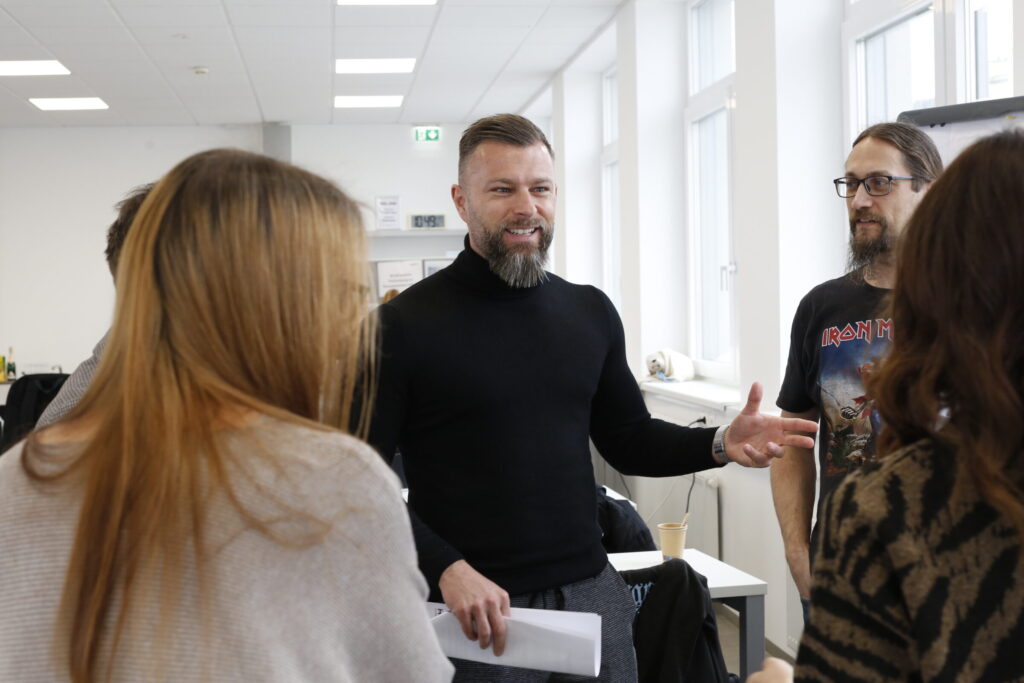
A Conversation with Student Thomas Fister: Lifelong Learning as a Way of Life
Table of Contents:
Saturday morning. While many are sleeping in, Thomas Fister logs into the online campus—for his third degree program. For him, standing still is not an option—every new opportunity is an investment in his own personal growth.
At 39 years old, with a busy work life that balances employment and self-employment and having already completed two degrees, Thomas Fister would have had every reason to stop there. Instead, he is back on the FERNFH online campus today—for the third time. Not out of necessity, but out of conviction and the knowledge of the added value that continuous professional development brings to him both personally and professionally.
Thomas Fister works in the IT sector in Vienna—both as an employee and as a freelancer—and thus operates in a work environment that leaves little room for stagnation. He does not view education as a completed phase of life, but rather as an ongoing process that continues to evolve over the years. His academic career reflects this very attitude: from his bachelor’s degree to his first master’s degree and on to another master’s program, each step was taken deliberately and driven by a passion for the subject matter.
His journey at the Ferdinand Porsche FERNFH began in 2016 with a bachelor’s degree in Aging Services Management, followed by a master’s degree in Business Informatics. When, a few years later, the new master’s program in Digital Health Management was introduced in the health sciences department, he decided to pursue another degree. The deciding factors were primarily the thematic focuses on “Twin Transformation” and “Digital Workplace Health Management,” as well as their direct relevance to his professional practice.
Back to FERNFH
He was particularly intrigued by the “Twin Transformation” specialization track, which combines sustainability and green IT. For Thomas, these aren’t abstract concepts about the future, but rather topics that already play a central role in his daily work: “These aren’t just trendy topics that are somehow on the sidelines; they’re subjects I can directly relate to my work. That makes a real difference.”
He doesn’t see his decision to pursue a master’s degree as a bold move, but rather as a logical continuation of his path so far. He was already familiar with the structure of distance learning at FERNFH, its flexibility, and how it fits with his daily work life. When asked about this, he explains: “On the contrary, I have to say that the decision was actually easy because I know that studying at FERNFH fits perfectly into my life thanks to its flexibility and the fact that it can be done from anywhere.”
Learning When It's Right
Thomas Fister’s experience illustrates in a very practical way how lifelong learning plays out in everyday life: The online campus replaces the traditional lecture hall, and learning materials, forums, and digital libraries are available at any time. While work commitments take priority during the week, learning often shifts to the weekend in focused sessions that are deliberately scheduled.
My motivation does waver from time to time, but Thomas has found a pragmatic way to deal with it. Here’s how he handles it:“For me, my university to-dos reliably pile up on the weekends. On weekdays, I’m tied up with work from morning till night, so there’s hardly any time for them during the week. But that’s okay… when my motivation wanes, a quick reality check helps: watching three episodes of a streaming series on the couch would be the alternative. And compared to that, investing in my own education is clearly the better choice.”
A Degree Program at the Forefront of the Times
As part of the first cohort in the Master’s program in Digital Health Management, he finds the course content to be particularly timely and dynamic. The courses address topics that are constantly evolving, ranging from artificial intelligence and innovation management to issues of digital transformation in the healthcare sector. The impact of this is clear to him: “It makes the program feel different—more vibrant, closer to what’s actually happening right now.”
In particular, he emphasizes the close connection between theoretical concepts and their practical application. Many of the topics covered are directly relevant to his day-to-day work.
When Things Get Intense
He describes the periods when multiple demands come together at once—especially around the time of final projects—as particularly challenging. When professional responsibilities, ongoing courses, and the master’s thesis are all happening at the same time, good time management is crucial. Thomas sums up how he handles this: “All I can really say is that the only thing that helps is consistently setting aside 2–3 days and sitting down to work. Quell any feelings of self-pity, celebrate small successes, and stay motivated that way. Always keep the end goal in sight.”
He also emphasizes how important it is to interact with fellow students. Despite the physical distance, a shared understanding of the challenges of studying while working develops.
What Remains
Three degree programs leave their mark, especially on the way one approaches topics. Thomas describes how his approach has changed over the years: Issues are examined in greater detail, connections are recognized more clearly, and decisions are made with greater reflection: “My studies are a valuable complement to my professional work. New subject areas and perspectives are added, and many things take on additional depth. You question things differently, make better sense of them, and you definitely notice that in practice as well.”
For him, lifelong learning doesn’t mean collecting as many degrees as possible, but rather continuously developing oneself and remaining open to new perspectives. For anyone considering starting a degree program, he has a clear perspective: “There’s no such thing as the perfect time to start… and that’s why it’s always ‘now.’ Anyone who’s seriously thinking about it has actually already taken the first step. And once you get started, it goes by faster than you think. Looking back, you really wonder when the semesters actually flew by.”
In the end, what matters is not so much the individual degree as the attitude behind it: the willingness to continue growing and to break new ground—step by step.
What remains when you read Thomas’s story is the image of a person who charts his own course with clarity. A person who has understood that education doesn’t end with a degree. That’s when it really begins.