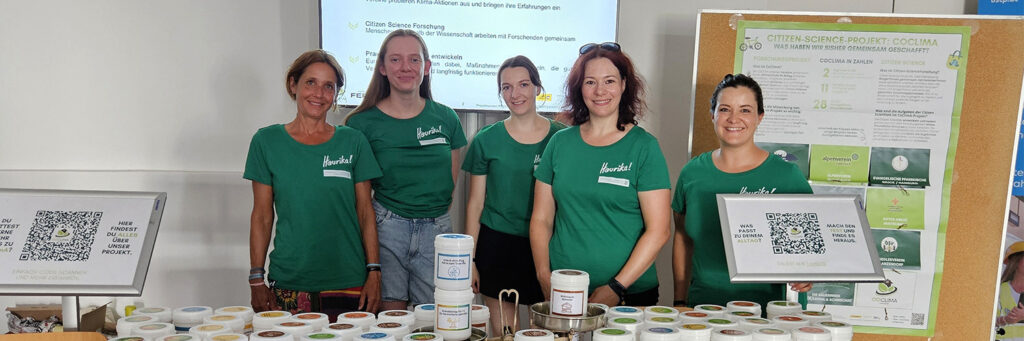
In the citizen science project “CoClimA,” 11 associations and organizations are working with researchers to develop and test climate-friendly measures for their daily lives. The project is examining how these measures impact communities.
Climate-friendly behavior rarely emerges on its own—it is shaped by communities. This is precisely where the research project comes in: it supports local groups (clubs and organizations) in implementing climate-friendly ideas within their existing structures and analyzing their impact.
Existing members of these groups are encouraged to support the project ascitizen scientistsand to reflect on their behavior and actions with regard to climate protection.
By taking targeted steps in the areas of nutrition, consumption, mobility, and energy use, they can reevaluate and adjust not only their day-to-day activities within their clubs and organizations but also their everyday personal habits.
The focus here is on how new routines can emerge in the context of existing social dynamics and group norms, when climate-friendly behavior becomes the norm for everyone, and what practical approaches are needed to gain the support of group members.
Social Change at the Regional Level
For such practices to be effective, changes are needed at the level whereCO2 emissions actually occur on a daily basis—because reducing these emissions is essential to combating climate change.
This change happens primarily through interaction with others. In this context, citizens are not viewed as individuals, but as part of a community. Belonging to a group that thinks sustainably automatically changes one’s own habits and behavior in everyday life.
Our research at CoClimA focuses primarily on changes that have regional and local impacts—on collaboration with regional organizations in the Römerland Carnuntum and KLAR! Mistelbach-Wolkersdorf Region. The Römerland Carnuntum region comprises around 30 municipalities and several cadastral municipalities, while the KLAR! Mistelbach-Wolkersdorf region includes three municipalities and a few cadastral municipalities.
Our partner organizations
Existing members of the organizations are making a significant contribution to the project in their respective regions as citizen scientists.
Participating organizations in the KLAR! Mistelbach-Wolkersdorf region:
- Mistelbach Fire Department: https://www.ff-mistelbach.at/
- Mistelbach Red Cross: https://www.roteskreuz.at/niederoesterreich/mistelbach/home
- Mistelbach Shooting Club: https://www.schuetzenverein-mistelbach.org/
- Mistelbach Alpine Club: https://www.alpenverein.at/mistelbach/
- Wolkersdorf Chess Club: https://www.schachverein-wolkersdorf.at/
Participating organizations in the Römerland-Carnuntum region:
- Blue Bats Schwechat: https://bluebats.at/
- Protestant Parish Church of Bruck/Hainburg: https://evangelischanderleitha.weebly.com/
- Prellenkirchen Music Society: http://www.mv-prellenkirchen.at/
- Mannersdorf Desert Nature Park: https://www.naturpark-wueste-mannersdorf.at/
- The Farmers' Wives of Bruck/Leitha & Schwechat: https://www.baeuerinnen-noe.at/bruck-leitha-schwechat +2500++1737215
- Lanzendorf Residents' Association: https://www.lanzendorf.at/Siedlerverein
The CoClimA Project Team
Dedicated staff members in the regions are actively committed to achieving the project’s goals, establishing and maintaining ongoing contact with the organizations, and providing them with advice and support. The FERNFH team is in close, regular communication with the regional staff as well as with project partners from Joanneum Research and the Institute for Advanced Studies (IHS) in Vienna.
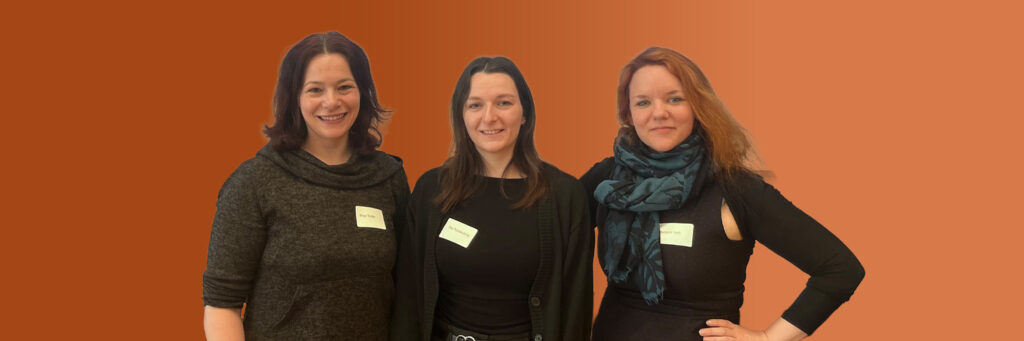
Female employees of FERNFH
- Prof.(FH) Dr.Birgit Teufer, BSc, BA, MA
Project Manager - Prof.(FH) Mag.Dr.Karin Waldherr
Senior Researcher - Pia Riedl, MA
Project Staff Member - Katharina Glöckel, MA
Project Assistant
Regional staff members
- Sonja Wirgler
Project staff member, contact person for the Römerland Carnuntum region - Clarissa Balluch, BSc
Project Assistant, Contact Person for the KLAR! Mistelbach-Wolkersdorf Region
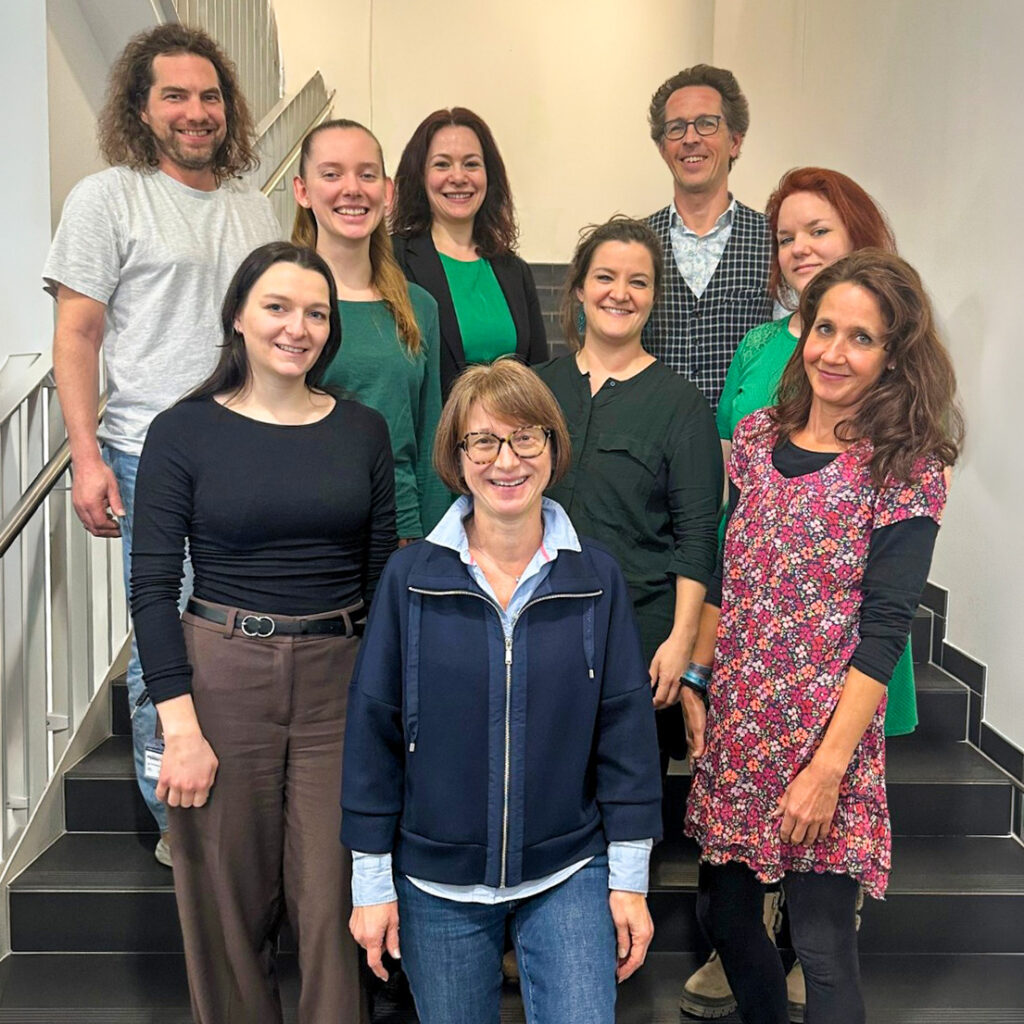
The entire CoClimA project team, from left to right: Hans-Peter Ellmer, Pia Riedl, Clarissa Balluch, Birgit Teufer, Karin Waldherr, Katharina Glöckel, Sebastian Seebauer, Barbara Hartl, Sonja Wirgler
The CoClimA project is funded by the Lower Austrian Research Promotion Agency (GFF NÖ). Project number: FTI23-C-004


Information & Details on the Project Timeline
Here you can learn more about the scientific background, the objectives, and the structure of the project.
Objectives, Research Focus, and Project Timeline
Expand to view all details.The goal of CoClimA is to investigate whether citizens’ collective climate-friendly engagement is reflected in the region’s social norms and behaviors. To this end, targeted interventions are being developed and implemented to promote climate-friendly behavior.
A pre- and post-survey examines social norms and behaviors in the regions. Between the two surveys, selected organizations implement measures to promote climate-friendly behavior. The project team compares the results of the two surveys to analyze the differences and changes. At the same time, we are conducting similar surveys with an Austrian control group with the support of a market research agency.
Focus of the research
The research areas of social norms and regional action are linked by analyzing the following areas:
- The Impact of Regional Social Norms on Climate-Friendly Behavior
- Development of regional standards
- Spread of behavioral change at the regional level
The project is divided into four phases:
- Recruitment of regional organizations (October 2024 to March 2025):
For the research, a maximum of 10 organizations from each of the two regions will be selected to collaborate with the project team. - Evaluation (April 2025 – May 2027):
Members of the organization will actively support the project team in conducting and analyzing the surveys. - Implementation of Measures (May 2025 – March 2027):
The participating organizations will work with experts in workshops to select climate-friendly measures and implement them in their region. - Communication (April 2027 – September 2027):
Once the measures have been successfully implemented, the findings will be shared with umbrella organizations to ensure a broad impact.
Consortium

Barbara Hartl, M.A.,Ph.D.
View herprofile on the IHS website
Kira Abstiens, MSc
View herprofile on the IHS website

Mag. Dr. Sebastian Seebauer
Go to profile on the Joanneum Research website
Hans-Peter Ellmer, MA
Continue to the profile on the Joanneum Research website
Contact
Please feel free to send general inquiries to coclima@fernfh.ac.at.
Publications & Presentations
To help our partner organizations select appropriate interventions, we have compiled a variety of practical ideas and inspiring approaches. The proposed interventions are organized into the following categories Energy, nutrition, Clothing and mobility. To assist with the selection, a document (guide) has been created.
If you are interested in other climate-friendly initiatives, please feel free to request the detailed list of ideas by email at coclima@fernfh.ac.at .
In addition, we have compiled a list ofexperts inthe fieldsofclimate and the environmentfromLower Austria who can serve as points of contact for technical information. The experts listed here represent only a selection and do not constitute a complete list of all relevant organizations and individuals. If you would like to be added to this list as an expert, please feel free to contact us by email.
A Glimpse into Our Project Work
Here you’ll find the latest insights, news, and updates on the CoClimA project. Stay up to date and find out what’s happening with the project.