Startup Conference at the Start of the Semester: WIBA with an Innovative In-Person Format
The Bachelor's program in Business Information Systems has replaced the first in-person phase of the semester with an innovative conference format—with great success.
Since the start of this academic year, the WIBA community at FERNFH has been meeting for Semester Start-Up Conferences—a format that combines academic content with the energy of a professional conference and shows students, even while they are still in school, which topics are currently of interest to both academia and industry in the field of business informatics.
Start-up Conference as a Logical Step Toward Greater Flexibility
“To mark the program’s 10th anniversary, I decided to modernize its educational model and create more flexible, personalized options,” says Prof. (FH) DI Dr. Martin Staudinger. At the end of the last academic year, he completed his 15th year as program director at WIBA, and the launch of the new conference format marks an important step in this comprehensive transformation.
The idea originated back in 2020 at the first I-Dee (Innovation Day), held under the theme “Flexible Studying.” At the time, Staudinger filled an A4 page with ideas for increasing flexibility and cross-referenced them with the University of Applied Sciences Act and the Accreditation Ordinance. Among the ideas that remained was the “Thinking Ahead Conference,” which has now become a reality as the Start-Up Conference. The concrete planning was carried out as a team with the research assistants, the assistant, and the program administrator.
Networking, workshops, and learning
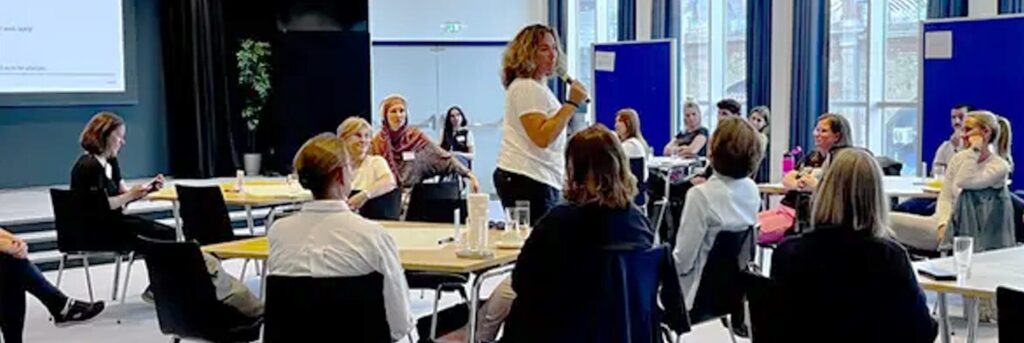
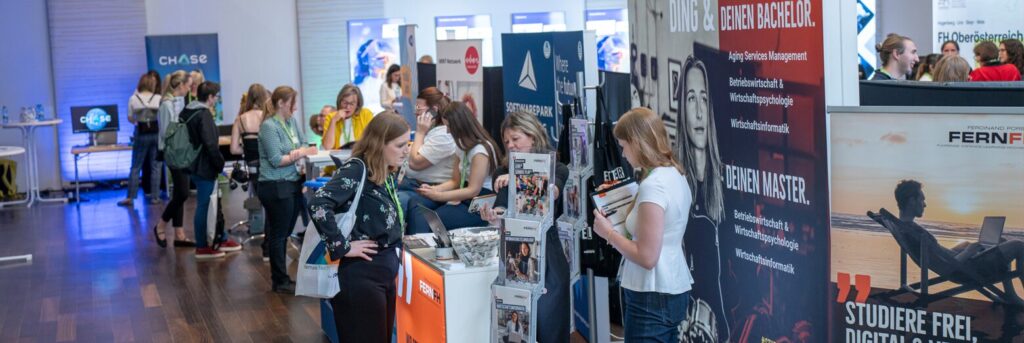
The new format differs significantly from the program’s previous in-person sessions. Instead of simply imparting knowledge, students experience a real professional conference with keynote speeches, workshops, and networking opportunities. Particularly innovative: a dedicated program track called “Pitching My Idea,” where students can present and discuss their own digital business ideas. “We sometimes believe that we have to work toward the goal of the ‘final exam.’ But I believe that the time afterward is far more important—and that’s what we should be focusing on,” said Staudinger, explaining the rationale behind the new format for WIBA’s in-person sessions at the start of each semester. If students take away from the conference the realization that it pays off to meet regularly for professional input and networking, then, for him, the goal has been achieved.
Students Take Center Stage at the New Startup Conference
The first edition showed that the concept works. Of the approximately 160 participants, about three-quarters explicitly described the conference as “enriching” and hope that it “will be just as interesting in the future.”
In-person interaction remains important even in distance learning
Despite the increasing flexibility of distance learning programs, Staudinger emphasizes the importance of in-person interactions: “Most people are social beings and don’t want to get to know their fellow students and instructors solely through online Microsoft Teams sessions. It is the university’s responsibility to facilitate in-person relationships. I believe that, otherwise, quality education simply isn’t possible.”
The new format also solves a practical problem: Following the partial removal of the strict semester-based scheduling of individual courses in the curriculum for the Bachelor’s program in Business Informatics, it would have become logistically difficult to avoid both free periods and scheduling conflicts for all students on in-person class days.
Networking as an Asset for Students – A Look Ahead
An expansion to other degree programs at FERNFH is conceivable in principle, but not mandatory. “It has to fit into the program’s overall pedagogical concept,” says Staudinger. For WIBA, at any rate, one thing is clear: The Start-Up Conference is more than just a new format; it’s here to stay and serves as a model for how distance learning can be designed in a contemporary and forward-looking way.