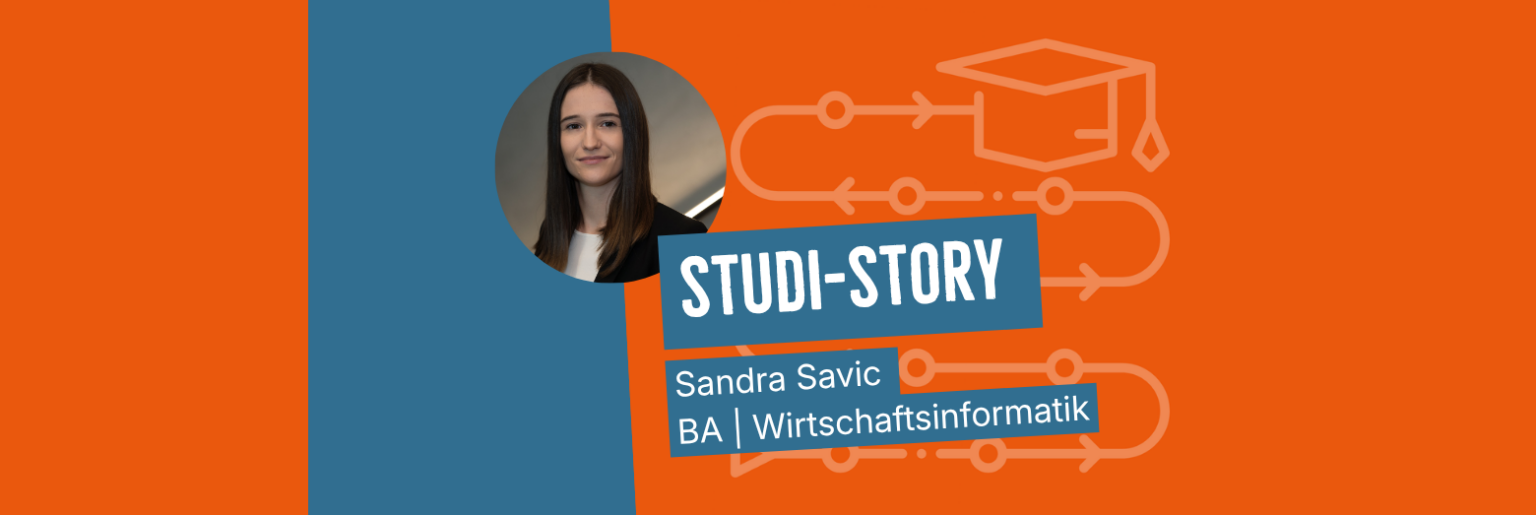
Balancing Distance Learning and Everyday Life – A Conversation with Student Sandra Savic
A full-time job and a bachelor’s degree program at the same time: What sounds like a balancing act to many has been part of Sandra Savic’s everyday life since 2023. The data analyst is studying business informatics at FERNFH and has structured her studies from the very beginning to fit seamlessly into her life, rather than turning it upside down.
Sandra’s enthusiasm for the intersection of business and technology is nothing new. Even back in business school, she chose the information and communication technology track. Business informatics was the next logical step for her. It was important to her to pursue a practical, forward-looking degree program that played to her strengths.
At the time she decided to pursue a bachelor’s degree in Business Informatics through distance learning, Sandra was working as a statistician at ÖAMTC. For her, the key factor was being able to balance her career and her studies. Through her own research, she came across FERNFH, and her decision was quickly made:
“My personal interest in the field and the opportunity for professional growth were the deciding factors. I was particularly impressed by the program’s practical focus.”
She now works as a data analyst, and what she learned in college is directly applicable to her day-to-day work. This development is no coincidence; rather, it is the result of a deliberate choice of major and career path.
A routine for distance learning that really works
Sandra plans her study sessions carefully and consistently—during the week after work, and on weekends depending on how much work the current units require. What sounds structured is the result of consistent planning and a study model that makes this possible in the first place.
All course materials and assignments are available via the online campus at any time and from anywhere. Exam preparation can be integrated into your daily routine without disrupting everything else:
"With good planning, set study times, and the flexibility of distance learning, a routine develops over time that makes many things easier."
The courses that left a particularly lasting impression on her were Advanced Programming 1 and 2, in which Python was studied not only in class but also extensively through self-study:
“We learned a lot and further deepened our knowledge through self-study. That showed me what’s possible when you really stick with it.”
A strong community in distance learning that takes you by surprise
Sandra is well aware of this stereotype: distance learning means isolation, no real interaction—just you and your laptop. Her experience proves this stereotype wrong, right from the very first week.
She got to know her group during the team-building event at the start of the semester. Since then, she has tackled numerous projects together with two fellow students—Christoph and Halil. Microsoft Teams, WhatsApp, meals together after in-person classes: Their connection is real, even though their studies are online:
“A strong sense of community and genuine camaraderie has developed, despite the physical distance.”
Her advice to everyone just starting out: Find a study group early on that you get along with well. There are plenty of group projects, and the exchange of ideas is valuable. Plus, the faculty and staff at FERNFH are easy to reach and take individual questions seriously—that makes a difference, too.
What Comes After a Bachelor's Degree in Business Information Systems
After completing her bachelor’s degree, Sandra plans to pursue a master’s degree in data science or software engineering at Technikum Wien. This goal has taken shape over the course of her studies, just as her confidence in her own abilities has grown.
As Sandra's story shows, distance learning can be easily combined with work and personal life. The flexibility offered by FERNFH allows her to successfully balance all of these aspects and further her professional development.