Review of Serious Games for Mental Health: The Next Step in the PSYGESKOM Research Project
Using digital games specifically to promote mental health—this is the goal of the PSYGESKOM research project conducted by the Ferdinand Porsche FERNFH and the Medical University of Vienna. A recent systematic literature review now provides the scientific basis for the development of a serious game for adolescents in Austria.
In recent years, so-called “serious games”—digital games with educational or therapeutic goals—have increasingly established themselves as an innovative approach in the field of mental health promotion. As part of thePSYGESKOM project—Communicating Mental Health Through Play—researchers from FERNFH and the Medical University of Vienna are investigating how digital game worlds can be specifically used to strengthen mental health literacy among adolescents.
Systematic Literature Review on Serious Games in Adolescence
A key initial step in the project was the recently publishedsystematic literature reviewof existing serious games that are used worldwide to promote mental health literacy among adolescents. The review was published in the journal JMIR Mental Health .
A total of 36 studies on 17 different games were analyzed. The analysis showed that most games promote general skills such as emotion regulation and stress management. Topics such as recognizing mental illness or reducing stigma, however, were addressed less frequently—particularly in games aimed at younger adolescents (ages 10–14).
Key Success Factors: Co-design, School Involvement, and Game Mechanics
The analysis makes it clear thatclosely involving the target group, as well as teachers and other stakeholders, during game development is crucial to the success of the intervention. Many of the games examined were developed throughco-designin collaboration with young people, educators, and experts.
Technical and design aspects—such as diverse game mechanics, the ability to customize avatars, and realistic game worlds—also help players identify with the game content—a key factor in the game’s effectiveness.
A foundation for developing your own game
“How can young people implicitly learn how to promote their mental health while playing video games? – That’s what we’re exploring in the PSYGESKOM project. The systematic literature review on existing ‘serious games’ that was just published was a first step toward developing a game for Austrian adolescents,”explainsProf. (FH) Mag.aDr.in Karin Waldherr, director of the PSYGESKOM research project at FERNFH.
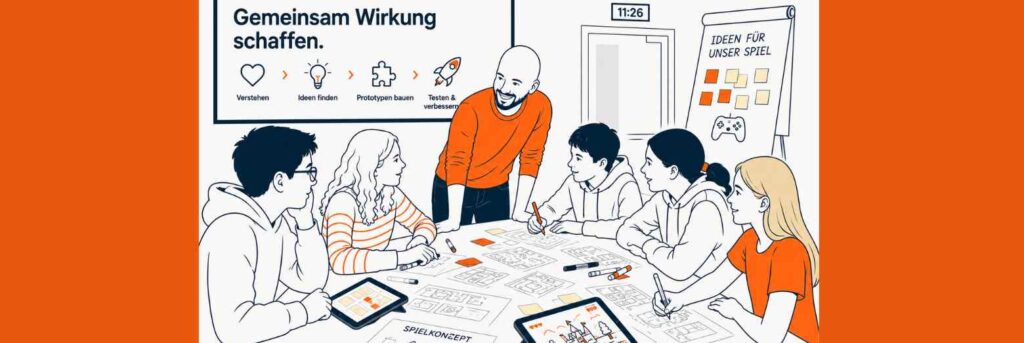
The research project aims to develop a game prototype for smartphones and tablets that promotes mental health literacy among 10- to 14-year-old students. The focus is on participatory development: children and adolescents, along with experts in psychology, child and adolescent psychiatry, the social sciences, software development, artificial intelligence, and storytelling, are working together to design the game.
In a controlled study, the prototype will be evaluated by240 students in Vienna and Lower Austriato assess its effectiveness and user experience.
The project is led byProf. (FH) Dr. KarinWaldherr(FERNFH) andDr. Michael Zeiler(MedUni Vienna). The project partner is theUniversity Clinic for Child and Adolescent Psychiatry at MedUni Vienna.
PSYGESKOM is funded bythe Vienna Science, Research, and Technology Fund (WWTF)and theLower Austrian Research Promotion Agency(project number: 10.47379/LS22030). The project is scheduled to run from April 2023 to March 2027.
Related Links
- For publication inJMIR Mental Health(Open Access)
- More about the PSYGESKOM project
- Research Activities at FERNFH